Advantages of ferrite beads ~ In the modern world of high-speed electronics, controlling electromagnetic interference (EMI) and maintaining signal integrity are more important than ever. Among the many components used to suppress EMI and reduce noise in circuits, ferrite beads are one of the most effective and widely used solutions. These passive electronic components provide essential noise filtering functions in a variety of consumer electronics, power supply designs, and industrial equipment.
This article will discuss in detail the advantages of ferrite beads, covering their roles, types, applications, maintenance tips, and their compliance with legal and industrial standards.
What Are Ferrite Beads?
A ferrite bead, also known as a ferrite choke, is a passive component made from a ceramic compound consisting of iron oxide and other metallic elements. These materials form a magnetic core that acts as a frequency-dependent resistor. Ferrite beads are commonly used in electronic circuits to suppress high-frequency noise.
They are typically placed around a wire or cable or integrated into surface-mount components on PCBs. When alternating current passes through the bead, the ferrite core resists and dissipates the high-frequency signals as heat, effectively filtering out unwanted noise.
Key Advantages of Ferrite Beads
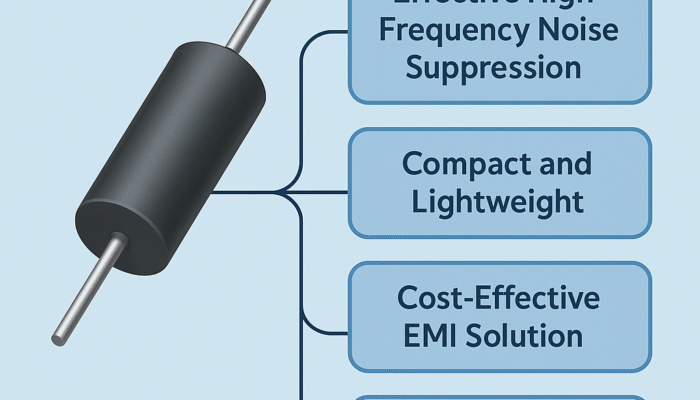
1. Effective High-Frequency Noise Suppression
One of the primary benefits of ferrite beads is their ability to suppress high-frequency EMI. This makes them ideal for applications in RF circuits, USB lines, power inputs, and data lines. The bead blocks high-frequency signals while allowing low-frequency or DC signals to pass, improving the signal integrity of the system.
2. Compact and Lightweight
Ferrite beads are available in very small form factors, making them perfect for space-constrained designs, especially in portable or handheld devices. Despite their small size, they provide excellent noise attenuation without adding significant weight or complexity.
3. Easy Integration into PCB Designs
Modern ferrite beads come in surface-mount packages, making them easy to incorporate into automated PCB assembly lines. Designers can include them as part of a multilayer PCB design for compact noise filtering.
4. Cost-Effective EMI Solution
Compared to other EMI suppression techniques like shielded cables or metal enclosures, ferrite beads are a low-cost solution. Their affordability makes them a preferred choice in mass-produced consumer electronics where cost-effectiveness is crucial.
5. Passive Operation and Energy Efficiency
Since ferrite beads are passive components, they do not require external power sources. They consume no additional power and do not generate noise themselves, contributing to energy-efficient circuit operation.
6. Improved Signal Integrity
Ferrite beads play a vital role in maintaining clean signals by removing unwanted high-frequency interference. This is especially critical in audio, video, and data communication applications where clarity and fidelity are important.
7. Advantages of ferrite beads: Versatile Applications
From power supplies to USB devices, and from automotive electronics to telecommunication systems, ferrite beads can be used across a wide range of industries and applications, showcasing their versatility.
Common Applications of Advantages of ferrite beads
- Power Supply Filtering: Installed at power input lines to suppress switching noise from power converters.
- Data Lines: Used in USB, HDMI, Ethernet, and audio signal lines to prevent RF interference.
- Automotive Electronics: Reduce noise in ECU and infotainment systems.
- Medical Devices: Maintain EMC compliance in sensitive equipment.
- Consumer Electronics: Improve performance of smartphones, laptops, gaming consoles, etc.
Types of Ferrite Beads
There are several types of ferrite beads, including:
- Surface-Mount Ferrite Beads (SMD): Used in PCB designs for high-density applications.
- Through-Hole Ferrite Beads: Common in older designs or where mechanical strength is important.
- Clamp-On or Snap-On Ferrites: Applied externally on cables for retrofit EMI suppression.
- Multilayer Ferrite Beads: Offer enhanced impedance characteristics over a wider frequency range.
Each type has specific impedance characteristics and is chosen based on frequency requirements, power levels, and application constraints.
Advantages of ferrite beads Maintenance and Reliability
Ferrite beads are robust and require minimal maintenance. However, proper selection and usage are critical:
- Avoid exceeding rated current to prevent overheating.
- Verify impedance curves to ensure correct noise frequency targeting.
- Inspect for physical cracks during device assembly or after thermal cycling.
When correctly used, ferrite beads offer long-term, reliable performance and can greatly reduce the need for costly design revisions.

Legal and Industrial Standards Compliance
Using ferrite beads helps designers comply with EMC (Electromagnetic Compatibility) regulations such as:
- FCC Part 15 (USA)
- CISPR 22 (International)
- CE Marking (Europe)
- IEC 61000 standards
In many countries, failure to comply with these EMI regulations can result in product recalls, fines, or market entry bans. Ferrite beads are an essential part of achieving the necessary EMC certifications.
Example: Ferrite Beads in USB Applications
In a typical USB application, a ferrite bead is placed in series with the VBUS or ground line to suppress power-related noise. This ensures:
- Stable voltage delivery
- Reduced radiated EMI
- Compliance with USB EMI specifications
Such configurations are critical in devices like external hard drives, USB hubs, and audio interfaces where high-frequency noise can degrade performance.
Conclusion of Advantages of ferrite beads
Ferrite beads are a simple yet powerful tool in electronic design. Their advantages—such as noise suppression, low cost, small size, and energy efficiency—make them an indispensable component for designers dealing with EMI-sensitive circuits. By incorporating ferrite beads into your system, you can enhance reliability, ensure compliance with global standards, and improve the overall performance of your electronic products.
Whether you’re designing a power supply or a high-speed communication interface, ferrite beads offer a practical, reliable, and cost-effective solution for managing noise and maintaining signal clarity.