
Introduction
Autopilot systems are one of the most revolutionary technological advancements in modern transportation. From airplanes soaring across continents to ships navigating oceans and cars driving on highways, autopilot technology has reshaped how humans interact with vehicles. While the concept may sound futuristic, autopilot systems have been around for more than a century. They have evolved from basic mechanical devices into complex, AI-driven systems capable of handling various aspects of navigation and control.
In this article, we will explore the history, working principles, applications, benefits, challenges, and the future of autopilot systems across different industries.
1. What Is an Autopilot System?
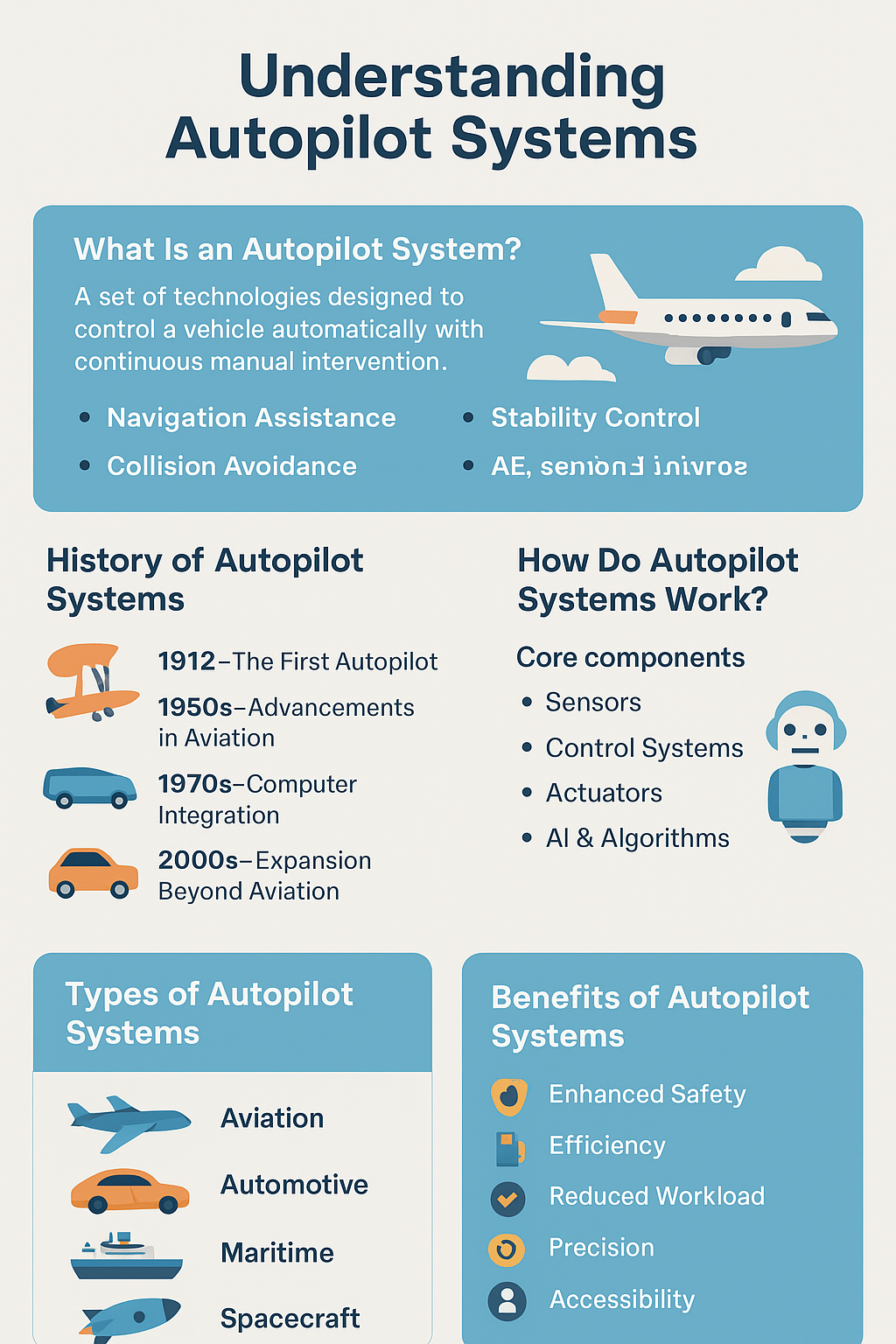
An autopilot system is a set of technologies designed to control a vehicle automatically without continuous manual intervention. It maintains stability, navigates routes, and can even make decisions based on environmental conditions.
While the term “autopilot” is most often associated with aviation, it is now widely used in automobiles (self-driving cars), maritime navigation, drones, and even spacecraft.
Key Functions of Autopilot Systems:
- Navigation Assistance – maintaining the correct route.
- Stability Control – ensuring smooth operation.
- Speed and Altitude Control (in aviation).
- Collision Avoidance – using sensors and AI.
- Data Processing – integrating GPS, radar, and onboard sensors.
2. History of Autopilot Systems
The journey of autopilot systems dates back to the early 20th century:
- 1912 – The First Autopilot: The Sperry Corporation introduced the first autopilot system, which used gyroscopes to control aircraft direction.
- 1930s – Advancements in Aviation: Autopilot became standard in commercial aircraft, handling basic navigation.
- 1970s – Computer Integration: Digital computers improved autopilot precision.
- 2000s – Expansion Beyond Aviation: Autopilot entered automotive and maritime industries.
- Today – AI and Machine Learning: Modern autopilots use AI, GPS, and advanced sensors to enable autonomous driving and navigation.
3. How Do Autopilot Systems Work?
Autopilot systems integrate hardware and software to control vehicles.
Core Components:
- Sensors – collect environmental data (radar, LiDAR, GPS, gyroscopes).
- Control Systems – interpret data and adjust movements.
- Actuators – physically control steering, throttle, brakes, or flight surfaces.
- AI & Algorithms – enable predictive decision-making.
Process Overview:
- Data is gathered through sensors.
- Software analyzes the data against navigation goals.
- Actuators execute commands (steering, altitude, speed).
- Feedback loops ensure adjustments in real time.
4. Types of Autopilot Systems
Autopilot systems vary depending on industry and application:
Aviation Autopilot
- Single-Axis Autopilot: Controls roll (basic level).
- Two-Axis Autopilot: Controls roll and pitch.
- Three-Axis Autopilot: Controls roll, pitch, and yaw.
- Modern Flight Management Systems (FMS): Fully integrated with GPS, weather radar, and automatic landing capabilities.
Automotive Autopilot
- Driver Assistance Systems: Adaptive cruise control, lane keeping assist.
- Semi-Autonomous Driving: Tesla Autopilot, GM Super Cruise.
- Fully Autonomous Vehicles: Emerging technology aiming for Level 5 autonomy.
Maritime Autopilot
- Course Control Systems: Maintain a ship’s direction.
- Dynamic Positioning Systems: Control vessel position in offshore operations.
Spacecraft Autopilot
- Used in rockets, satellites, and spacecraft for trajectory control, docking, and landing.
5. Benefits of Autopilot Systems
Autopilot technology provides a wide range of advantages:
- Enhanced Safety – reduces human errors in navigation.
- Efficiency – improves fuel economy and operational consistency.
- Reduced Workload – allows pilots, drivers, and operators to focus on higher-level decision-making.
- Precision – advanced navigation accuracy in complex conditions.
- Accessibility – supports industries with limited skilled manpower.
6. Challenges and Limitations
Despite its advantages, autopilot technology faces several challenges:
- Reliability Concerns – system failures can be catastrophic.
- Over-Reliance on Technology – operators may lose manual skills.
- Cybersecurity Threats – risk of hacking in connected systems.
- Regulatory Barriers – laws differ across regions for self-driving cars and autonomous aircraft.
- High Costs – advanced autopilot systems are expensive to develop and implement.
7. Future of Autopilot Systems
Autopilot technology is advancing rapidly, driven by AI, machine learning, and big data.
Key Future Trends:
- Full Autonomy in Cars – vehicles without human drivers.
- Smart Aviation Systems – AI-assisted decision-making for flights.
- Maritime Automation – fully autonomous cargo ships.
- Space Exploration – advanced autopilot for deep-space missions.
- Integration with IoT and 5G – enabling real-time communication between vehicles.
The future will likely bring Level 5 autonomy, where vehicles can operate without human intervention under any circumstances.
8. Applications of Autopilot Systems Across Industries
Aviation
Commercial flights use autopilot for most of the journey, from takeoff assistance to landing.
Automotive
Companies like Tesla, Waymo, and BMW are pioneering autonomous driving.
Maritime
Cargo ships, fishing vessels, and military ships employ autopilot for navigation and efficiency.
Space Exploration
NASA and SpaceX rely on autopilot for docking, orbit adjustments, and re-entry control.
9. Autopilot and Artificial Intelligence
Modern autopilot is inseparable from AI. Using machine learning models, autopilot systems learn from vast datasets to predict conditions, avoid obstacles, and adapt to new scenarios. This combination of AI + Autopilot is what makes self-driving cars and advanced aircraft possible.
Conclusion
Autopilot systems have evolved from simple gyroscopic devices to highly advanced AI-driven technologies that shape the future of transportation. Whether in aviation, automotive, maritime, or space industries, autopilot is redefining safety, efficiency, and convenience.
As research continues, we can expect a future where autonomous systems are not just an option but a standard across global transportation networks. The balance between human oversight and machine autonomy will be key in ensuring both safety and progress.