Understanding Analog ICs: Building Blocks of Modern Electronics
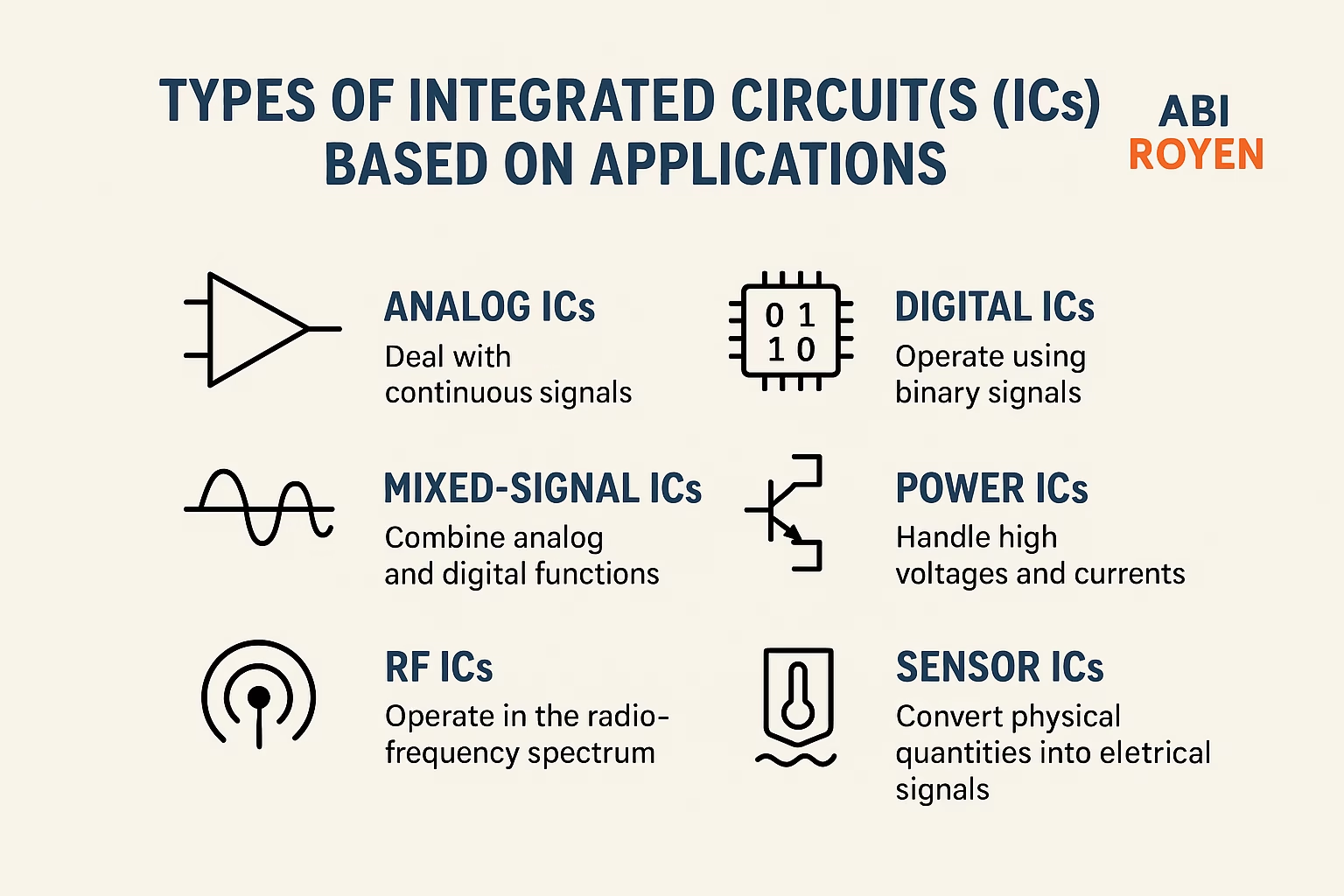
In the world of electronics, integrated circuits (ICs) are the heart of virtually every system. Among the various types of ICs, Analog ICs play a vital role in managing and processing real-world signals. Unlike digital ICs that operate with discrete binary values (0s and 1s), analog ICs handle continuous signals, allowing them to work directly with natural phenomena like sound, temperature, and light.
In this comprehensive guide, we’ll explore what analog ICs are, how they function, the various types available, and their wide-ranging applications across industries.
What Are Analog ICs?
Analog Integrated Circuits (Analog ICs) are electronic components designed to process continuous analog signals. These signals can vary in magnitude smoothly over a range of values, unlike digital signals that have fixed high or low states.
Analog ICs amplify, filter, mix, or modulate these signals. They are essential for converting real-world data into a form that electronic systems can interpret and respond to, especially before digital processing occurs.
Key Characteristics of Analog ICs:
- Operate with continuously variable voltages or currents
- Sensitive to noise and external interference
- Used in signal conditioning and conversion
- Typically composed of transistors, resistors, capacitors, and diodes
How Analog ICs Work
Analog ICs manipulate analog signals in real-time. A typical analog IC might take an input voltage (say, from a sensor), amplify it, and send it to an output for further processing or control. The output depends on the exact configuration and internal circuitry of the IC.
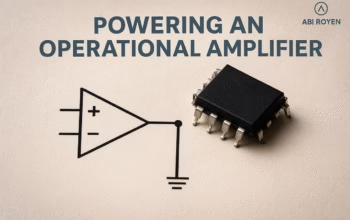
For example, an operational amplifier (op-amp), one of the most common analog ICs, can amplify a small voltage difference between its input terminals to a much larger voltage, useful in audio equipment and sensor systems.
Types of Analog ICs
There are several different types of analog ICs, each serving specific functions in a circuit:
1. Operational Amplifiers (Op-Amps)
Op-amps are high-gain voltage amplifiers with differential inputs. They’re widely used in signal amplification, filtering, oscillators, and voltage comparators.
2. Linear Voltage Regulators
These ICs maintain a constant output voltage regardless of input fluctuations or output load variations. They’re essential for power management in electronic devices.
3. Analog Multipliers
These are used to multiply two analog signals. Applications include modulators, demodulators, and automatic gain control systems.
4. Comparators
Analog comparators compare two voltage levels and output a digital signal indicating which is higher. These are often used in control systems.
5. Analog Switches and Multiplexers
These ICs direct analog signals between different parts of a circuit, essential in data acquisition and switching networks.
6. Timers and Oscillators
Popular examples like the 555 Timer IC are used to generate precise timing intervals or waveforms in analog systems.
Analog vs Digital ICs
| Feature | Analog ICs | Digital ICs |
|---|---|---|
| Signal Type | Continuous analog signals | Discrete binary signals (0 and 1) |
| Complexity | Typically less complex in logic | Can perform complex processing |
| Application | Audio, RF, sensor input processing | Microprocessors, memory, logic gates |
| Power Consumption | Often higher due to continuous operation | Generally lower per operation |
| Example Components | Op-amps, filters, analog switches | Microcontrollers, logic ICs, flip-flops |
In many modern systems, analog and digital ICs are combined in mixed-signal ICs, such as ADCs (Analog to Digital Converters) and DACs (Digital to Analog Converters), bridging the gap between the analog world and digital processing.

Applications of Analog ICs
Analog ICs are essential in a wide range of real-world applications, including:
1. Audio Systems
Used in amplifiers, equalizers, and audio signal processing to ensure high-fidelity sound.
2. Sensor Interfacing
Sensors produce analog outputs (e.g., temperature, pressure), which are conditioned and amplified by analog IC before digital conversion.
3. Telecommunications
Used in modulators, filters, and RF circuits for signal transmission and reception.
4. Medical Devices
Vital in equipment like ECG machines, where analog ICs amplify and process biological signals.
5. Power Management
Voltage regulators and analog power controllers manage and distribute power efficiently.
6. Instrumentation
Oscilloscopes, signal analyzers, and other test equipment rely heavily on analog circuits.
Choosing the Right Analog IC
When selecting an analog IC for a project, consider the following factors:
- Functionality: Understand the role the IC will play (amplifier, filter, switch, etc.)
- Voltage and Current Ratings: Ensure compatibility with your circuit.
- Noise and Signal Integrity: Look for low-noise ICs if your application is sensitive.
- Package Type: Surface-mount vs. through-hole based on your PCB design.
- Manufacturer Support: Opt for brands with strong documentation and application notes (e.g., Texas Instruments, Analog Devices, STMicroelectronics).
Challenges in Using Analog ICs
Analog design requires careful attention to:
- Noise susceptibility: Analog signals can pick up interference.
- Precision: Small changes in voltage can significantly affect output.
- Layout and shielding: PCB design must minimize signal loss and distortion.
Due to these challenges, analog IC often demand more expertise in design and implementation compared to their digital counterparts.
The Future of Analog ICs
Despite the digital revolution, analog ICs remain irreplaceable. As more devices connect to the physical world (think IoT, AI-powered sensors, and biomedical devices), the demand for accurate, efficient analog signal processing will only grow.
New innovations include:
- Low-power analog ICs for wearable and remote sensors
- High-frequency analog ICs for 5G and next-gen wireless technologies
- Precision analog front-ends for AI and machine learning systems
Conclusion
Analog ICs may not get as much spotlight as digital processors, but they are the unsung heroes behind almost every modern electronic device. From amplifying a whisper in your phone’s microphone to regulating voltage in a drone’s motor controller, analog IC bridge the gap between the physical world and digital logic.
Understanding how they work, what types are available, and where they are used is essential for anyone looking to build, design, or troubleshoot electronic systems.
Want to learn more about electronics? Explore more guides and tutorials on Abi Royen.