
In the field of electronics, resistors are among the most fundamental and widely used components. They control current, divide voltages, and protect circuits from damage. While modern electronics often rely on surface-mount devices (SMD) due to their compact size, Through-Hole Resistors (THT) remain essential in various applications where durability, mechanical strength, and easy handling are required.
This article explores the world of THT resistors, their types, benefits, applications, and how they compare with other resistor technologies.
What Are Through-Hole Resistors (THT)?
Through-Hole Resistors, commonly abbreviated as THT resistors, are electronic components designed to be mounted by inserting their leads (metal wires) into pre-drilled holes on a printed circuit board (PCB) and soldered on the opposite side.
They were the industry standard before Surface-Mount Technology (SMT) became popular. Even today, THT resistors are widely used in power electronics, testing equipment, prototyping, and applications that demand higher mechanical strength.
Key Characteristics of THT Resistors:
- Long leads for easy insertion into PCBs or breadboards.
- Durable structure that withstands mechanical stress.
- Available in various types (carbon film, metal film, wirewound).
- Power handling from 1/8 watt to several watts.
- Color-coded markings for resistance value identification.
Structure and Design of Through-Hole Resistors (THT)
The construction of a THT resistor depends on its type, but most share a similar basic design:
- Resistive Material – The core element that provides resistance, such as carbon, metal film, or wire winding.
- Ceramic or insulating body – Provides mechanical support and heat resistance.
- Protective coating – Typically an epoxy layer to prevent moisture and oxidation.
- Leads – Metal wires extending from both ends, designed to be soldered through PCB holes.
The axial lead design makes them easy to insert and ideal for both hobbyists and professional circuit designers.
Types of Through-Hole Resistors (THT)
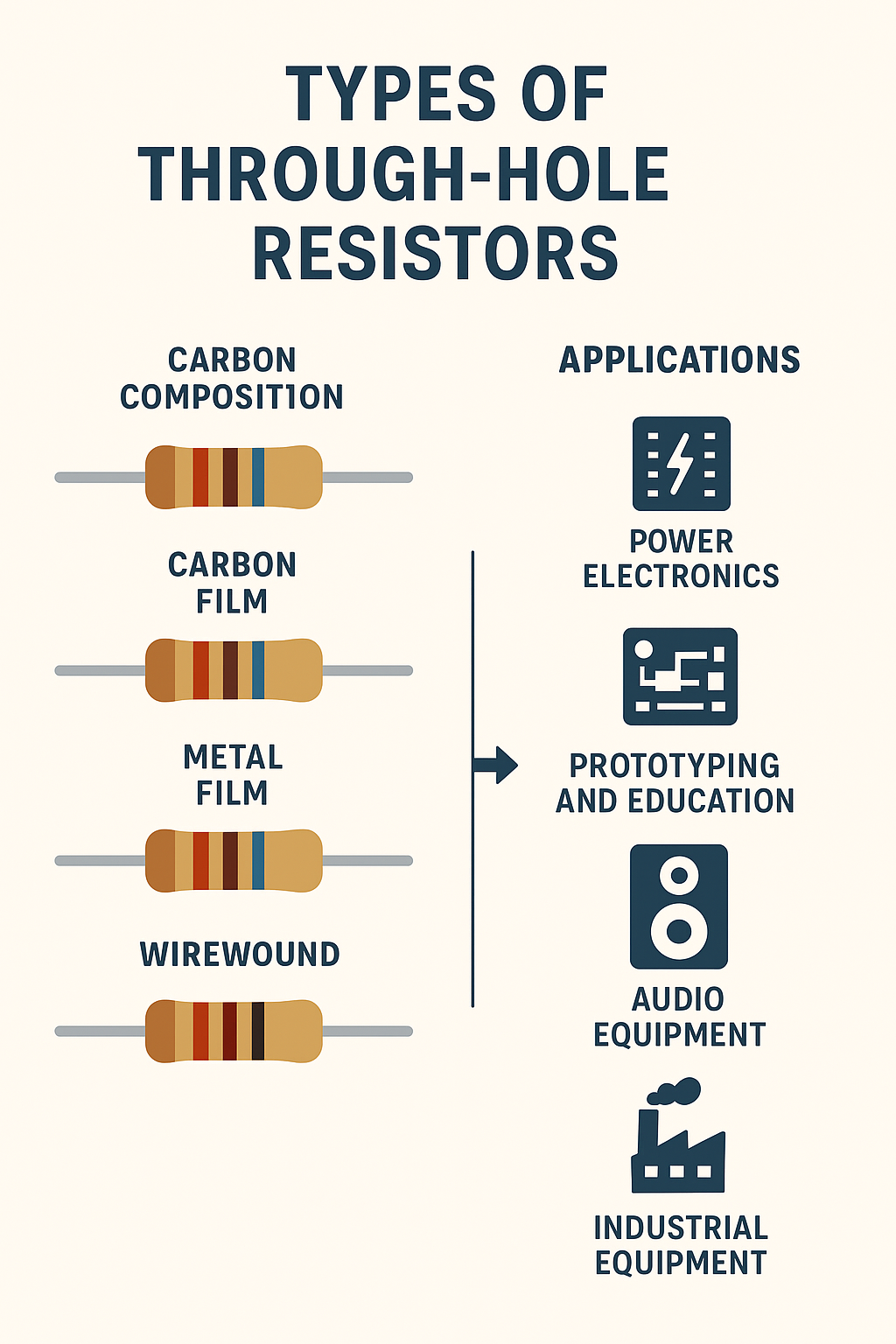
There are several types of THT resistors, each designed for different purposes. The most common ones include:
1. Carbon Composition Resistors
- Made from a mixture of carbon powder and resin.
- Offer high-energy pulse handling.
- Less common today due to poor stability and higher noise.
2. Carbon Film Resistors
- Constructed by depositing a thin carbon film on a ceramic substrate.
- Low cost and widely used in consumer electronics.
- Better performance than carbon composition.
3. Metal Film Resistors
- Made using a thin metal film.
- Provide high accuracy, stability, and low noise.
- Often used in precision circuits and instrumentation.
4. Metal Oxide Film Resistors
- Use metal oxide material for better heat resistance.
- Superior in high-temperature and high-voltage applications.
5. Wirewound Resistors
- Consist of a resistive wire (often nichrome) wound around a ceramic core.
- Can handle high power and high currents.
- Typically used in power supplies and motor control circuits.
Applications of Through-Hole Resistors (THT)
Through-hole resistors are versatile components found in countless electronic systems. Some of their major applications include:
- Power Electronics – Due to their robustness, they are preferred in circuits with high power dissipation.
- Prototyping and Education – Their large size makes them ideal for breadboards and teaching environments.
- Audio Equipment – Metal film THT resistors are valued for low noise in amplifiers and sound systems.
- Industrial Equipment – Used in machinery where vibrations or mechanical stress are common.
- High-Voltage Circuits – Certain THT resistors can withstand higher voltages than SMD alternatives.
Advantages of Through-Hole Resistors (THT)
Even though modern electronics often use SMD resistors, THT resistors still have unique advantages:
- Mechanical Strength: The long leads provide strong anchoring to the PCB.
- Ease of Handling: Larger size makes them easier to solder manually.
- Better Heat Dissipation: Wirewound and metal oxide THT resistors handle higher temperatures.
- Durability: Withstands environmental stress and vibrations.
- Higher Power Ratings: Available in higher wattages compared to SMD.
Disadvantages of THT Resistors
Despite their strengths, THT resistors have some drawbacks:
- Larger Size: Not suitable for compact, modern electronic devices.
- Slower Assembly: Requires drilling holes in PCBs, which is less efficient for mass production.
- Less Automated: SMD allows faster and cheaper automated manufacturing.
THT Resistors vs. SMD Resistors
| Feature | THT Resistors | SMD Resistors |
|---|---|---|
| Mounting Method | Through PCB holes | Surface mount |
| Size | Larger | Very small |
| Mechanical Strength | High | Lower |
| Power Handling | High (up to several watts) | Moderate |
| Ease of Prototyping | Easy to handle | Difficult to handle manually |
| Production Efficiency | Slower | Faster |
This comparison shows why THT resistors are still preferred in high-power and educational applications, while SMD resistors dominate compact consumer electronics.
How to Identify a THT Resistor
One of the most recognizable features of THT resistors is the color bands used for resistance coding. Each resistor typically has 4 to 6 colored bands, which indicate:
- Resistance value (first two or three bands).
- Multiplier (third or fourth band).
- Tolerance (last band).
For example, a resistor with bands red, violet, brown, gold represents 270 ohms ±5%.
Future of Through-Hole Resistors (THT)
Although surface-mount technology continues to dominate, through-hole resistors will not disappear anytime soon. Their mechanical reliability, high power capacity, and educational importance ensure they remain relevant in electronics manufacturing and training.
Industries such as aerospace, military, power electronics, and heavy machinery still rely heavily on THT components due to their proven durability.
Conclusion
Through-Hole Resistors (THT) are essential components that have stood the test of time. While SMD resistors are the go-to choice for compact electronics, THT resistors continue to play a crucial role in applications that demand strength, reliability, and high power handling.
From carbon composition to precision metal film resistors, THT resistors offer versatility for engineers, students, and hobbyists alike. Whether you are prototyping a circuit, building a power supply, or learning electronics for the first time, THT resistors will remain an invaluable part of your toolkit.
✅ Published on Abi Royen under Electronics Components category.