Laser Diode are one of the most important components in modern optoelectronic technology. Found in devices ranging from barcode scanners to fiber-optic communication systems, laser diodes play a vital role in how we transmit data, read information, and interact with digital devices. This article explores the working principles of laser diodes, their applications, benefits, and why they have become indispensable in today’s world.
1. What is a Laser Diode?
A laser diode is a semiconductor device that emits coherent light when an electric current passes through it. Unlike traditional light-emitting diodes (LEDs) that produce incoherent light, laser diodes generate light that is both monochromatic (single wavelength) and coherent (all light waves are in phase). This property makes them ideal for applications requiring precision and high efficiency.
Laser diodes are essentially a type of diode, similar in structure to LEDs, but with additional layers and mirrors to enable stimulated emission of radiation, a principle first described by Albert Einstein.
2. How Does a Laser Diode Work?
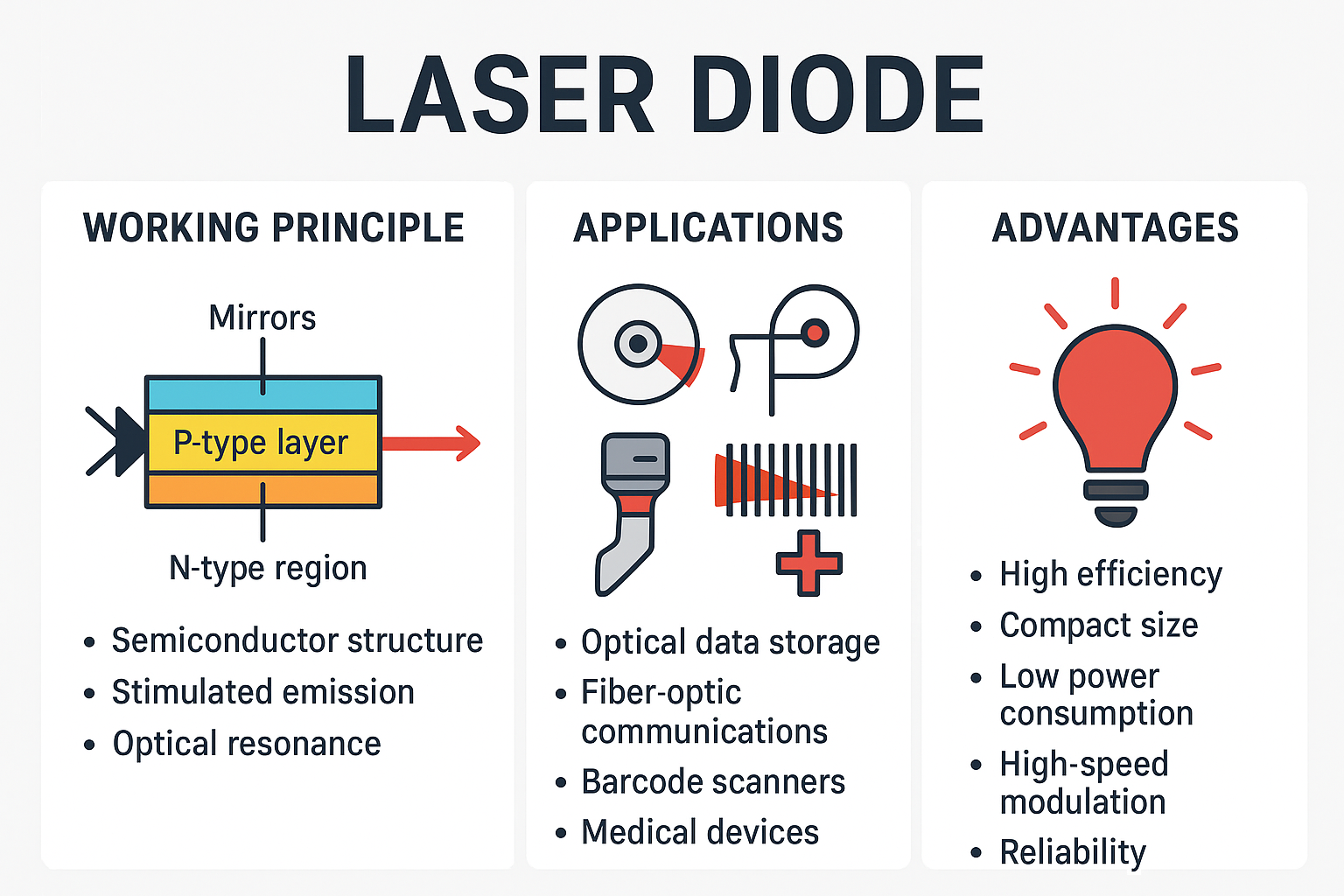
The operation of a laser diode is based on the principles of semiconductor physics and optics. Below is a simplified explanation of how a laser diode works:
a. Semiconductor Structure
A typical laser diode consists of:
- P-type layer (positive charge carriers)
- N-type layer (negative charge carriers)
- Active region (where light is generated)
- Mirrors at the ends to form an optical cavity
When voltage is applied, electrons from the N-type region and holes from the P-type region combine in the active region, releasing energy in the form of photons (light).
b. Stimulated Emission
The photons produced stimulate other excited electrons to release additional photons of the same phase and wavelength, leading to a chain reaction. This process is called stimulated emission, the core principle of laser operation.
c. Optical Resonance
The mirrors at the ends of the laser diode cavity reflect photons back and forth, amplifying the light. One mirror is partially transparent, allowing a coherent beam of laser light to exit.
3. Types of Laser Diode
Laser diodes come in several types, each suited for specific applications:
- Edge-Emitting Laser Diodes (EELs): Most common type, used in CD/DVD players and barcode scanners.
- Vertical-Cavity Surface-Emitting Lasers (VCSELs): Emit light perpendicular to the wafer surface, widely used in data communication and 3D sensing.
- Distributed Feedback Lasers (DFB): Provide stable single-wavelength output, essential for optical communication systems.
4. Key Applications of Laser Diode
Laser diodes are found in a wide range of technologies, including:
a. Optical Data Storage
Laser diodes are the heart of CD, DVD, and Blu-ray players. The precise laser beam reads data encoded on the discs.
b. Fiber-Optic Communications
High-speed internet and telecommunications rely on laser diodes to transmit data through optical fibers with minimal loss.
c. Barcode Scanners
Retail and logistics industries use laser diode-based scanners to read product barcodes quickly and accurately.
d. Medical Applications
Laser diodes are used in medical devices for surgical procedures, dental treatments, and therapeutic applications.
e. Industrial Applications
From material processing to laser cutting, laser diodes provide powerful and efficient solutions in manufacturing.
f. Consumer Electronics
Laser diodes power laser pointers, gaming peripherals, and augmented reality devices.
5. Advantages of Laser Diode
Laser diodes offer several benefits over other light sources:
- High Efficiency: Converts electrical energy to light with minimal losses.
- Compact Size: Small form factor allows integration into various devices.
- Low Power Consumption: Ideal for battery-powered applications.
- High-Speed Modulation: Crucial for communication and data transfer.
- Reliability: Long operational life with proper usage.
6. Challenges and Limitations
Despite their advantages, laser diodes have some limitations:
- Temperature Sensitivity: Performance can degrade at high temperatures.
- Complex Manufacturing: Requires precise fabrication techniques.
- Cost for High-Power Versions: High-performance laser diodes can be expensive.
7. Future of Laser Diode
The future of laser diodes looks promising, driven by advancements in quantum technologies, LiDAR systems for autonomous vehicles, 5G/6G communications, and biomedical imaging. As demand for faster and more efficient optical systems grows, laser diodes will continue to evolve, becoming even more powerful and versatile.
Conclusion
Laser diodes are a cornerstone of modern technology. Their unique ability to produce coherent light in a compact, efficient package has revolutionized communication, medicine, and industry. Understanding how they work and their potential applications provides insight into why they remain at the forefront of innovation.
For more insights into cutting-edge electronics and optoelectronics, visit Abi Royen.