
Capacitors are among the most fundamental and widely used passive components in electronic circuits. Whether in a simple flashlight or a complex power supply system, capacitor play a crucial role in storing and releasing electrical energy. In this article, we’ll explore the essentials of capacitor, their types, how they work, and their real-world applications.
What is a Capacitor?
A capacitor is a two-terminal passive electronic component that stores energy in an electric field. Unlike batteries, which generate energy chemically, capacitor store energy electrostatically. They are primarily used to block direct current (DC) while allowing alternating current (AC) to pass, smooth out voltage fluctuations, and for energy storage, filtering, and timing applications.
How Does a Capacitor Work?
A capacitor consists of two conductive plates separated by a dielectric (insulating material). When a voltage is applied across the terminals, electric charges of equal magnitude but opposite polarity accumulate on the plates, creating an electric field.
The capacitance (C), measured in farads (F), defines a capacitor’s ability to store charge. The greater the capacitance, the more energy the capacitor can store. The key factors affecting capacitance include:
- Surface area of plates (larger area = higher capacitance)
- Distance between plates (shorter distance = higher capacitance)
- Dielectric constant of the insulating material
Main Functions of Capacitors
- Energy Storage: Store and release energy quickly for applications like camera flashes.
- Filtering: Smooth out voltage in power supplies (e.g., in AC to DC converters).
- Decoupling/Bypassing: Eliminate noise and stabilize voltage in circuits.
- Coupling: Allow AC signals to pass while blocking DC signals between amplifier stages.
- Timing: Used in combination with resistors in timer circuits (e.g., RC time constants).
- Power Factor Correction: Improve the efficiency of AC power systems.
Types of Capacitors
There are various types of capacitor, each suited for specific applications. Below are the most common ones:
1. Ceramic Capacitors
- Features: Small, non-polarized, inexpensive
- Uses: High-frequency applications, decoupling
- Range: Picofarads (pF) to microfarads (µF)
2. Electrolytic Capacitors
- Features: Polarized, high capacitance
- Uses: Power supply filters, audio circuits
- Range: Microfarads (µF) to millifarads (mF)
3. Tantalum Capacitors
- Features: Stable, polarized, compact
- Uses: Military, aerospace, medical electronics
- Range: Small to medium capacitance
4. Film Capacitors
- Features: Non-polarized, high precision
- Uses: Signal coupling, motor run applications
- Range: Nanofarads (nF) to microfarads (µF)
5. Supercapacitors (Ultracapacitors)
- Features: Extremely high capacitance, energy storage
- Uses: Backup power, regenerative braking systems
- Range: Farads (F)
6. Mica Capacitors
- Features: High stability and precision
- Uses: RF circuits, measuring instruments
- Range: Picofarads (pF)
Capacitor Markings and Polarity
Capacitor are marked with alphanumeric codes indicating their capacitance value, voltage rating, and sometimes tolerance. Electrolytic and tantalum capacitor are polarized, meaning incorrect orientation can lead to circuit failure or explosion. Ceramic and film capacitors, on the other hand, are non-polarized.
Common Applications of Capacitors
- Power Supply Units (PSUs): For filtering AC ripple and voltage stabilization.
- Electric Motors: In start and run circuits.
- Radio Frequency (RF) Systems: For tuning and frequency selection.
- Audio Equipment: In tone controls and signal processing.
- Automotive Electronics: For power buffering and noise suppression.
- Renewable Energy Systems: In solar inverters and wind turbines.
Capacitors in Legal and Industrial Standards
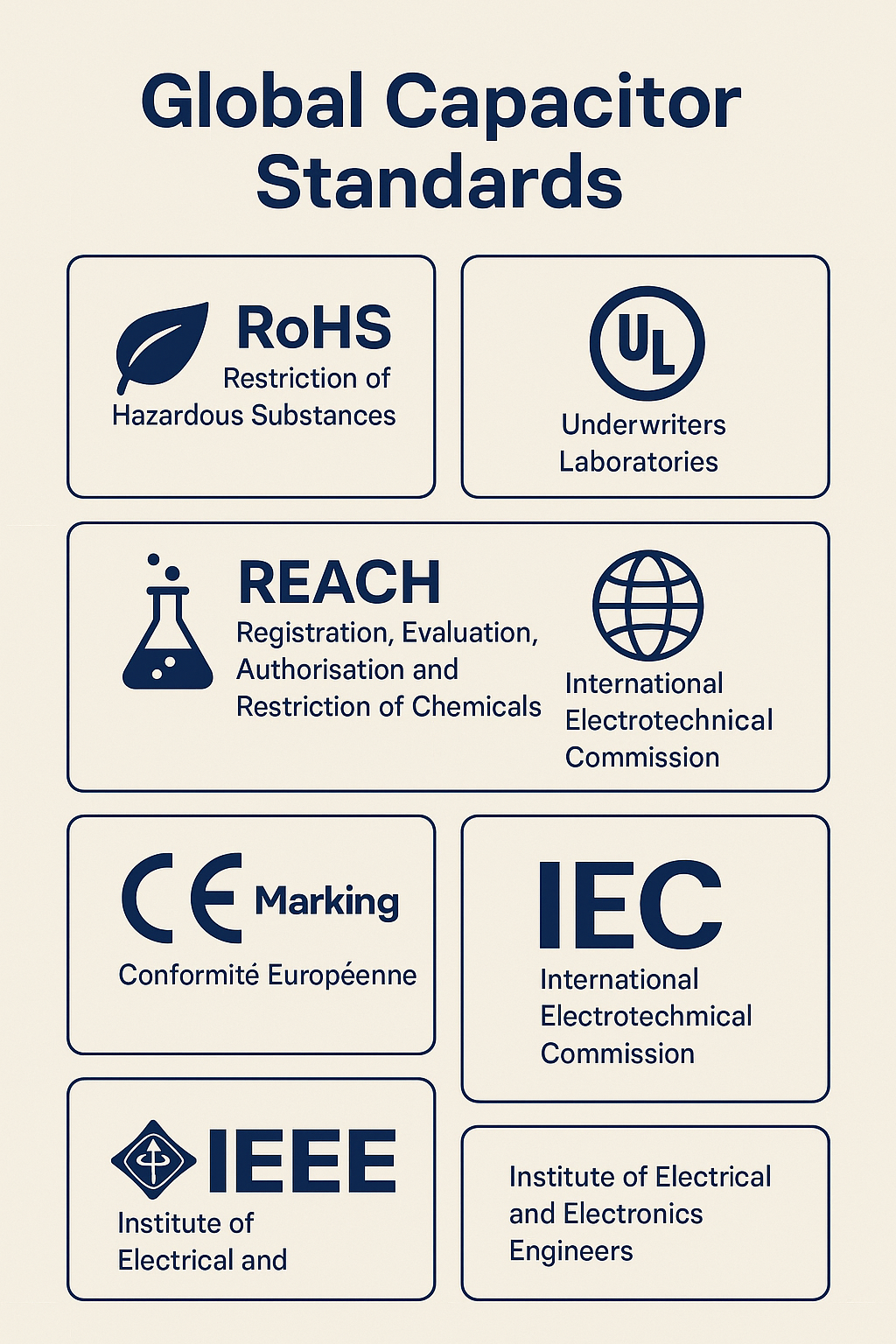
Capacitors, especially those used in industrial and medical devices, must comply with international standards such as:
- IEC 60384 – Fixed capacitor for use in electronic equipment
- RoHS – Restriction of hazardous substances in manufacturing
- REACH – Regulation on chemical substances used in components
- UL Certification – Safety standards for components used in the U.S.
For marine and hazardous environments, like those served by Abi Royen, capacitor must be suitable for ATEX or IECEx certified equipment.
Capacitor Selection Guide
When choosing a capacitor, consider the following:
- Capacitance Value: Based on energy storage or filtering needs
- Voltage Rating: Always choose higher than the circuit voltage
- Temperature Stability: Important in industrial/marine applications
- Size Constraints: Especially in compact or embedded systems
- Frequency Response: Critical in audio/RF applications
Maintenance and Life Expectancy
Capacitors generally have a long lifespan, but factors like high voltage, temperature, and humidity can degrade performance. Electrolytic capacitor are more prone to aging. Regular inspection and preventive maintenance are advised in mission-critical systems.
Signs of capacitor failure:
- Bulging or leaking
- Noisy operation in power circuits
- Decreased performance or power loss
Conclusion
Capacitors are indispensable components in modern electronics, powering everything from basic circuits to advanced communication systems. Understanding their operation, types, and applications helps engineers and technicians select the right components for each task. Whether you’re designing marine instrumentation or industrial automation systems, capacitor form the backbone of your power and signal systems.
For more insights and products related to capacitor and other electronic components, visit Abi Royen — your trusted engineering partner in industrial, marine, and hazardous area solutions.