
Capacitors are one of the most essential passive components in electronics. They store electrical energy temporarily and release it when needed, making them vital in filtering, timing, signal processing, and power conditioning applications. Capacitors come in various types, each with unique characteristics and suited to different applications. Understanding the different types of capacitors is essential for engineers, hobbyists, and students involved in electronics design.
In this article, we will dive deep into the classification of capacitors, explore their construction, working principles, and highlight their practical uses in real-world circuits.
1. Basic Capacitor Structure and Working Principle
Before diving into the types, let’s briefly revisit what a capacitor is. A typical capacitor consists of two conductive plates separated by a dielectric (insulating material). When voltage is applied across the plates, an electric field develops across the dielectric, storing energy.
The capacitance value depends on three main factors:
- The surface area of the plates
- The distance between the plates
- The dielectric constant of the insulating material
Capacitors are broadly classified into fixed capacitors and variable capacitors. From there, we can delve into various subtypes.
2. Types of Capacitors: Fixed Capacitors
Fixed capacitors have a constant capacitance value that cannot be adjusted. These are the most commonly used in electronics. Fixed capacitors are further divided based on their dielectric material.
2.1 Ceramic Capacitors
- Dielectric: Ceramic materials
- Characteristics: Small size, non-polarized, available in low and high capacitance values
- Applications: Decoupling, bypassing, filtering, and RF applications
- Pros: Low cost, high-frequency response
- Cons: Not suitable for high-capacitance applications
2.2 Electrolytic Capacitors
- Dielectric: Electrolyte-soaked paper or aluminum oxide layer
- Types: Aluminum and Tantalum electrolytics
- Characteristics: High capacitance values, polarized
- Applications: Power supply filtering, audio coupling, timing circuits
- Pros: High capacitance in small volume
- Cons: Polarized, limited lifespan, higher ESR (Equivalent Series Resistance)
2.3 Film Capacitors
- Dielectric: Plastic films like polyester, polypropylene, or polycarbonate
- Characteristics: Stable, low ESR, non-polarized
- Applications: Signal coupling, decoupling, high-frequency applications
- Pros: High reliability and long life
- Cons: Larger in size compared to ceramic or electrolytic
2.4 Mica Capacitors
- Dielectric: Mica (natural or synthetic)
- Characteristics: High precision, low loss, very stable
- Applications: RF circuits, oscillators, filters
- Pros: Extremely reliable, temperature stable
- Cons: Expensive, limited capacitance range
2.5 Paper Capacitors (Obsolete)
- Dielectric: Waxed paper
- Characteristics: Used in older electronics, now largely replaced
- Applications: Historical use in radio circuits
- Pros/Cons: Largely outdated due to size and degradation issues
2.6 Supercapacitors (Ultracapacitors)
- Dielectric: Electrochemical double-layer
- Characteristics: Very high capacitance, low voltage
- Applications: Energy storage, backup power, regenerative braking
- Pros: Long cycle life, fast charging
- Cons: Expensive per Farad, large in size
3. Types of Capacitors: Variable Capacitors
Variable capacitors are designed to allow manual or automatic adjustment of their capacitance value.
3.1 Tuning Capacitors
- Structure: Two sets of interleaved plates with air or plastic dielectric
- Applications: Tuning radios, filters, oscillators
- Pros: Smooth adjustment, high Q factor
- Cons: Sensitive to mechanical vibration
3.2 Trimmer Capacitors
- Structure: Small, adjustable capacitors typically adjusted with a screwdriver
- Applications: Calibration circuits, precision tuning
- Pros: Precise, compact
- Cons: Not meant for frequent adjustment
4. Specialized Types of Capacitors
There are also capacitors designed for specific tasks or environments.
4.1 Motor Start/Run Capacitors
Used in AC induction motors to provide phase shift and start torque.
4.2 Safety Capacitors (X and Y Capacitors)
Used in mains-connected equipment to suppress EMI and protect users.
4.3 Types of Capacitors: Tantalum Capacitors
- A subtype of electrolytic capacitor with stable performance and small size
- Common in smartphones, laptops, and compact electronics
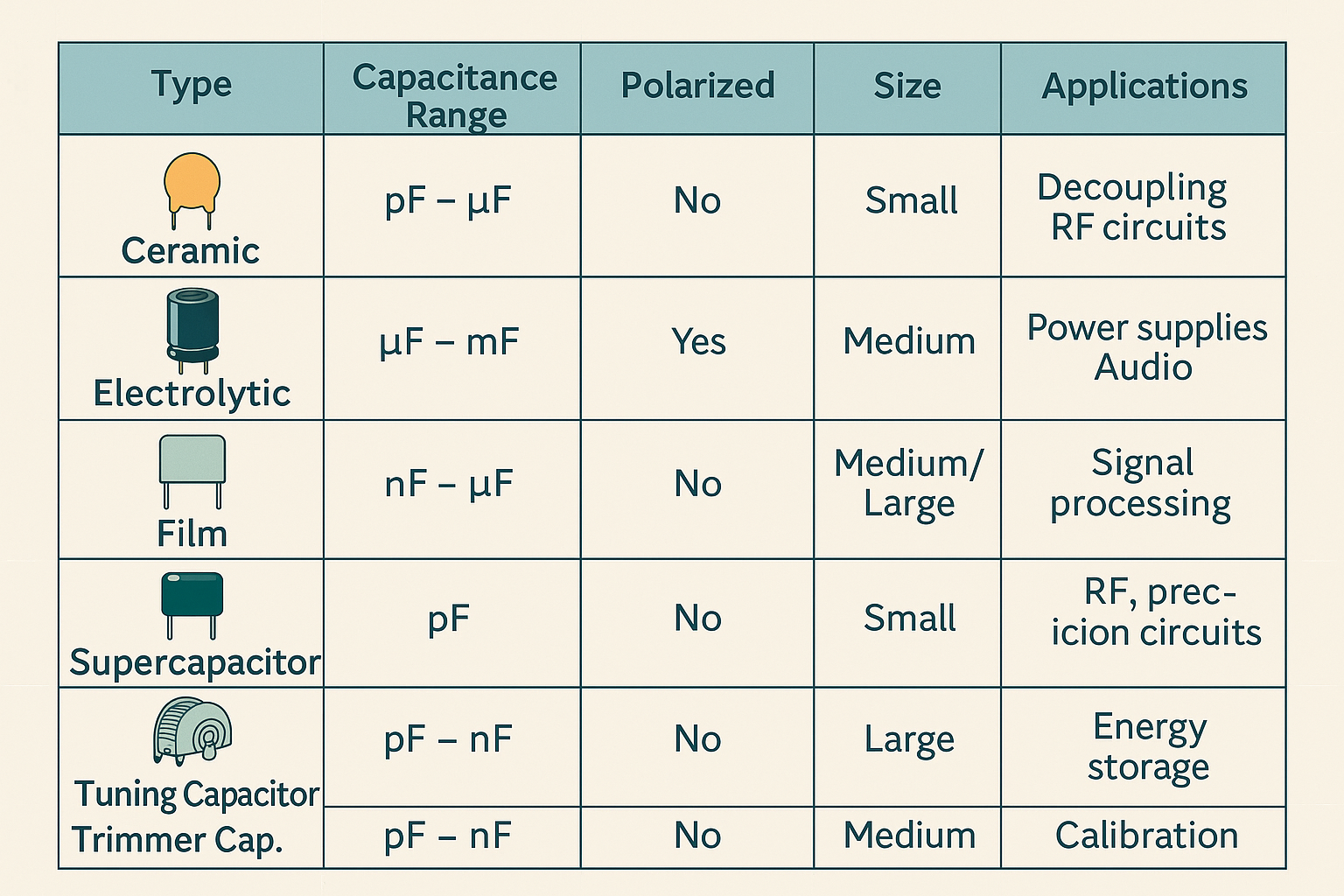
5. Comparison Table of Types of Capacitors
| Type | Capacitance Range | Polarized | Size | Applications |
|---|---|---|---|---|
| Ceramic | pF – µF | No | Small | Decoupling, RF circuits |
| Electrolytic | µF – mF | Yes | Medium | Power supplies, audio |
| Film | nF – µF | No | Medium/Large | Signal processing |
| Mica | pF | No | Small | RF, precision circuits |
| Supercapacitor | mF – F | No | Large | Energy storage |
| Tuning Capacitor | pF – nF | No | Medium | Radio tuning |
| Trimmer Capacitor | pF – nF | No | Small | Calibration |
6. How to Choose the Right Types of Capacitors
When selecting a capacitor, consider the following parameters:
- Capacitance value
- Voltage rating
- Polarity
- Tolerance
- Size and form factor
- Temperature coefficient
- Application-specific factors (e.g., ESR, leakage current)
7. Common Applications of Capacitors
- Power Supply Filtering – Smoothing voltage ripples
- Decoupling and Bypassing – Removing unwanted noise
- Timing Circuits – RC oscillators and delays
- Energy Storage – In flash units or regenerative systems
- Signal Coupling – Passing AC signals between stages
- Tuning and Frequency Selection – In radios and TV receivers
Conclusion of Types of Capacitors
Capacitors are versatile components that come in many forms, each tailored to specific functions and environments. Understanding the types of capacitors and their properties allows designers to make better choices in circuit design and troubleshooting.
Whether you’re working on power electronics, RF systems, or consumer devices, selecting the right capacitor type is essential to achieving reliable and efficient performance. Bookmark this guide as your go-to reference for capacitor selection and application!