
1. Introduction
The Schottky diode, also known as the Schottky barrier diode (SBD), is a special type of semiconductor diode known for its low forward voltage drop and fast switching speed. Unlike conventional PN-junction diodes, the Schottky-diode uses a metal-semiconductor junction instead of a P-type and N-type semiconductor junction.
This unique design gives Schottky-diodes distinct electrical properties that make them ideal for high-speed switching, power rectification, and radio-frequency (RF) applications.
Schottky-diodes are named after Walter H. Schottky, a German physicist who made significant contributions to semiconductor physics and vacuum tube technology.
2. Structure and Working Principle Schottky Diode
2.1 Construction
A Schottky diode is built using:
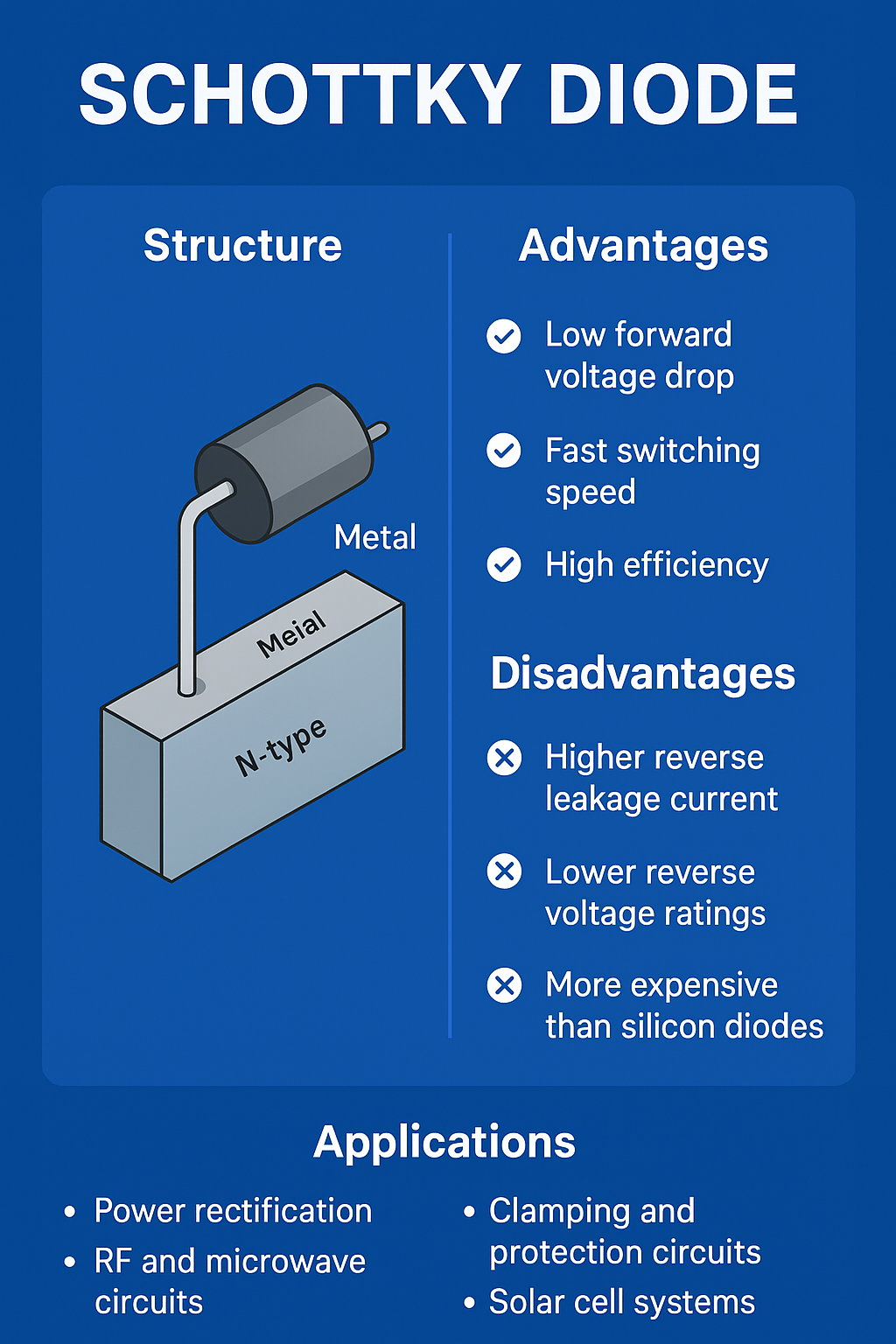
- Metal layer (such as platinum, tungsten, molybdenum, or gold)
- N-type semiconductor substrate (usually silicon)
Unlike conventional diodes that form a PN junction, Schottky-diodes form a metal-semiconductor junction. The contact between the metal and semiconductor creates a Schottky barrier that controls the flow of current.
2.2 Working Principle
When a forward voltage is applied:
- Electrons move from the N-type semiconductor into the metal contact.
- Due to the absence of minority carrier storage, current flows almost instantly.
When reverse biased:
- The Schottky barrier prevents most electrons from crossing the junction.
- Leakage current is generally higher compared to silicon PN diodes, but switching speed is much faster.
3. Key Characteristics of Schottky Diode
Schottky-diodes are unique because of the following characteristics:
3.1 Low Forward Voltage Drop
- Typical forward voltage: 0.15V to 0.45V (compared to 0.6V–1.0V for PN diodes)
- This low drop reduces power loss and improves efficiency in low-voltage circuits.
3.2 Fast Switching Speed
- No minority carrier storage means switching occurs in nanoseconds.
- Ideal for high-frequency applications like RF circuits and digital logic.
3.3 High Reverse Leakage Current
- Due to the metal-semiconductor junction, Schottky diodes have higher reverse leakage currents.
- Designers must account for this in precision circuits.
3.4 Lower Reverse Voltage Ratings
- Typically 20V to 200V maximum reverse voltage.
- Not suitable for very high-voltage rectification.
4. Advantages and Disadvantages Schottky Diode
4.1 Advantages
- Low forward voltage drop → reduced power loss
- High efficiency in low-voltage and high-frequency circuits
- Fast recovery time → suitable for switching power supplies and RF circuits
- Smaller size and lighter weight compared to conventional diodes
4.2 Disadvantages
- Higher reverse leakage current
- Lower maximum reverse voltage limits usage in high-voltage applications
- Generally more expensive than standard silicon diodes
5. Applications of Schottky Diode
Schottky-diodes are used in various modern electronics due to their speed and efficiency.
5.1 Power Rectification
Used in switch-mode power supplies (SMPS) to improve conversion efficiency.
5.2 RF and Microwave Circuits
Due to their fast switching, they are widely used in mixers, detectors, and modulators.
5.3 Clamping and Protection Circuits
Protect sensitive components from voltage spikes.
5.4 Solar Cell Systems
Used in photovoltaic systems to prevent reverse current flow at night.
5.5 Logic Circuits
In digital electronics, Schottky-diodes improve switching performance in TTL logic families.
6. Common Schottky Diode Types and Examples
- 1N5819 – General-purpose low-voltage rectifier
- SS14 – Surface-mount Schottky for compact devices
- MBR2045CT – Power Schottky diode for SMPS
- BAT54 – Small signal Schottky diode for high-speed switching
7. How to Select a Schottky Diode
When choosing a Schottky diode, consider:
- Forward voltage drop (Vf) for efficiency
- Reverse voltage rating (Vr) to avoid breakdown
- Forward current rating (If) for load requirements
- Package type for PCB space and thermal management
8. Schottky Diode vs. PN Junction Diode
| Feature | Schottky Diode | PN Junction Diode |
|---|---|---|
| Junction type | Metal-semiconductor | P-N semiconductor |
| Forward voltage drop | 0.15V–0.45V | 0.6V–1.0V |
| Switching speed | Very fast | Moderate |
| Reverse leakage current | Higher | Lower |
| Reverse voltage rating | Lower | Higher |
9. Conclusion
The Schottky-diode plays a vital role in modern electronics, especially in applications that require high speed and low power loss. While they have limitations such as higher leakage current and lower reverse voltage tolerance, their benefits make them indispensable in power supplies, RF circuits, and digital logic systems.
By understanding the working principle, characteristics, and application areas of Schottky diodes, engineers can design more efficient and reliable electronic systems.