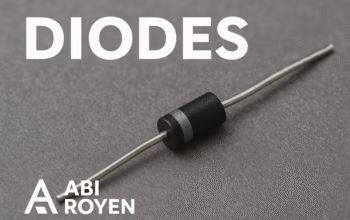
Diodes are fundamental components in the world of electronics. Whether you’re designing a power supply or working with signal modulation, understanding how diode work and where they apply is essential. This article provides a comprehensive guide on diode, including their structure, types, working principles, and real-world applications.
🔌 What is a Diodes?
A diode is a two-terminal electronic component that allows the current to flow in one direction only, acting as a one-way valve for electrical current. The direction of current flow is from the anode (positive) to the cathode (negative). This property is known as rectification.
Diode are made of semiconductor materials, typically silicon or germanium, and form a p-n junction — the basic building block of most semiconductor devices.
⚙️ How Does a Diode Work?
When a voltage is applied across a diode in the forward-biased condition (positive to anode, negative to cathode), the diode conducts electricity. In the reverse-biased condition (positive to cathode, negative to anode), the diode blocks current.
This unidirectional behavior arises from the physics of the p-n junction:
- Forward Bias: Electrons and holes recombine at the junction, allowing current to flow.
- Reverse Bias: The junction widens, preventing current flow (except for a tiny leakage current).
🔎 Characteristics of Diodes
| Property | Description |
|---|---|
| Forward Voltage Drop | Typically ~0.7V for silicon, ~0.3V for germanium |
| Reverse Leakage | Small current in reverse bias |
| Breakdown Voltage | Maximum reverse voltage before diode conducts |
| Reverse Recovery Time | Time needed to stop conducting in reverse direction |
🧪 Types of Diodes
1. Rectifier Diode
Used for converting alternating current (AC) to direct current (DC). Common in power supplies.
Example: 1N4007
2. Zener Diode
Designed to allow current to flow in the reverse direction once the voltage exceeds a specific value. Used for voltage regulation.
Example: 1N4733A (5.1V Zener)
3. Light Emitting Diode (LED)
Emits light when forward-biased. Common in indicators, displays, and lighting.
Example: 5mm Red LED
4. Schottky Diode
Has a lower forward voltage drop (~0.2V) and faster switching. Ideal for high-frequency and low-voltage applications.
Example: 1N5819
5. Photodiode
Generates current when exposed to light. Used in optical sensors.
Example: BPW34
6. Varactor Diode
Acts as a variable capacitor under reverse bias. Used in RF tuning circuits.
7. Tunnel Diode
Exhibits negative resistance. Used in high-speed switching and microwave applications.
⚡ Applications of Diode
| Application | Diode Type Used |
|---|---|
| AC to DC Rectification | Rectifier Diode |
| Voltage Regulation | Zener Diode |
| Signal Demodulation | Detector Diode |
| Circuit Protection (ESD) | TVS Diode |
| Light Emission | LED |
| Light Detection | Photodiode |
| Frequency Modulation | Varactor Diode |
| Fast Switching | Schottky Diode |
🧰 Example Diodes Use Case: Full-Wave Bridge Rectifier
A common circuit that uses four diodes in a bridge configuration to convert AC to DC. Here’s how it works:
- During the positive AC cycle, two diode conduct.
- During the negative cycle, the other two conduct.
- This ensures current always flows in the same direction across the load.
Benefit: Efficient power conversion in power supplies.
🛡️ How to Test a Diode
Using a digital multimeter:
- Set to Diode Mode.
- Connect probes: Red to anode, black to cathode.
- A good diode shows ~0.6V–0.7V (silicon) in forward bias.
- In reverse, it shows OL or infinite resistance.
Tip: A shorted diode shows low resistance both ways; an open diode shows OL both ways.
🧽 Diodes Maintenance and Handling Tips
- Static Protection: Some diode (e.g., Schottky) are ESD-sensitive.
- Thermal Management: High current can cause heat buildup—use proper heat sinking.
- Voltage Rating: Never exceed reverse voltage ratings to avoid breakdown.
- Circuit Design: Use snubber circuits to protect diodes in inductive loads.
📊 Diode vs Other Components
| Feature | Diode | Resistor | Capacitor |
|---|---|---|---|
| Directional? | Yes | No | No |
| Conducts Current? | One-way | Both ways | AC (blocks DC) |
| Stores Energy? | No | No | Yes |
🧱 Diodes in Modern Electronics
Diodes are found in almost every electronic circuit:
- Smartphones use diode in charging circuits.
- Solar panels use blocking diode to prevent reverse current.
- Power supplies use them in rectifiers and voltage clamps.
- Automotive systems rely on diode for alternator and lamp protection.
As electronic devices evolve, new diode technologies emerge, including silicon carbide (SiC) and gallium nitride (GaN) diode for high-power and high-speed applications.
🏁 Conclusion Diodes
Diode are indispensable components in electronic circuits. Their ability to control the direction of current makes them ideal for rectification, voltage regulation, protection, and signal processing.
Whether you’re an electronics hobbyist or a professional engineer, understanding diode—how they work, the types available, and their practical uses—will empower you to design more efficient and robust circuits.
🖋️ Article Summary
- Diodes allow current to flow in one direction.
- They are essential for rectification, regulation, and signal processing.
- Types include rectifier, Zener, LED, Schottky, photodiode, and more.
- Proper use requires understanding voltage, polarity, and thermal limits.