Electricity powers our modern world, and at the heart of this invisible energy lies electric current (I). From the charging of smartphones to the functioning of massive industrial machines, current plays a fundamental role in how energy is transferred and used. This article explores electric current in detail—its definition, formula, types, measurement, and applications in everyday life and advanced technology.
🔹 What is Electric Current (I)?
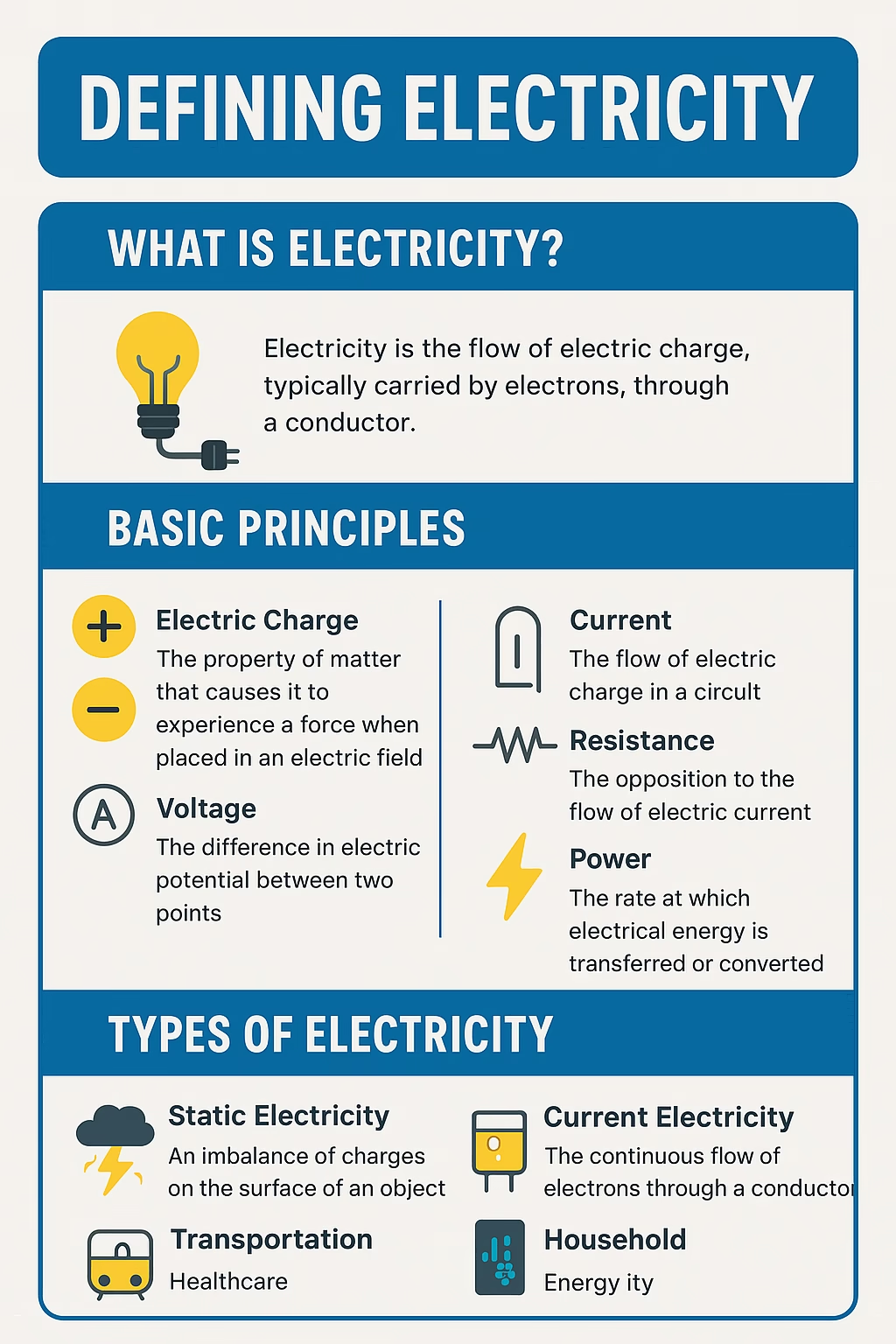
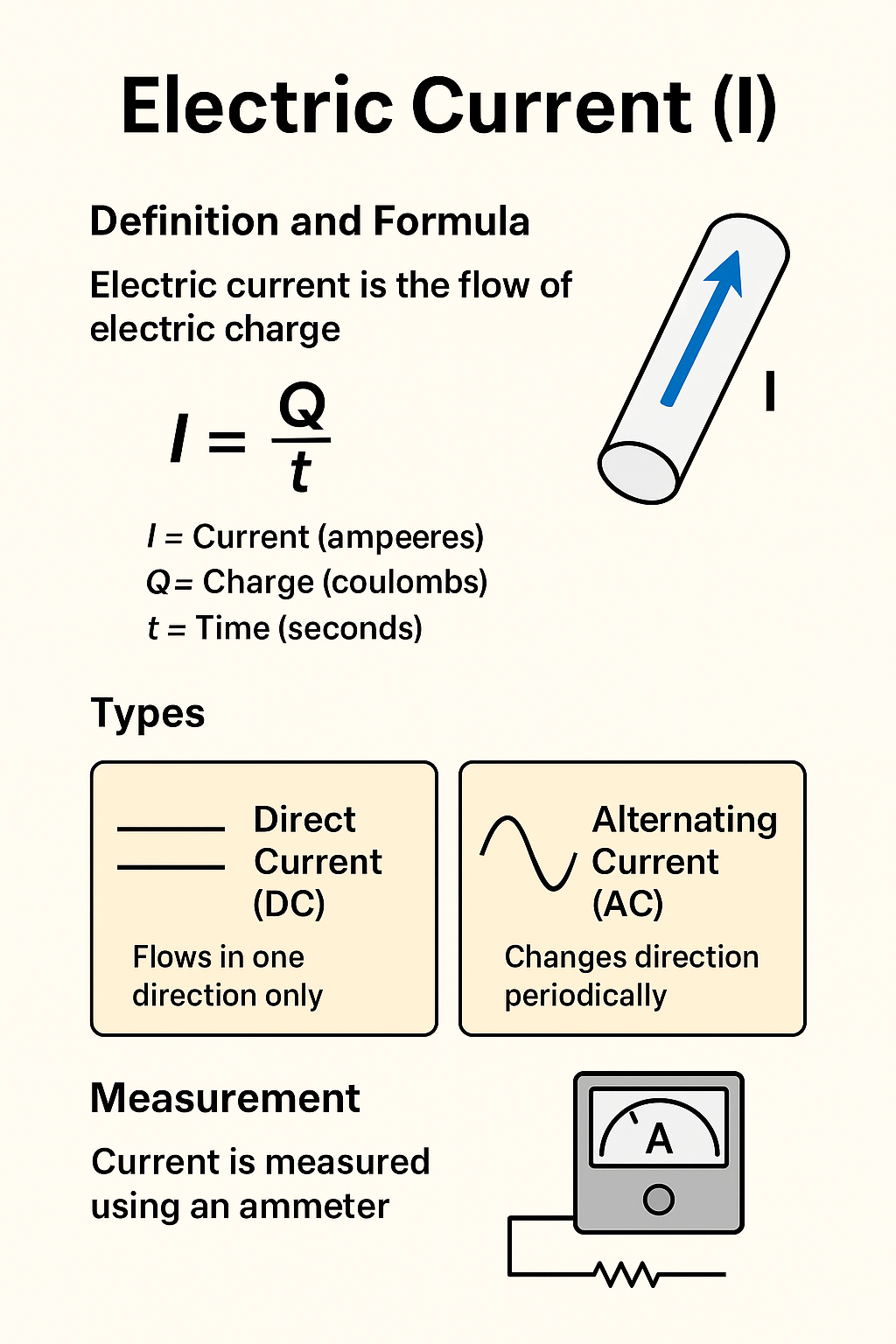
In physics and electrical engineering, electric current (I) is defined as the flow of electric charge through a conductor, typically measured in amperes (A).
Mathematically, it is expressed as: I=QtI = \frac{Q}{t}I=tQ
Where:
- I = Current (amperes)
- Q = Charge (coulombs)
- t = Time (seconds)
This means that electric current represents the amount of charge passing through a cross-section of a conductor per unit time.
🔹 The Role of Voltage and Resistance in Current (I)
Current does not flow independently—it is driven by voltage (V) and influenced by resistance (R), as explained by Ohm’s Law: I=VRI = \frac{V}{R}I=RV
This formula demonstrates that:
- A higher voltage results in a higher current (if resistance is constant).
- A higher resistance decreases current flow.
For example, in household electrical wiring, the balance of voltage and resistance ensures safe operation of appliances.
🔹 Types of Electric Current
There are two primary types of electric current used in practical applications:
1. Direct Current (DC)
- Flows in one direction only.
- Common sources: batteries, solar cells, and DC power supplies.
- Used in electronics such as laptops, smartphones, and LED lights.
2. Alternating Current (AC)
- Changes direction periodically.
- Generated by power stations and transmitted over long distances.
- Standard household electricity is AC (50 Hz or 60 Hz depending on the country).
⚡ Key Difference: While DC is best suited for low-voltage electronics, AC is more efficient for long-distance power transmission.
🔹 Measurement of Electric Current (I)
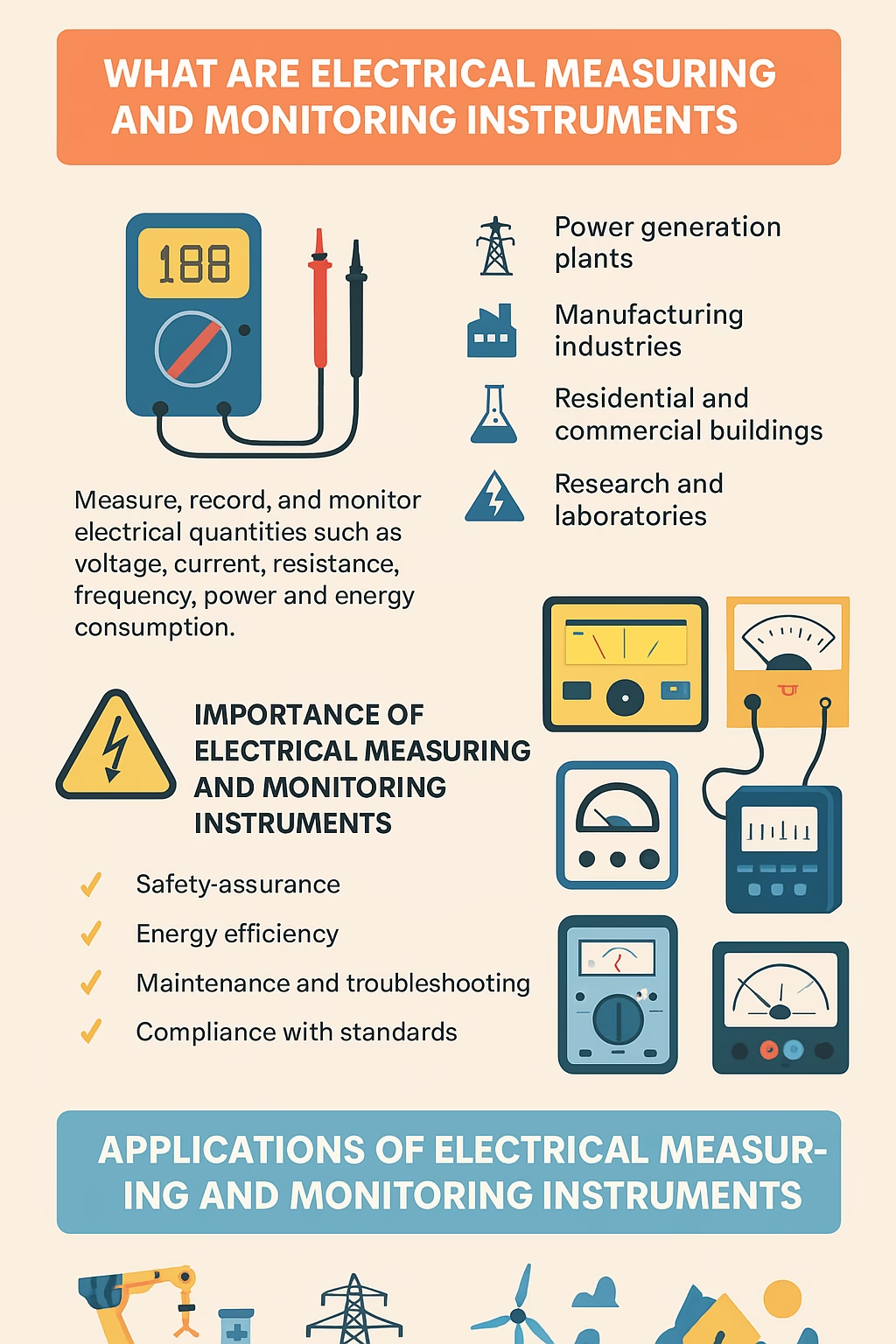
To measure current, engineers use an instrument called an ammeter, connected in series with the circuit.
- Analog Ammeters use a moving coil mechanism.
- Digital Ammeters display current with higher precision.
- Clamp Meters measure current without direct contact, useful for AC circuits.
The unit of current, ampere (A), is defined as one coulomb of charge passing through a point per second.
🔹 Effects of Electric Current (I)
Electric current produces various effects, which form the foundation of modern electrical technology:
- Heating Effect
- Used in electric heaters, toasters, and light bulbs.
- Governed by Joule’s Law of Heating.
- Magnetic Effect
- Current-carrying wires create magnetic fields.
- Basis of electric motors, transformers, and generators.
- Chemical Effect
- Electrolysis in industries like electroplating, metal refining, and battery charging.
- Physiological Effect
- Current can stimulate nerves and muscles but can also be harmful at high levels.
🔹 Applications of Electric Current
Electric current is essential in nearly every aspect of modern life. Its applications include:
✅ Everyday Life
- Charging smartphones, laptops, and gadgets.
- Powering household appliances like refrigerators, TVs, and washing machines.
✅ Industrial Uses
- Running large motors in factories.
- Welding, electroplating, and manufacturing processes.
✅ Communication Systems
- Internet data transmission relies on controlled current flow.
- Fiber optics and wireless systems still use current for processing signals.
✅ Transportation
- Electric vehicles (EVs) use DC batteries and AC motors.
- Railway systems use high-voltage current for traction.
🔹 Safety Considerations with Current (I)
While current is useful, it can also be dangerous. Even small amounts can cause harm to the human body.
- 1 mA – 10 mA: Tingling sensation.
- 10 mA – 30 mA: Muscle contraction, difficult to release.
- Above 100 mA: Fatal if passing through the heart.
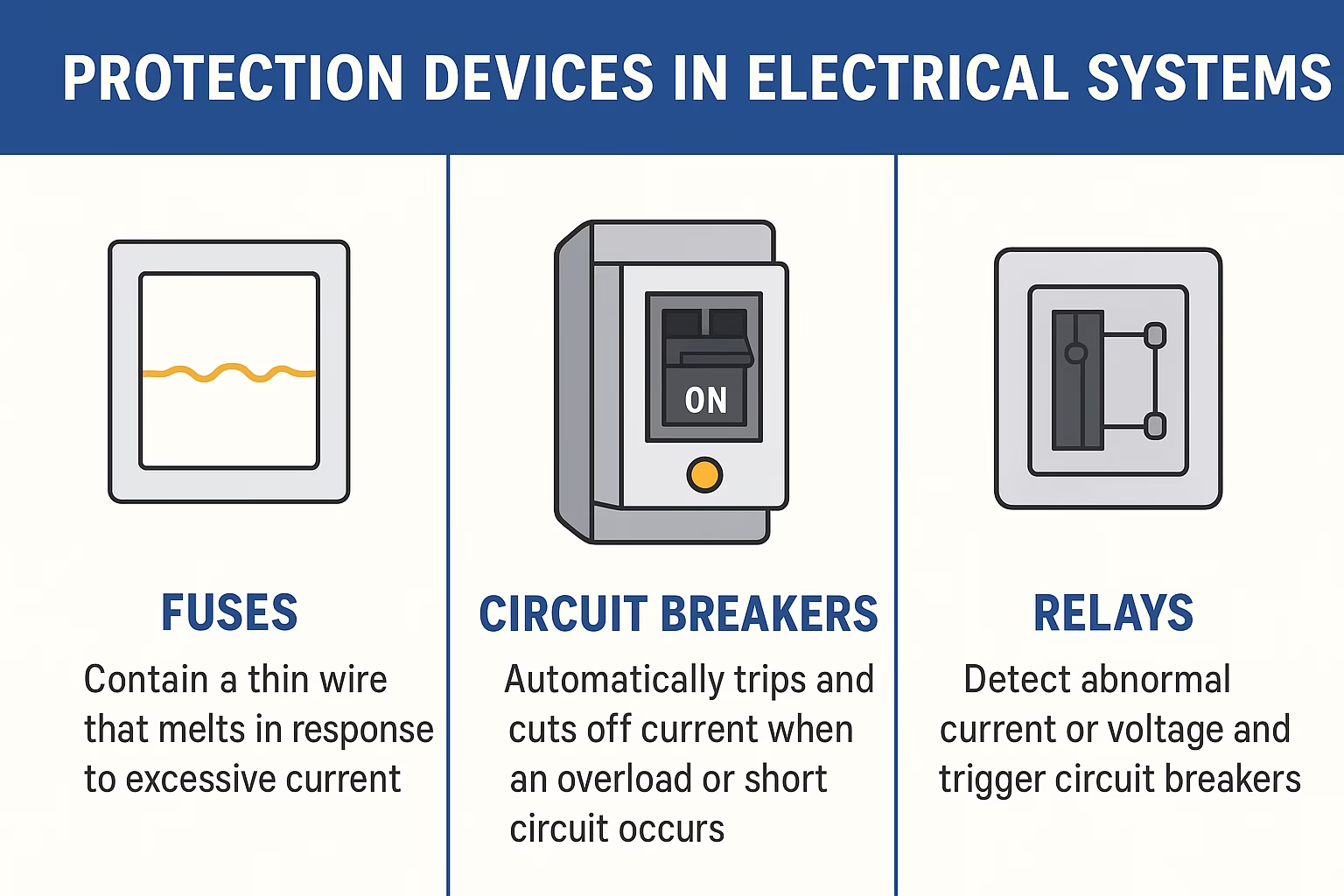
Safety devices such as circuit breakers, fuses, and ground fault interrupters (GFCI) protect users from electrical hazards.
🔹 Future of Electric Current in Technology
As technology advances, the demand for efficient and controlled current continues to grow:
- Renewable Energy: Solar panels and wind turbines generate current for sustainable energy.
- Electric Mobility: EVs rely on efficient battery current management.
- Smart Grids: Modern power systems require precise current monitoring for efficiency.
The evolution of current-based technologies is shaping the future of energy consumption, making it cleaner, safer, and more efficient.
🔹 Conclusion
Electric current (I) is the lifeblood of modern civilization. Defined as the flow of charge per unit time, it underpins everything from lighting homes to powering industries and advancing communication systems. With the growing demand for renewable energy, electric vehicles, and smart grids, the role of current will only become more vital.
By understanding the fundamentals of current, engineers, students, and enthusiasts can better appreciate the invisible force that powers the world.