In the world of electronics, one component stands out for its critical role in converting alternating current (AC) into direct current (DC): the Rectifier Diode. It is the backbone of most power supply systems, found in everything from phone chargers to industrial equipment. But what exactly is a diode rectifier? How does it work, and why is it so important in electronic design?
In this comprehensive article on abiroyen.com, we’ll explore the Rectifier Diode, covering its structure, operation, classifications, and key uses in real-world circuits.
What Is a Rectifier Diode?
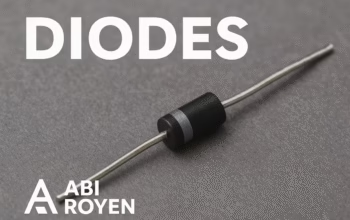
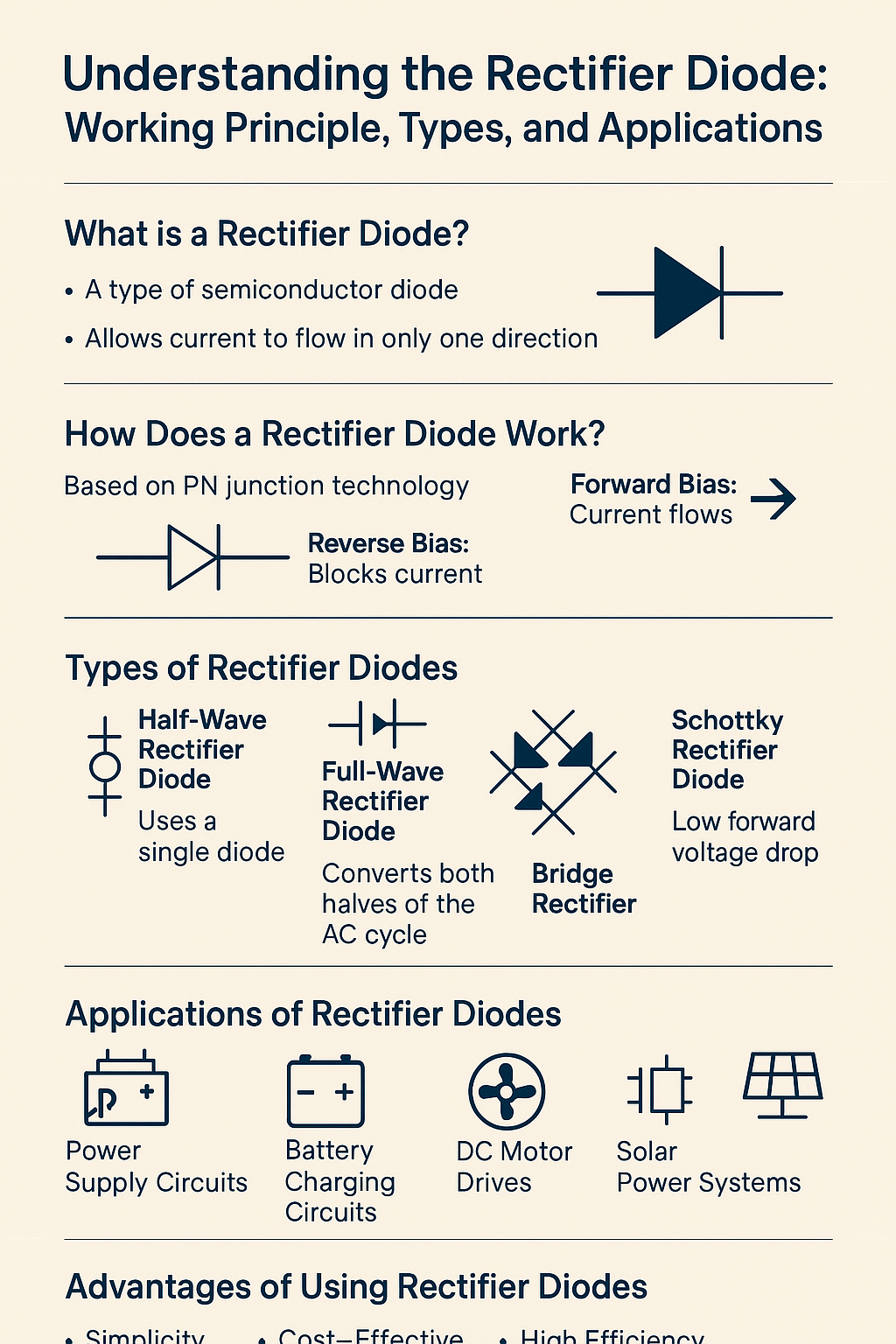
A diode rectifier is a type of semiconductor diode that allows current to flow in only one direction. It is specifically designed to handle high voltage and current levels, making it ideal for converting AC power into DC power — a process known as rectification.
Diode rectifier are usually made from silicon, although germanium diodes exist for lower-voltage applications. Their ability to conduct electricity in one direction and block it in the other makes them essential in circuits that require a steady DC voltage.
How Does a Rectifier Diode Work?
The operation of a diode rectifier is based on PN junction technology:
- In the forward bias condition (positive terminal connected to the P-side), the diode allows current to pass.
- In reverse bias (positive terminal connected to the N-side), the diode blocks the current flow.
This unidirectional behavior allows the diode to filter out the negative part of an AC signal, producing a pulsating DC output. Multiple diodes rectifier can be combined in different configurations to achieve full-wave rectification, which further smoothens the output.
Types of Rectifier Diodes
There are several types of diode rectifier, each suited to different applications based on voltage, current, and frequency requirements:
1. Half-Wave Rectifier Diode
- Uses a single diode.
- Converts only one half of the AC cycle (either positive or negative) into DC.
- Simple design but inefficient for high-power applications.
2. Full-Wave Rectifier Diode
- Converts both halves of the AC cycle.
- Requires either:
- Two diodes and a center-tapped transformer.
- Four diodes in a bridge rectifier configuration.
3. Bridge Rectifier
- Most common type for full-wave rectification.
- Uses four diodes arranged in a bridge to convert AC to DC efficiently.
- Provides a higher average output voltage.
4. Schottky Rectifier Diode
- Has a lower forward voltage drop (0.2 to 0.4V).
- Faster switching speed.
- Commonly used in high-frequency and low-voltage applications.
5. Fast Recovery Diode
- Designed for high-speed switching.
- Useful in applications like switching power supplies.
Key Characteristics of Rectifier Diodes
When choosing a rectifier diodes for your circuit, consider the following parameters:
- Maximum Reverse Voltage (V<sub>R</sub>): The maximum voltage the diode can withstand in reverse bias.
- Forward Current (I<sub>F</sub>): The maximum current the diode can carry in forward bias.
- Reverse Recovery Time (t<sub>rr</sub>): Time it takes for the diode to switch from conducting to non-conducting state.
- Forward Voltage Drop (V<sub>F</sub>): Voltage lost across the diode when it is forward biased.
Applications of Rectifier Diodes
Rectifier diodes are widely used in various applications, including:
1. Power Supply Circuits
- Converts AC from wall outlets to DC for electronic devices.
- Bridge rectifiers are commonly used here.
2. Battery Charging Circuits
- Ensures that current flows only from the charger to the battery.
- Prevents backflow that could damage the charger.
3. DC Motor Drives
- Converts AC to DC for controlling motor speed and direction.
4. Signal Demodulation
- Used in AM radios to extract the audio signal from the carrier wave.
5. Solar Power Systems
- Prevents reverse current that could damage solar panels at night.
Advantages of Using Rectifier Diodes
- Simplicity: Easy to implement in circuit design.
- Cost-Effective: Affordable and widely available.
- High Efficiency: Especially in bridge configurations.
- Compact Size: Takes up little space on a circuit board.
Limitations of Rectifier Diodes
- Voltage Drop: Energy is lost as heat due to the forward voltage drop.
- Pulsating Output: Requires filtering (usually with capacitors) to get a smooth DC output.
- Heat Generation: High current flow can cause significant heat buildup.
Choosing the Right Rectifier Diode
When selecting a rectifier diodes for your project, consider:
- The maximum voltage the circuit will experience.
- The amount of current needed.
- The frequency of the input signal.
- The thermal environment — whether you’ll need a heatsink.
Common rectifier diodes models include:
- 1N4001 – 1N4007 series for general-purpose rectification.
- MB6S for integrated bridge rectifier solutions.
- 1N5819 for Schottky diode applications.
Conclusion
The Rectifier Diodes is a vital component in modern electronics. From powering household devices to enabling complex industrial machinery, these small components play a big role in shaping how electricity is used. Understanding how they work, what types exist, and where they are applied can give engineers and hobbyists a solid foundation for designing reliable, efficient circuits.
For more technical insights and detailed guides on electronic components, stay tuned to Abi Royen – abiroyen.com.