Transformers Based on Usage ~ Transformers are essential components in electrical systems, serving as the bridge that modifies voltage levels to suit specific applications. One of the most practical ways to categorize transformers is based on their usage. This classification allows engineers and technicians to select the most appropriate type for a particular task, whether it’s transmitting electricity over long distances or ensuring electrical isolation in sensitive circuits.
In this article, we will explore the various types of transformers categorized based on usage, their key features, real-world applications, and why understanding this classification is vital for efficient power management.
1. What Are Transformers Based on Usage?
Transformers based on usage are categorized according to the specific function or role they play in an electrical system. Unlike classifications based on construction (e.g., core-type or shell-type) or voltage levels (step-up or step-down), this usage-based classification focuses on where and how the transformer is used.
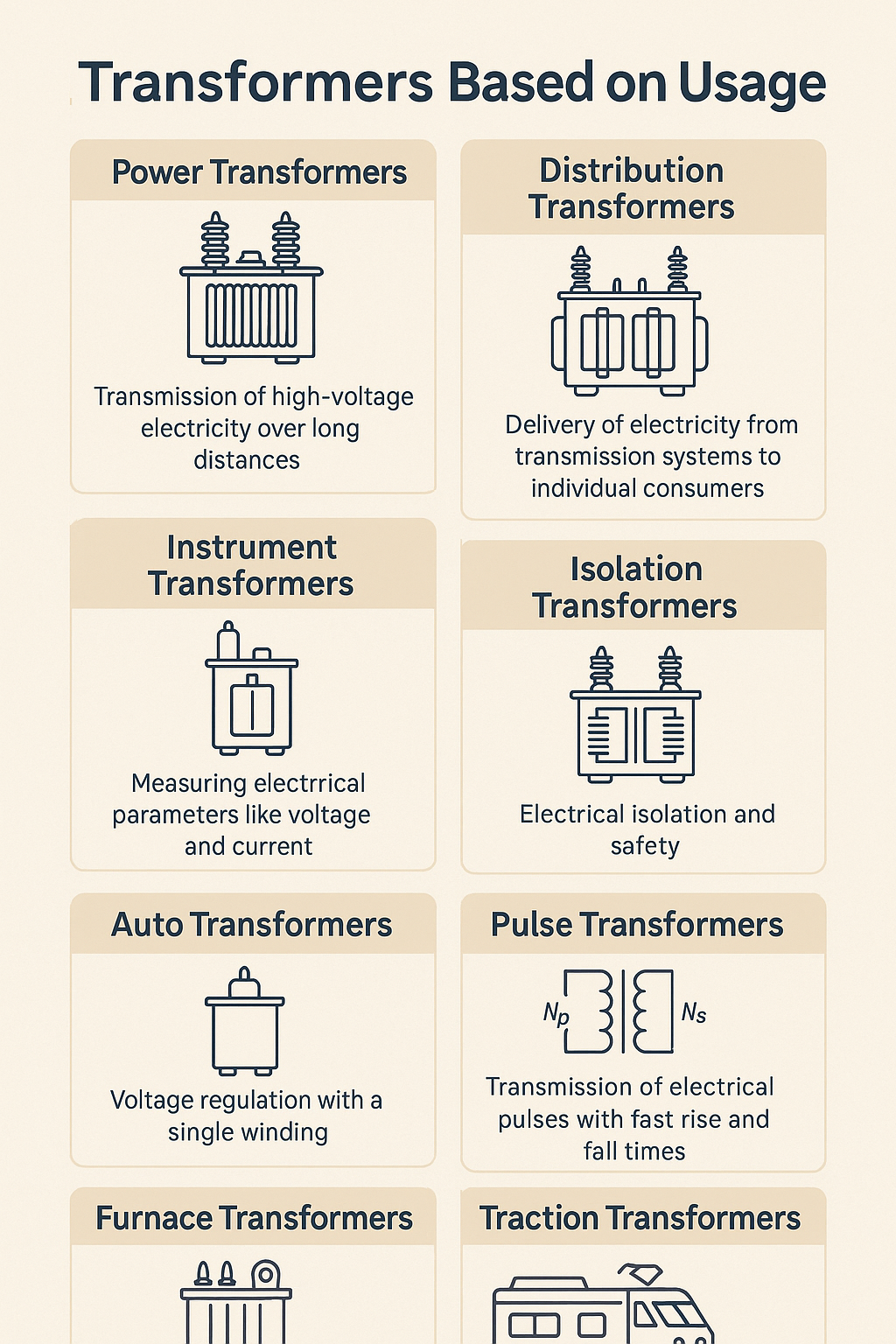
The main types include:
- Power Transformers
- Distribution Transformers
- Instrument Transformers
- Isolation Transformers
- Auto Transformers
- Pulse Transformers
- Furnace Transformers
- Traction Transformers
Each of these transformers is designed with particular use cases in mind, and understanding them can significantly enhance the efficiency and safety of electrical operations.
2. Types of Transformers Based on Usage
a. Power Transformers
Usage: Transmission of high-voltage electricity over long distances.
Power transformers are typically used in transmission networks where the voltage level is significantly high. They operate at peak load conditions and are designed to be highly efficient, especially at full load. These transformers are large in size and are usually installed at power generation stations or substations.
Applications:
- Power plants
- Transmission substations
- Inter-grid power transfer
b. Distribution Transformers
Usage: Delivery of electricity from transmission systems to individual consumers.
Distribution transformers operate at lower voltage levels compared to power transformers. They are designed to provide maximum efficiency at 50-70% load and are used in residential, commercial, and industrial areas.
Applications:
- Pole-mounted transformers
- Underground electrical distribution
- Small-scale industrial applications
c. Instrument Transformers
Usage: Measuring electrical parameters like voltage and current in high-voltage circuits.
Instrument transformers are further categorized into Current Transformers (CTs) and Potential Transformers (PTs). They are essential in protective relaying and accurate measurement.
Applications:
- Electrical metering
- Protective relays in substations
- High-voltage monitoring systems
d. Isolation Transformers
Usage: Electrical isolation and safety.
Isolation transformers decouple two circuits, allowing AC signals to pass while blocking DC. This is essential in medical equipment, audio systems, and sensitive electronics to prevent electric shock and interference.
Applications:
- Hospital medical devices
- Audio/Video equipment
- Laboratory instruments
e. Auto Transformers
Usage: Voltage regulation with a single winding.
Unlike traditional transformers, auto transformers have a single winding that acts as both the primary and secondary winding. They are more compact and cost-effective but offer less electrical isolation.
Applications:
- Railway traction systems
- Motor starting
- Voltage stabilization in labs
f. Pulse Transformers
Usage: Transmission of electrical pulses with fast rise and fall times.
Pulse transformers are used in digital circuits and radar systems where rapid switching is required. They offer high-frequency response and low distortion.
Applications:
- Radar and sonar systems
- Switching power supplies
- Signal transmission in digital circuits
g. Furnace Transformers
Usage: Power supply for electric arc furnaces.
These transformers are heavy-duty and built to handle high currents for smelting processes. They need to endure frequent short circuits and thermal stress.
Applications:
- Steel manufacturing
- Aluminum smelting
- Glass and cement industries
h. Traction Transformers
Usage: Electric trains and railway systems.
Traction transformers are mounted on railway vehicles or substations to supply power for locomotives. They need to be lightweight, efficient, and robust to handle harsh operating conditions.
Applications:
- High-speed trains
- Metro and light rail systems
- Electric locomotives
3. Key Benefits of Using the Right Transformers Based on Usage
Choosing the correct transformer based on usage offers multiple advantages:
- Efficiency: Using a transformer tailored to its environment ensures optimal power usage.
- Cost-effectiveness: Avoids over-engineering and reduces unnecessary expenses.
- Safety: Specialized transformers like isolation types reduce the risk of electric shock.
- Longevity: Appropriate usage increases the lifespan of the transformer.
- Compliance: Helps meet industry-specific electrical codes and regulations.
4. Real-World Industry Applications
Industries rely on usage-based transformers to achieve operational excellence:
- Healthcare: Isolation transformers in operating rooms and diagnostic equipment.
- Manufacturing: Furnace and distribution transformers in process automation.
- Energy: Power transformers in high-voltage transmission grids.
- Transportation: Traction transformers in modern rail systems.
- Telecommunications: Pulse transformers in signal routing and data centers.
5. Maintenance and Monitoring Considerations
Each transformer type has different maintenance needs. For example:
- Power and furnace transformers require regular oil testing and thermal scanning.
- Instrument transformers need calibration for measurement accuracy.
- Isolation transformers should be inspected for insulation integrity.
Proper preventive maintenance ensures reliability, reduces downtime, and improves safety.
6. Future Trends in Transformers Based on Usage Usage
- Smart Transformers: Integration with IoT and AI for predictive maintenance and real-time monitoring.
- Eco-friendly Designs: Use of biodegradable insulation oils and recyclable materials.
- Compact Solutions: Miniature and modular transformers for urban and portable applications.
As electrical infrastructure modernizes, usage-specific transformers will play a pivotal role in grid modernization and renewable integration.
Conclusion of Transformers Based on Usage
Transformers based on usage form the backbone of various electrical systems across sectors. From high-voltage power transmission to sensitive medical devices, each type serves a unique function that ensures the safe and efficient distribution of electricity. By understanding these transformer types and their applications, engineers and stakeholders can make informed decisions that lead to energy efficiency, operational safety, and cost optimization.