The Metal-Oxide-Semiconductor FET (MOSFET) is one of the most widely used and crucial components in modern electronic systems. Whether it’s a smartphone, a car engine control unit, or a power supply, MOSFETs are found in almost every type of electronic circuitry.
In this comprehensive guide, we’ll explore the structure, working principle, types, advantages, and applications of Metal-Oxide-Semiconductor FETs (MOSFETs).
What is a Metal-Oxide-Semiconductor FET (MOSFET)?
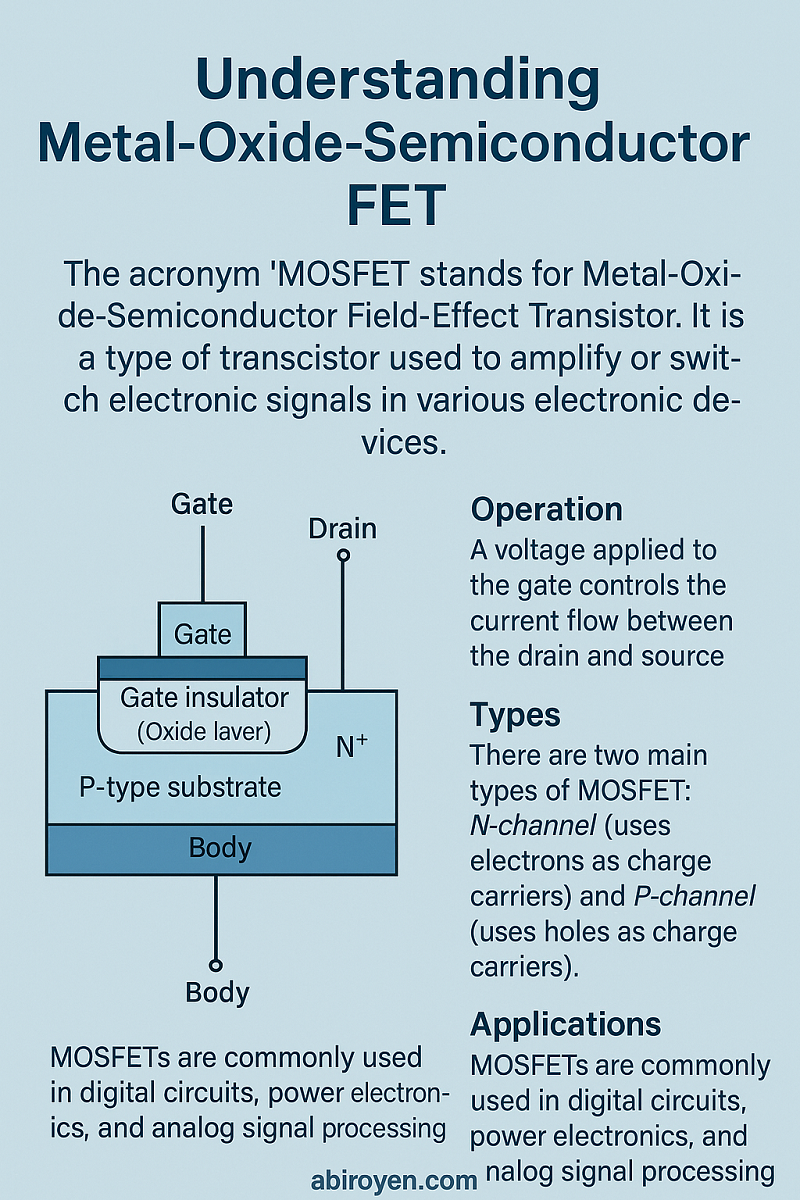
A MOSFET is a type of field-effect transistor (FET) that is controlled by voltage rather than current. It is built using a metal gate, an insulating oxide layer, and a semiconductor substrate — hence the name Metal-Oxide-Semiconductor.
MOSFETs act as electronic switches or amplifiers. Their ability to operate at high switching speeds and with high efficiency makes them indispensable in both analog and digital circuits.
Structure of a MOSFET
A MOSFET consists of four terminals:
- Gate (G)
- Drain (D)
- Source (S)
- Body (B) (also known as substrate)
Internally, the MOSFET is composed of:
- Semiconductor Substrate: Usually silicon-based, forming the body.
- Oxide Layer: Typically silicon dioxide (SiO₂), which acts as an insulator.
- Metallic Gate Electrode: Often made of polysilicon or a metal.
There are two major types of MOSFETs based on their channel type:
- n-channel MOSFET (NMOS)
- p-channel MOSFET (PMOS)
Each can be further categorized into:
- Depletion-mode MOSFET
- Enhancement-mode MOSFET (most commonly used)
How Does a Metal-Oxide-Semiconductor FET (MOSFET) Work?
The operation of a MOSFET is controlled by the voltage applied to the gate terminal. Here’s how it works:
- When a voltage is applied to the gate, it creates an electric field that either attracts or repels electrons or holes in the semiconductor.
- This field controls the formation of a conductive channel between the source and drain.
- In enhancement-mode MOSFETs, the channel doesn’t exist naturally and must be “enhanced” or induced by the gate voltage.
- In depletion-mode MOSFETs, the channel exists by default and can be “depleted” to stop current flow.
The gate is insulated from the channel by the oxide layer, meaning no gate current flows, making it highly energy efficient.
Types of Metal-Oxide-Semiconductor FET (MOSFET)
1. Enhancement-mode NMOS
- Conducts when a positive voltage is applied to the gate.
- Offers higher speed and lower ON resistance than PMOS.
2. Enhancement-mode PMOS
- Conducts when a negative gate voltage is applied.
- Less common due to slower switching speeds.
3. Depletion-mode NMOS
- Conducts by default; gate voltage turns it off.
4. Depletion-mode PMOS
- Also conducts by default but is off with a positive gate voltage.
Key Parameters of MOSFETs
Understanding these parameters is vital for selecting the right MOSFET for your application:
- Threshold Voltage (Vth): Minimum gate voltage required to turn on the device.
- Drain Current (Id): Current flowing from drain to source.
- On-Resistance (Rds(on)): Resistance between drain and source when MOSFET is on.
- Gate Charge (Qg): Determines the speed of switching.
- Breakdown Voltage (Vds max): Maximum voltage the MOSFET can handle.
Applications of Metal-Oxide-Semiconductor FET (MOSFET)
1. Switching Power Supplies
MOSFETs are ideal for high-speed switching, making them essential in DC-DC converters and power inverters.
2. Digital Logic Circuits
CMOS (Complementary MOS) technology uses both NMOS and PMOS to build microprocessors, RAM, and other digital ICs.
3. Motor Drivers
In robotics and automotive systems, MOSFETs control motors with precision using PWM (Pulse Width Modulation).
4. Amplifiers
Used in analog circuits, MOSFETs offer high input impedance and low distortion.
5. Battery Management Systems
MOSFETs help in controlling charging and discharging paths for Li-ion batteries.
6. RF Applications
High-frequency MOSFETs are used in RF amplifiers and transceivers.
Advantages of Metal-Oxide-Semiconductor FET (MOSFET)
- High switching speed
- Low power consumption
- Compact size
- High efficiency
- Thermal stability
These advantages make them a preferred choice in almost every modern electronic device.
Challenges and Limitations
Despite their wide usage, MOSFETs have some limitations:
- Sensitive to static discharge (ESD)
- Limited high-voltage handling in compact packages
- Thermal runaway at high currents if not properly managed
Proper design and heat sinking are crucial for reliability in high-power applications.
Future Trends in Metal-Oxide-Semiconductor FET (MOSFET) Technology
- GaN and SiC MOSFETs: Wide-bandgap materials like Gallium Nitride (GaN) and Silicon Carbide (SiC) are replacing traditional silicon for higher efficiency and faster switching.
- Power Integration: MOSFETs are increasingly integrated into IC packages for space-saving and performance.
- Smart MOSFETs: Built-in protection circuits like thermal shutdown and current limiting are becoming standard.
Conclusion of Metal-Oxide-Semiconductor FET (MOSFET)
The Metal-Oxide-Semiconductor FET (MOSFET) is a cornerstone of modern electronics. Its unique ability to switch at high speeds with minimal power loss has made it irreplaceable in applications ranging from microprocessors to power converters.
As the demand for more efficient, faster, and compact electronic devices continues to rise, innovations in MOSFET technology will continue to shape the future of the electronics industry.
If you’re a student, hobbyist, or engineer looking to deepen your understanding of semiconductors, mastering the MOSFET is an essential step.