Capacitor Selection Guide ~ Capacitors are fundamental components in electronic circuits, used for energy storage, filtering, signal coupling, and more. However, choosing the right capacitor for your application isn’t always straightforward. With a wide range of capacitor types, values, voltage ratings, and materials, selecting the wrong one can lead to poor circuit performance or even component failure.
This comprehensive capacitor selection guide will walk you through the key factors to consider when choosing a capacitor and help you make informed decisions for your projects.
📌 Why Choosing the Right Capacitor Matters
Capacitors play a critical role in:
- Power supply filtering
- Oscillators and timers
- Signal processing
- Energy storage in power electronics
- Tuning circuits in RF applications
Each use case has specific requirements. The wrong capacitor can introduce noise, instability, or inefficiency. That’s why a systematic approach to capacitor selection is essential.
🧩 Step-by-Step Capacitor Selection Guide
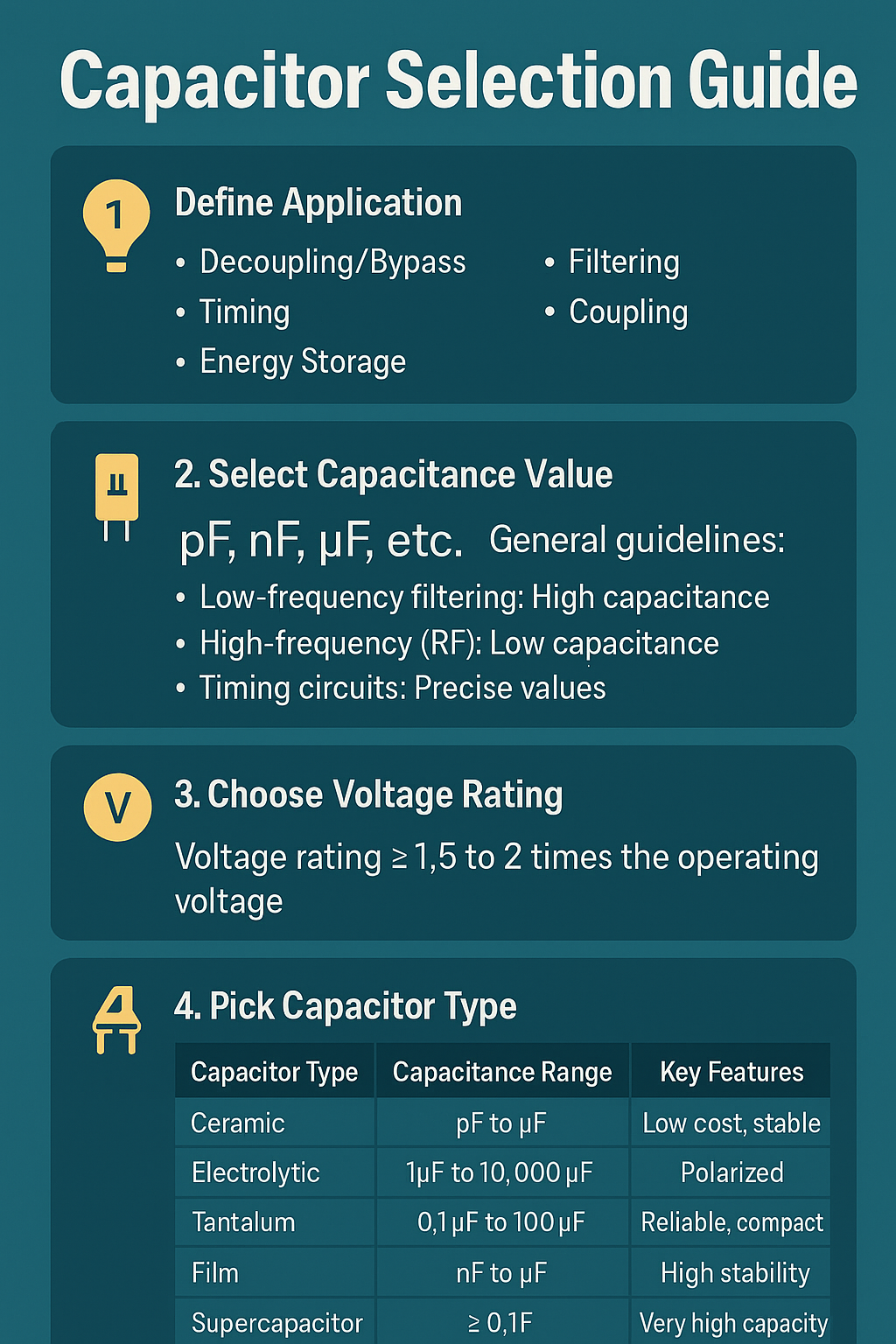
1. Define the Application Purpose
Start by identifying what the capacitor needs to do in the circuit. Common purposes include:
- Decoupling/Bypass: Smooths out voltage fluctuations
- Filtering: Removes AC signals from DC power
- Timing: Works with resistors to set time constants (RC circuits)
- Coupling: Transfers signals between stages while blocking DC
- Energy Storage: Holds charge for power delivery when needed
Each function may call for different types and specifications of capacitors.
2. Select the Appropriate Capacitance Value
Capacitance is measured in Farads (F), though most applications use microfarads (μF), nanofarads (nF), or picofarads (pF).
General guidelines:
- Low-frequency filtering: Use high-capacitance (e.g., 10μF–1000μF)
- High-frequency applications (RF): Use low-capacitance (e.g., 1pF–100nF)
- Timing circuits: Typically require precise values (e.g., 1nF–1μF)
- Coupling/decoupling: Range between 10nF and 1μF
Always verify the value based on circuit requirements or simulation results.
3. Choose a Suitable Voltage Rating
The voltage rating (WV or VDC) tells you the maximum voltage the capacitor can handle safely. Rule of thumb:
Choose a voltage rating at least 1.5 to 2 times higher than the expected operating voltage.
For example, in a 12V power supply circuit, choose a capacitor rated at 25V or more. This ensures safety, longevity, and reduces the risk of dielectric breakdown.
4. Pick the Right Capacitor Type
Each type has unique strengths and weaknesses. Here are the most common:
| Capacitor Type | Capacitance Range | Advantages | Common Applications |
|---|---|---|---|
| Ceramic | pF to μF | Low cost, small size, stable | Decoupling, bypass, RF |
| Electrolytic | 1μF to 10000μF | High capacitance, polarized | Power supply filtering |
| Tantalum | 0.1μF to 100μF | Stable, reliable, compact | Space-constrained digital circuits |
| Film | nF to μF | High stability, non-polarized | Audio, timing, precision filtering |
| Supercapacitor | 0.1F to 5000F | Very high capacity | Energy storage, backup power |
| Mica | pF range | Very stable, accurate | RF circuits, high-frequency apps |
5. Consider the Tolerance
Tolerance indicates how much the actual capacitance can vary from its stated value, e.g., ±5%, ±10%, etc. For critical timing or resonance applications, tighter tolerances (±1% or ±5%) are ideal.
6. Evaluate ESR and ESL Ratings
- ESR (Equivalent Series Resistance): Lower ESR means better performance in high-frequency or high-current applications.
- ESL (Equivalent Series Inductance): Affects how the capacitor behaves at high frequencies. Ceramic capacitors generally have low ESL.
In power electronics, choosing low-ESR capacitors helps reduce ripple and improve efficiency.
7. Capacitor Selection Guide about Size and Mounting Type
- Through-hole capacitors are easier to handle for prototyping.
- Surface-mount (SMD) capacitors are suitable for compact PCBs and automated assembly.
Also consider the physical size and footprint based on your PCB layout and available space.
8. Operating Temperature and Stability
Check the operating temperature range, especially for industrial or automotive environments. Standard ratings are from -40°C to +85°C, while some capacitors support up to +125°C or more.
Look for temperature-stable dielectrics such as C0G (NP0) for consistent performance in critical applications.
9. Lifespan and Reliability
Electrolytic capacitors degrade over time, especially with heat and ripple current. For long-life applications, select capacitors rated for:
- High-temperature endurance
- Long operational hours (e.g., 2000h–10000h at 105°C)
- Quality brands with proven reliability
💡 Pro Tips for Capacitor Selection Guide
- Use multiple capacitors in parallel (e.g., a 10μF + 100nF + 1nF) to cover a wider frequency range in decoupling applications.
- Always check datasheets for detailed specifications, especially for ESR, ripple current, and leakage.
- In audio applications, avoid electrolytic capacitors in signal paths—use film or tantalum for better fidelity.
- For switching regulators, prioritize low-ESR ceramic capacitors to reduce noise and improve stability.
🔎 Tools to Aid Selection
Several online tools can help with capacitor selection:
- Capacitor value calculators
- SPICE simulations
- Datasheet comparison platforms
- Manufacturer selection guides (e.g., from Murata, Kemet, Panasonic)
These tools help you model behavior before placing a component on your board.
🛒 Where to Buy Capacitors
Purchase from reputable electronics distributors to ensure quality and authenticity:
- Digi-Key
- Mouser
- RS Components
- Arrow Electronics
- Element14/Farnell
Look for RoHS compliance, proper packaging (especially for SMD), and complete datasheets.
✅ Summary: Key Checklist for Capacitor Selection Guide
- Define your circuit application.
- Determine the required capacitance value.
- Choose a voltage rating above your operating voltage.
- Select a capacitor type suited for your needs.
- Ensure tolerance is within acceptable limits.
- Verify ESR, ESL, and ripple current specs.
- Match the physical size and mounting style.
- Consider temperature range and reliability.
🧾 Final Thoughts about Capacitor Selection Guide
Selecting the right capacitor is more than just choosing a value off a chart. It’s a strategic decision that affects performance, efficiency, and longevity. Whether you’re building a simple LED flasher or designing a power supply for a high-end processor, this guide empowers you to make the right capacitor choices every time.
Published by Abi Royen
Your trusted source for electronics knowledge.