
Measuring wind has been a crucial part of human civilization for centuries. From ancient sailors who relied on the direction and strength of the wind to navigate, to modern meteorologists and engineers who depend on precise wind data, the need to measure wind speed and direction has shaped scientific instruments over time. Among the most important of these instruments is the anemometer.
This article will provide a comprehensive explanation of what an anemometer is, how it works, its history, the various types available, and its modern applications across multiple industries.
What is an Anemometer?
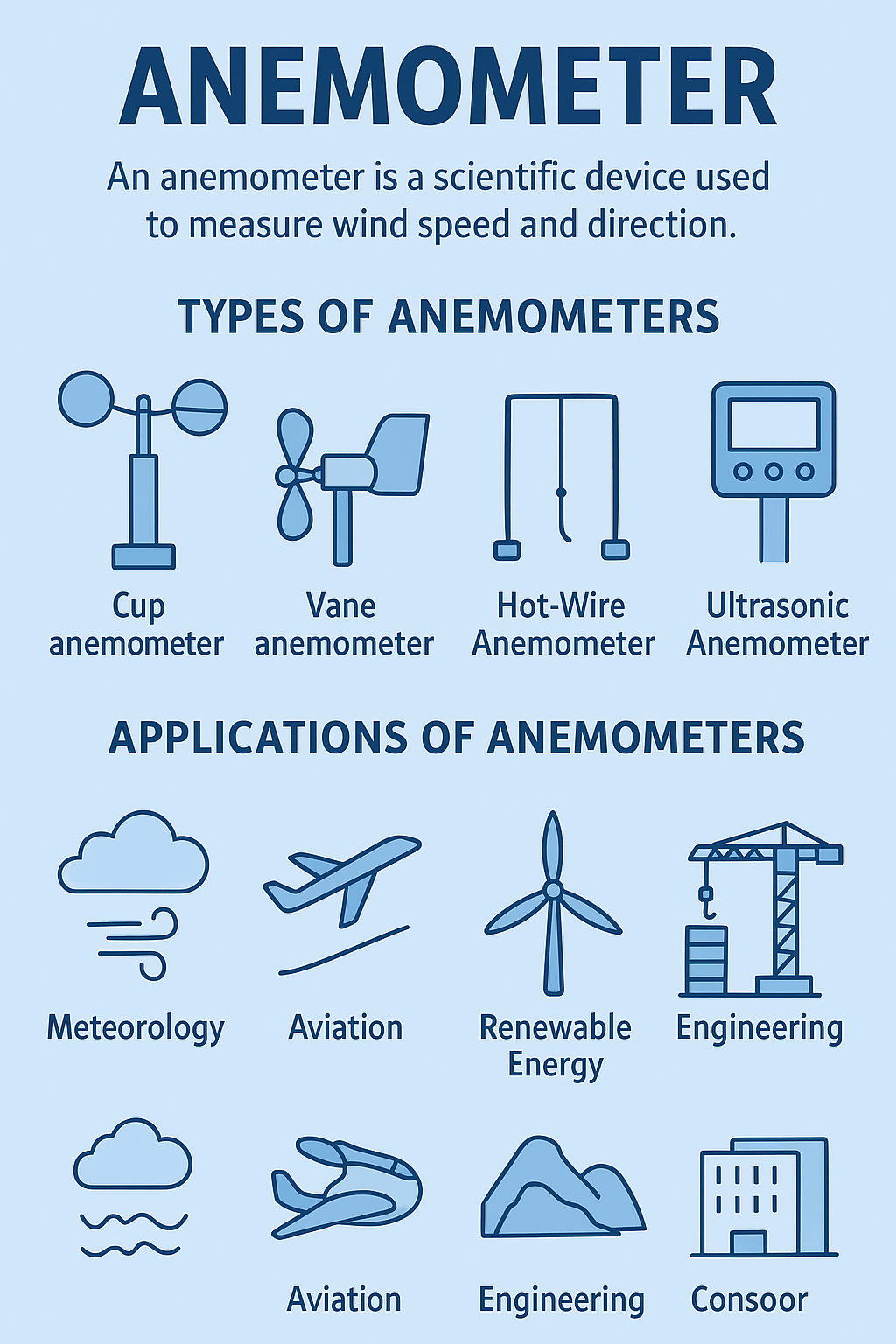
An anemometer is a scientific device used to measure wind speed, wind pressure, and sometimes wind direction. It is a fundamental instrument in meteorology, aerodynamics, and environmental science.
The word anemometer comes from the Greek word anemos, which means “wind.” While the primary function is to measure wind velocity, modern anemometers are highly advanced and often include sensors for temperature, humidity, and even barometric pressure, making them multi-functional devices.
A Brief History of the Anemometer
The invention of the anemometer dates back to the 15th century. The earliest known design was created by Leon Battista Alberti in 1450, who introduced a mechanical device with a plate that moved in response to the wind.
Later, in the 19th century, John Thomas Romney Robinson, an Irish astronomer, developed the cup anemometer, which became one of the most widely used designs. This device featured four hemispherical cups that rotated in proportion to the wind speed.
Over time, technological advancements gave rise to new variations such as hot-wire anemometers in the 20th century and modern digital and ultrasonic anemometers that provide highly accurate readings for scientific and industrial applications.
How Does an Anemometer Work?
The working principle of an anemometer depends on its type, but in general, it measures the force or velocity of wind and converts this data into readable values.
- Mechanical Anemometers: Use rotating cups, vanes, or propellers. The rotation speed correlates with wind velocity.
- Thermal Anemometers: Use a heated wire that cools at a rate proportional to wind speed.
- Ultrasonic Anemometers: Measure wind by analyzing sound waves between transducers.
- Laser Doppler Anemometers: Use light scattering principles to detect air particle movements.
Types of Anemometers
Anemometers come in different designs, each with specific uses. The most common types include:
1. Cup Anemometer
- Invented by Robinson, it uses rotating cups to measure wind speed.
- Simple, durable, and widely used in meteorology.
2. Vane Anemometer
- Features a propeller and a tail vane that aligns with the wind direction.
- Suitable for measuring both wind speed and direction.
3. Hot-Wire Anemometer
- Uses a heated wire that cools down as air passes over it.
- Extremely sensitive and ideal for measuring low-speed airflow in laboratories.
4. Ultrasonic Anemometer
- Employs ultrasonic sound waves to detect wind velocity.
- Provides fast and precise data without moving parts, making it durable.
5. Laser Doppler Anemometer
- Uses laser beams to measure wind by detecting particle movement in the air.
- Highly accurate, often used in research and aerodynamics testing.
6. Digital Anemometers
- Portable, handheld devices with electronic displays.
- Commonly used in fieldwork, HVAC systems, and sports.
Functions of an Anemometer
The primary function of an anemometer is to measure wind speed, but its role extends beyond that:
- Wind Speed Measurement – Provides accurate readings in meters per second (m/s), kilometers per hour (km/h), or knots.
- Wind Direction Detection – Especially in vane and ultrasonic types.
- Airflow Analysis – Used in HVAC systems and industrial ventilation.
- Weather Monitoring – Essential for meteorological forecasting.
- Environmental Studies – Helps analyze wind patterns and climate behavior.
Applications of Anemometers
Anemometers are not limited to meteorology. They are widely used across industries:
1. Meteorology and Weather Forecasting
Meteorologists use anemometers to collect wind data that helps predict storms, hurricanes, and general weather conditions.
2. Aviation
Airports rely on anemometers to provide pilots with accurate wind speed and direction for safe takeoffs and landings.
3. Marine and Navigation
Ships and yachts use anemometers for navigation to determine wind strength at sea.
4. Renewable Energy
Wind farms depend on anemometers to analyze wind patterns and optimize turbine placement.
5. Construction and Engineering
High-rise buildings, bridges, and large structures require wind monitoring for safety and stability.
6. Sports and Outdoor Activities
Paragliding, sailing, and drone flying enthusiasts use handheld anemometers to ensure safe wind conditions.
7. HVAC Systems
Engineers use anemometers to measure airflow in heating, ventilation, and air conditioning systems.
Advantages of Anemometers
- Provide accurate wind measurement.
- Available in portable, handheld models.
- Advanced models offer multi-sensor capabilities.
- Useful across diverse industries.
Limitations of Anemometers
- Mechanical types may wear out over time.
- Hot-wire types are fragile and sensitive to dirt.
- Ultrasonic and laser types can be expensive.
- Accuracy may be influenced by environmental conditions.
Modern Innovations in Anemometers
With the rise of digital technology and IoT (Internet of Things), modern anemometers now come with advanced features such as:
- Wireless connectivity with smartphones and computers.
- Integration with weather stations and data loggers.
- Solar-powered operation for sustainability.
- AI-driven predictive analytics in renewable energy applications.
Conclusion
The anemometer, from its simple mechanical origins to its modern digital advancements, remains an essential instrument in science, engineering, and everyday applications. Its role in weather forecasting, aviation safety, renewable energy, and even sports highlights its versatility and importance.
As technology continues to evolve, we can expect even more accurate, durable, and connected versions of anemometers, helping us better understand and harness the power of wind.