Importance of Navigational Equipment ~ Navigational equipment has played a crucial role in human exploration and transportation for centuries. From the early use of the magnetic compass to today’s sophisticated GPS (Global Positioning System) and satellite navigation systems, these tools are essential for ensuring safety, efficiency, and accuracy in travel. In today’s interconnected world, where transportation systems are more advanced than ever, navigational equipment has become indispensable.
This article explores the importance of navigational equipment, its types, applications in various industries, and its role in ensuring safety and efficiency.
1. Understanding Navigational Equipment
Navigational equipment refers to the tools, instruments, and systems used to determine position, direction, and route during travel. They help operators and pilots make informed decisions while minimizing risks. Some common types include:
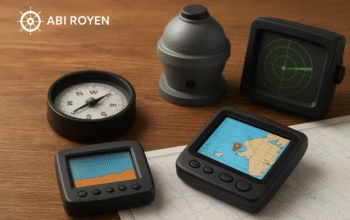
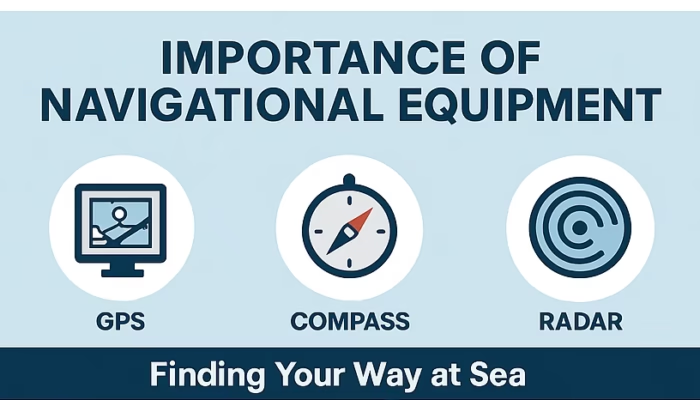
- Magnetic Compass – one of the oldest navigational tools, used to determine direction.
- Radar Systems – detect objects and obstacles, especially in marine and aviation navigation.
- Global Positioning System (GPS) – provides precise real-time location data.
- Gyrocompass – used in ships and aircraft for accurate heading information.
- Electronic Chart Display and Information System (ECDIS) – replaces traditional nautical charts with digital versions.
- Autopilot Systems – assist in controlling aircraft or ships automatically, reducing human workload.
2. Importance of Navigational Equipment
a. Ensuring Safety
Safety is the foremost reason navigational equipment is essential. Pilots, captains, and drivers rely on navigation tools to avoid collisions, navigate through adverse weather, and follow safe routes. For example:
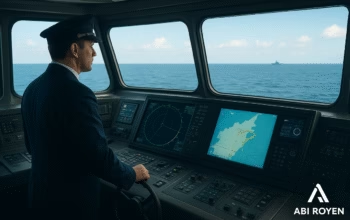
- Ships use radar and GPS to avoid icebergs or other vessels.
- Aircraft rely on navigation systems to ensure safe landing and takeoff.
b. Improving Efficiency
Modern navigation systems calculate the shortest and safest routes, saving time, fuel, and costs. In logistics and shipping industries, this efficiency translates into faster deliveries and reduced environmental impact.
c. Supporting Global Trade and Travel
With globalization, reliable navigational equipment ensures the smooth functioning of international trade and transportation. Ships carrying goods across oceans depend on satellite-based systems for accuracy.
d. Reducing Human Error
Advanced autopilot and electronic navigation systems minimize the risk of human mistakes, which remain a major cause of accidents.
e. Military and Defense Applications
In military operations, navigation is critical for the accurate movement of troops, vehicles, ships, and aircraft. Modern defense strategies rely heavily on advanced navigation technologies.
3. Applications of Navigational Equipment
Aviation
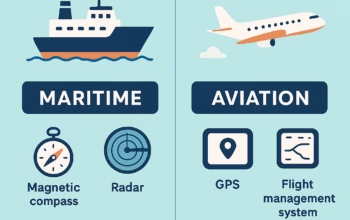
Aircraft use a combination of GPS, autopilot, radar, and flight management systems to ensure safe air travel. These tools help pilots maintain correct flight paths and avoid collisions.
Maritime
In shipping and fishing, navigational equipment such as ECDIS, radar, and sonar ensures vessels remain on course and avoid hazards like reefs or shallow waters.
Land Transportation
Navigation systems like GPS are widely used in cars, trucks, and trains to improve route planning and traffic management. Logistics companies rely on real-time tracking to optimize operations.
Space Exploration
Advanced navigation tools are crucial for spacecraft to travel accurately through space. These systems rely on deep-space networks and satellite communication.
4. Future of Navigational Equipment
The future of navigational equipment lies in AI integration, automation, and satellite advancements. Emerging technologies like autonomous ships and self-driving cars rely on precise navigation tools. With the development of 5G and improved satellite networks, the accuracy and reliability of navigation will reach new heights.
5. Conclusion of Importance of Navigational Equipment
Navigational equipment is the backbone of modern transportation systems. It ensures safety, reduces costs, supports global trade, and helps humanity explore beyond Earth. From ancient compasses to AI-powered navigation, these tools have evolved significantly, and their importance continues to grow with technological advancements.
For industries like aviation, maritime, and logistics, investing in modern navigation equipment is not just an option—it is a necessity for survival and competitiveness in a globalized world.