
In today’s fast-paced world, clear and reliable communication is essential. Whether at sea, in the air, or on land, many industries rely on VHF radios to stay connected. But what VHF radio? This article explores the basics of VHF radios, including how they work, where they are used, their benefits, and why they remain relevant in modern communication systems.
1. What VHF Radio: Definition and Frequency Range
VHF stands for Very High Frequency, which refers to a specific range of radio frequencies between 30 MHz and 300 MHz. VHF radios operate within this range, and are commonly used for short- to medium-range communication.
In most applications, VHF radios transmit and receive signals between 136 MHz to 174 MHz. This range allows for voice communication over line-of-sight distances, which is especially useful in open areas such as oceans, lakes, and rural landscapes.
2. Key Components of a VHF Radio
A standard VHF radio system consists of:
- Transmitter: Sends out radio signals.
- Receiver: Picks up incoming signals.
- Antenna: Facilitates signal transmission and reception.
- Microphone/Speaker: Allows users to speak and hear messages.
- Display/Interface: Shows frequency channels, volume, battery status, etc.
3. Types of VHF Radios
There are two main types of VHF radios based on their usage:
a. Handheld VHF Radios
- Portable and lightweight
- Powered by batteries
- Used in personal or recreational settings (e.g., kayaking, hiking, small boats)
b. Fixed-Mount VHF Radios
- Installed in vehicles, boats, or aircraft
- Provide higher power (typically up to 25 watts)
- Offer longer communication range
Some VHF radios also support Digital Selective Calling (DSC), which allows users to send automatic distress signals and private messages digitally.
4. Applications of VHF Radios
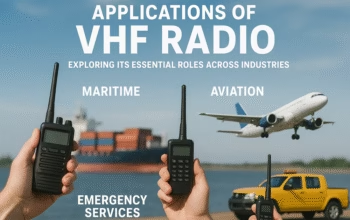
VHF radios are widely used across various industries:
a. Marine Communication
- Ships and boats use VHF marine radios to communicate with other vessels, harbors, and coastguards.
- Channel 16 (156.8 MHz) is the international distress, safety, and calling frequency.
b. Aviation Communication
- Aircraft use VHF radios for air-to-ground communication with control towers and other aircraft within visual range.
c. Emergency Services
- Fire departments, police, and search and rescue teams use VHF radios for dependable communication in remote or disaster-prone areas.
d. Commercial and Industrial Use
- Construction crews, utility companies, and security teams use VHF radios for real-time coordination on job sites.
5. How VHF Radios Work
VHF radios operate on a line-of-sight principle, meaning they work best when there are no obstacles between the transmitter and receiver. This makes them highly effective in flat or open terrains, like oceans or plains.
Because of this limitation, VHF signals can be blocked or weakened by hills, buildings, or thick forests. For extended coverage, repeaters or satellite-based systems are often used.

6. VHF vs UHF: What’s the Difference?
While both VHF (30–300 MHz) and UHF (Ultra High Frequency, 300 MHz–3 GHz) radios are used for two-way communication, they have distinct differences:
| Feature | VHF Radio | UHF Radio |
|---|---|---|
| Frequency Range | 30–300 MHz | 300 MHz–3 GHz |
| Range | Longer in open areas | Better indoors |
| Obstacle Penetration | Poor | Strong |
| Antenna Size | Larger | Smaller |
VHF radios are ideal for outdoor and maritime use, while UHF radios are preferred for indoor and urban environments.
7. Advantages of VHF Radios
- Longer Range in Open Areas: Ideal for rural or oceanic settings.
- Less Interference: VHF bands are generally less crowded.
- Lower Power Consumption: Great for battery-powered devices.
- Cost-Effective: Especially for basic communication needs.
8. Licensing and Legal Considerations
Depending on the country and usage, operating a VHF radio might require a license. For instance:
- In the United States, marine VHF radios used for recreational boating typically don’t require a license, but commercial use does.
- In Europe and Asia, regulations vary, and users should consult local authorities or telecommunication regulators.
Using DSC-equipped radios often requires a Maritime Mobile Service Identity (MMSI) number.
9. What VHF Radio: Choosing the Right VHF Radio
When selecting a VHF radio, consider the following:
- Range and Power Output: Higher wattage for extended range.
- Battery Life: Crucial for handheld devices.
- Waterproof Rating: Essential for marine use.
- GPS Integration: For location-based distress calls.
- Ease of Use: User-friendly interfaces are important, especially in emergencies.
Popular VHF radio brands include ICOM, Uniden, Standard Horizon, and Cobra.
10. What VHF Radio: Future of VHF Radios
Despite the rise of cellular and satellite technologies, VHF radios remain indispensable due to:
- Reliability during natural disasters
- Independence from cellular infrastructure
- Instant communication and broadcast capability
As new digital enhancements are integrated, such as AIS (Automatic Identification System) and Bluetooth connectivity, VHF radios continue to evolve to meet modern communication needs.
Conclusion of What VHF Radio
A VHF radio is more than just a communication device — it’s a vital lifeline for marine navigators, pilots, emergency responders, and outdoor enthusiasts. Its simplicity, durability, and effectiveness in line-of-sight communication ensure that it remains a trusted tool in critical situations.
Whether you’re planning a boating adventure or setting up a communication system for your team, understanding how VHF radios work and where they excel is essential.
Published on Abi Royen | Electronics & Communication