Introduction of Revolutionary Self-Governing Windmill
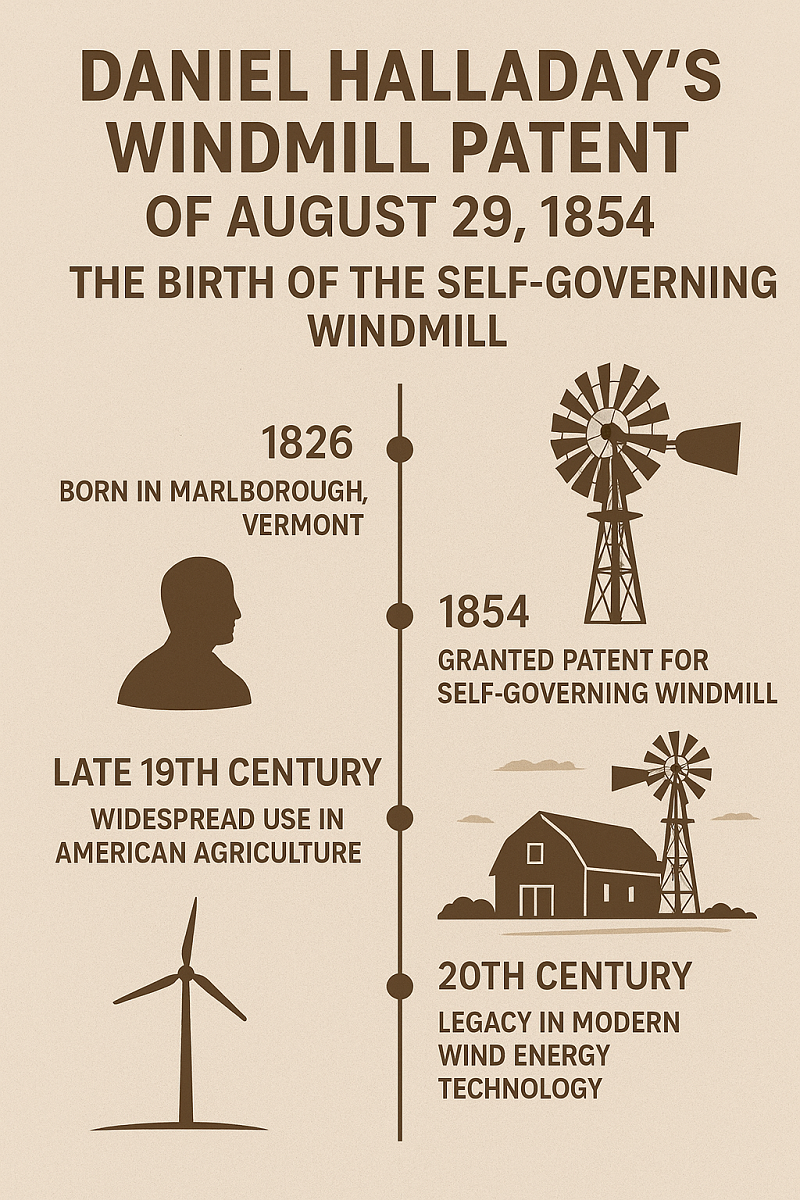
Revolutionary Self-Governing Windmill ~ On August 29, 1854, Daniel Halladay, a Vermont-born mechanic and inventor, secured a U.S. patent for a groundbreaking device: the self-governing windmill. At a time when the American frontier was rapidly expanding, settlers, farmers, and ranchers needed reliable ways to pump water for agriculture, livestock, and household use. Halladay’s invention revolutionized rural life, providing an automatic, low-maintenance, and efficient wind-powered water pump. This marked one of the earliest milestones in the history of renewable energy technology.
This article explores the origins of Halladay’s windmill, the technology behind it, its role in shaping American agriculture, and its enduring legacy in engineering and renewable energy.
The Historical Context of Mid-19th Century America
The mid-1800s was a period of expansion, innovation, and transformation in the United States. Several key historical developments framed the need for a reliable windmill technology:
- Westward Expansion: With the signing of laws like the Homestead Act (1862) and the growth of railroads, thousands of settlers moved westward into areas where water was scarce.
- Agricultural Development: Farms and ranches required steady access to groundwater for livestock and irrigation. Traditional manual pumps were too labor-intensive.
- Industrial and Engineering Advancements: The mid-19th century was an age of invention, with patents being filed for mechanical devices that could ease human labor.
Halladay’s windmill came at the perfect moment, offering a self-regulating solution for pumping water in remote and dry regions.
Daniel Halladay: The Inventor
Daniel Halladay (1826–1916) was a mechanic, engineer, and inventor born in Marlborough, Vermont. He moved to Connecticut, where he began working on mechanical devices that could be useful to farmers.
By 1854, Halladay, along with his business partner John Burnham, patented the self-regulating windmill, which would soon become a staple across the American Midwest and beyond.
The Technology Behind the Self-Governing Windmill
Before Halladay’s innovation, traditional windmills required constant manual adjustment to face the wind properly. These earlier models were inefficient, fragile, and not suitable for the unpredictable weather of the American plains.
Halladay’s design introduced self-governing mechanisms that made the windmill practical for long-term use:
- Automatic Tail Vane – The windmill could automatically adjust its position to face the wind without human intervention.
- Regulating Mechanism – The blades would shift or furl slightly in high winds to prevent damage, ensuring durability.
- Water Pumping Integration – The windmill connected to a reciprocating pump, drawing water efficiently from underground wells.
This combination allowed settlers to set up windmills that could work continuously, with minimal maintenance.
Impact on American Agriculture and Settlement
Halladay’s windmill transformed the agricultural landscape of America:
- Water Supply for Livestock: Ranchers across the Great Plains relied on windmills to water cattle in otherwise arid regions.
- Farming Expansion: Crops could be irrigated in places where rainfall was unreliable, increasing agricultural productivity.
- Rural Development: Families and small communities could settle in remote areas without worrying about constant manual water pumping.
- Economic Growth: By reducing labor and providing reliable access to water, windmills allowed farms to grow larger and more efficient.
By the late 19th century, Halladay’s invention had spread beyond the U.S., with windmills appearing in Australia, South America, and Africa, powering farms and ranches worldwide.
The Halladay Standard Windmill
One of the most famous models was the Halladay Standard Windmill, produced by the Halladay Windmill Company (later the U.S. Wind Engine & Pump Company).
Key features included:
- Wooden blades with iron framework.
- A vane that automatically oriented the wheel into the wind.
- Simple construction that allowed easy repair and long-term use.
This model became the prototype for thousands of windmills across the world, many of which remained in use well into the 20th century.
Legacy and Modern Relevance
Although Halladay’s windmill was primarily designed for water pumping, its principles laid the foundation for modern wind energy technology. Today’s massive wind turbines that generate electricity still rely on the same basic concept: harnessing the wind’s kinetic energy and converting it into useful work.
Key legacies include:
- Renewable Energy Inspiration – Halladay’s design is seen as an early chapter in the global pursuit of renewable energy.
- Rural Heritage Symbol – The image of a windmill remains a nostalgic symbol of American farming.
- Durability – Some original Halladay windmills are preserved in museums and heritage sites as examples of 19th-century engineering brilliance.
Conclusion of Revolutionary Self-Governing Windmill
Daniel Halladay’s windmill patent of August 29, 1854, represents one of the most important engineering breakthroughs of the 19th century. By inventing a self-governing windmill, Halladay provided a sustainable and efficient solution for water pumping, transforming agriculture, settlement, and rural life.
His innovation not only shaped American history but also paved the way for modern wind power, reminding us that the roots of renewable energy stretch back more than a century and a half.
As we look toward the future of sustainable energy, Halladay’s invention continues to stand as a testament to human ingenuity and the enduring power of the wind.