The Milky Way, our home galaxy, is a vast collection of stars, planets, dust, and cosmic mysteries. At its very center lies one of the most enigmatic and powerful objects in the universe — a supermassive Black hole Milky Way known as Sagittarius A*. Scientists have long studied this phenomenon to understand how it influences the galaxy, how it formed, and what it means for the future of cosmic exploration.
In this article, we will explore the nature of Sagittarius A*, how it was discovered, its role in the Milky Way, and what scientists continue to learn about it.
What Is a Black Hole?
A black hole is a region in space where gravity is so strong that nothing, not even light, can escape its pull. They form when massive stars collapse under their own gravity at the end of their life cycles. Black holes come in different sizes:
- Stellar-mass black holes: Formed from collapsing stars, usually a few times the mass of our Sun.
- Intermediate-mass black holes: Hundreds to thousands of times the Sun’s mass.
- Supermassive black holes: Millions to billions of times more massive than the Sun, usually located at the center of galaxies.
Sagittarius A* falls into the last category.
Sagittarius A*: The Supermassive Black hole Milky Way
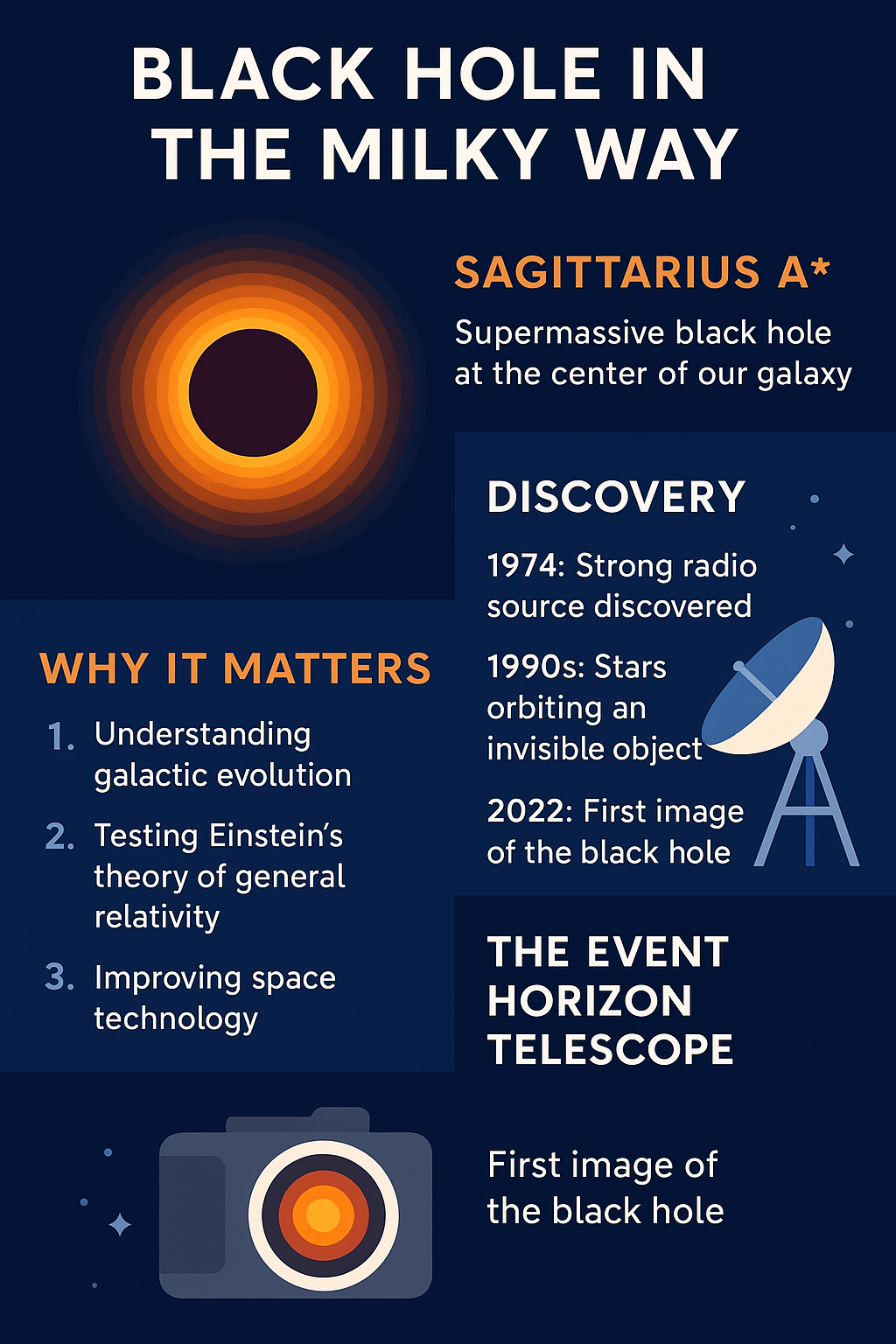
Sagittarius A* (pronounced “Sagittarius A-star”) is the supermassive black hole located at the center of the Milky Way galaxy, about 26,000 light-years from Earth in the constellation Sagittarius.
It has an estimated mass of about 4 million Suns. Despite its enormous mass, Sagittarius A* is relatively small in size, with a radius of around 14 million miles (23 million kilometers) — about the size of Mercury’s orbit around the Sun.
The Discovery of Sagittarius A*
The idea that a black hole might exist at the center of our galaxy emerged in the 1960s and 1970s, when radio astronomers detected unusual radio emissions from the Sagittarius constellation. This mysterious source was later identified as Sagittarius A*.
Key milestones in its discovery include:
- 1974: Bruce Balick and Robert Brown discovered a strong radio source in the center of the Milky Way.
- 1990s: Advanced telescopes tracked stars orbiting around an invisible object, confirming the presence of a supermassive black hole.
- 2022: The Event Horizon Telescope (EHT) collaboration released the first-ever image of Sagittarius A*, providing direct visual evidence of the black hole’s shadow.
Why Sagittarius A* Matters
Studying Sagittarius A* is essential for several reasons:
- Understanding Galactic Evolution
Supermassive black holes play a critical role in shaping galaxies. By studying Sagittarius A*, astronomers learn how such black holes influence star formation, galactic structure, and the distribution of matter. - Testing Einstein’s Theories
Observing the motion of stars near Sagittarius A* provides a real-world laboratory for testing Einstein’s theory of general relativity, especially under extreme gravitational conditions. - Improving Space Technology
Researching Sagittarius A* has led to innovations in telescope design, imaging techniques, and data processing, which benefit broader fields of science and technology.
The Behavior of Sagittarius A*
Unlike some active galactic nuclei that emit enormous amounts of radiation, Sagittarius A* is considered a quiet black hole. It does not consume large amounts of matter compared to black holes in other galaxies.
However, it occasionally emits powerful flares of X-rays and infrared radiation when surrounding gas and dust fall into it. These flares allow scientists to study how black holes interact with their environment.
The Stars Dancing Around the Black Hole
Astronomers have tracked stars orbiting Sagittarius A* for decades. The most famous of these stars is S2, which orbits the black hole every 16 years. By observing S2’s orbit, scientists were able to measure the mass of Sagittarius A* with incredible accuracy.
These stellar orbits provide crucial evidence for the existence of a supermassive black hole and confirm predictions made by Einstein’s general relativity.
Challenges in Studying Sagittarius A*
Studying Sagittarius A* is no easy task. The black hole is surrounded by thick clouds of gas and dust, making it difficult to observe with optical telescopes. Astronomers rely on radio, infrared, and X-ray telescopes to penetrate the cosmic fog and capture meaningful data.
Additionally, Sagittarius A* changes rapidly compared to larger black holes in other galaxies, requiring precise instruments to capture fleeting events.
The Event Horizon Telescope Breakthrough
In 2019, the Event Horizon Telescope (EHT) produced the first image of a black hole (M87* in the Virgo galaxy). Building on this success, in 2022, the EHT released the first image of Sagittarius A*.
This groundbreaking achievement confirmed theories about black hole structure and showed the bright ring of glowing gas surrounding its event horizon. It was a monumental step in visualizing one of the universe’s most mysterious objects.
Impact on the Milky Way
While Sagittarius A* is incredibly massive, it does not pose a direct threat to Earth. At 26,000 light-years away, its gravitational influence on our solar system is negligible.
However, its presence is crucial for the stability and dynamics of the Milky Way. Scientists believe the galaxy’s spiral arms, star formation, and central bulge are all influenced by the supermassive black hole’s gravitational power.
Future Research and Discoveries
As technology improves, astronomers aim to answer several key questions about Sagittarius A*:
- How did it form?
- Why is it relatively quiet compared to other supermassive black holes?
- How does it interact with nearby stars, gas, and dark matter?
- Could future missions one day explore the environment around it more closely?
With upcoming observatories such as the James Webb Space Telescope (JWST) and next-generation radio telescopes, scientists expect to gain deeper insights into Sagittarius A* and the fundamental nature of black holes.
Conclusion of Black hole Milky Way
The black hole Milky Way, Sagittarius A*, represents one of the greatest mysteries of modern astronomy. From its discovery to the first captured image, this cosmic giant continues to challenge our understanding of space, gravity, and the very structure of our galaxy.
As scientists push the boundaries of technology and theory, Sagittarius A* will remain a central figure in unlocking the secrets of the universe.