
Introduction of First Motorcycle Patent 1885 Gottlieb Daimler’s
First Motorcycle Patent 1885 Gottlieb Daimler’s ~ On August 29, 1885, history was made when Gottlieb Daimler, a German engineer and pioneer of internal combustion engines, patented the world’s first motorcycle. Known as the Reitwagen (riding car), this invention was not only the first motorcycle but also one of the earliest applications of the gasoline-powered engine for personal transportation. The patent symbolized the beginning of a new era in mobility, influencing not just motorcycles but also the development of automobiles and the broader transportation industry.
This article explores the origins, design, and legacy of Daimler’s invention while highlighting how his work continues to impact transportation more than a century later.
The World Before the Motorcycle
Before 1885, personal transportation was limited to bicycles, horse-drawn carriages, and early steam-powered vehicles. While bicycles were popular, they required significant human effort. Steam engines, though powerful, were large, inefficient, and impractical for individual transport.
Inventors across Europe were experimenting with ways to harness new energy sources for mobility. The introduction of internal combustion engines created a new possibility: lightweight, efficient, and independent vehicles. It was within this context that Daimler developed the world’s first motorcycle.
Gottlieb Daimler and the Birth of the Motorcycle
Gottlieb Daimler (1834–1900) was a German engineer who worked alongside Wilhelm Maybach. Both were instrumental in refining the high-speed internal combustion engine. Daimler’s vision was to create a small, reliable engine that could power different kinds of vehicles.
On August 29, 1885, Daimler patented the “Reitwagen”, literally translated as “riding wagon.” This invention was revolutionary because:
- It used a single-cylinder, four-stroke internal combustion engine powered by gasoline.
- It was lightweight and compact compared to steam engines.
- It proved that a combustion engine could be used for two-wheeled personal transport.
This patent marked the motorcycle’s official birthdate.
Design of the Reitwagen
The Reitwagen was a remarkable invention for its time, though it looked very different from modern motorcycles. Its design included:
- Wooden Frame and Wheels: Unlike modern steel designs, the Reitwagen was built using wood, resembling a bicycle with an engine.
- Internal Combustion Engine: A 264cc, single-cylinder engine producing about 0.5 horsepower at 600 rpm.
- Top Speed: The machine could reach around 11 km/h (7 mph).
- Stabilizing Wheels: Because of balance issues, small outrigger wheels were attached on both sides, giving it a resemblance to a children’s bicycle with training wheels.
Although primitive, this prototype laid the foundation for modern motorcycle engineering.
The Impact of the First Motorcycle Patent
The Reitwagen may not have been practical for everyday use, but its patent changed the course of transportation history. Here’s why:
- Proof of Concept – It showed that a compact, gasoline-powered engine could effectively power a two-wheeled vehicle.
- Inspiration for Automobiles – Daimler’s engine designs were later adapted to power early cars, eventually leading to the modern automobile industry.
- Motorcycle Industry – The invention inspired future engineers and companies, paving the way for iconic motorcycle manufacturers such as Harley-Davidson, BMW, and Honda.
- Global Mobility Revolution – From personal freedom to commercial applications, motorcycles became a symbol of affordable and efficient mobility.
Daimler’s Legacy Beyond Motorcycles
Gottlieb Daimler did not stop at motorcycles. He went on to establish the Daimler-Motoren-Gesellschaft (DMG), which later merged with Benz & Cie. to form the foundation of today’s Mercedes-Benz.
Thus, Daimler’s patent for the first motorcycle was not only a milestone in two-wheeled transportation but also a stepping stone toward the development of the modern automobile industry.
From Reitwagen to Modern Motorcycles
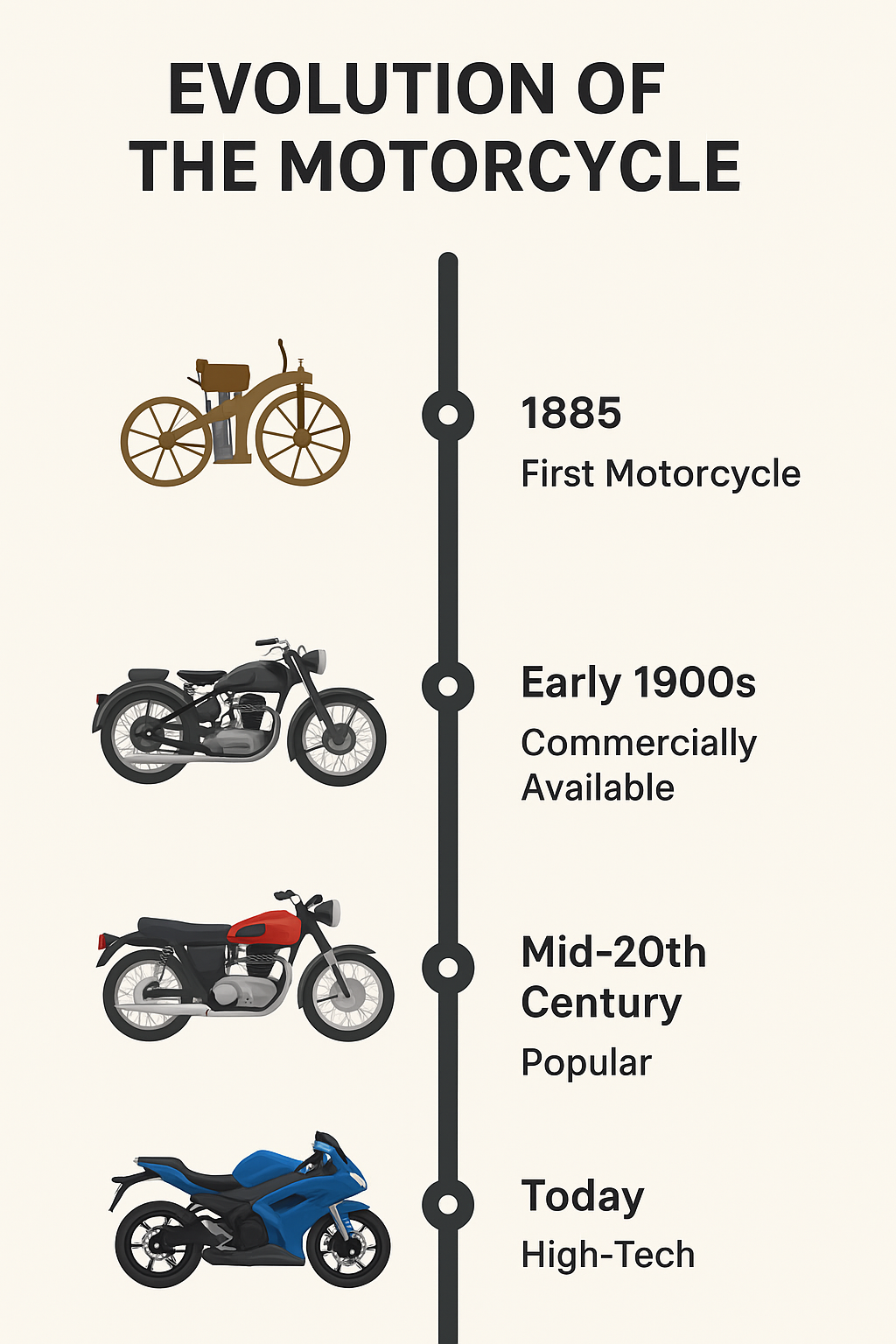
Since 1885, motorcycles have evolved dramatically:
- Early 1900s – Motorcycles became commercially available, with manufacturers like Indian Motorcycle (1901) and Harley-Davidson (1903) entering the market.
- Mid-20th Century – Advances in design, performance, and safety led to the widespread popularity of motorcycles as both transport and leisure machines.
- Today – Motorcycles range from economical commuter bikes to high-performance superbikes, featuring cutting-edge technologies such as electronic fuel injection, ABS braking systems, and even electric powertrains.
What started as a wooden prototype by Daimler has become a global industry worth billions, with motorcycles being used for daily commuting, sports, tourism, and adventure.
Interesting Facts About the First Motorcycle
- The Reitwagen was not mass-produced; it was more of an experimental prototype.
- It is often considered the grandfather of both motorcycles and automobiles, since it proved the potential of the gasoline engine.
- A replica of Daimler’s Reitwagen can be found in several museums, including the Mercedes-Benz Museum in Stuttgart, Germany.
- Daimler’s son, Paul Daimler, was the first person to ride the Reitwagen.
Conclusion of First Motorcycle Patent 1885 Gottlieb Daimler’s
The first motorcycle patent filed on August 29, 1885, by Gottlieb Daimler, was a defining moment in transportation history. While the Reitwagen itself was a simple wooden machine with limited performance, it introduced the world to the idea of motorized personal transport.
Daimler’s invention went beyond just motorcycles—it laid the groundwork for modern automobiles and forever changed the way humanity moves. From a small wooden prototype to today’s high-speed, high-tech motorcycles, the journey that began in 1885 continues to inspire innovation in engineering and design.
The motorcycle, once an experimental idea, is now a global icon of freedom, mobility, and technological progress.