Introduction of First Historic Pacific Flight
First Historic Pacific Flight ~ On August 29, 1929, the world witnessed a remarkable milestone in aviation history: the Graf Zeppelin (LZ 127) successfully completed the first nonstop flight across the Pacific Ocean. This extraordinary journey marked not only a technological triumph but also a significant step toward global air travel. The Zeppelin’s Pacific crossing demonstrated the potential of long-distance airship flights at a time when airplanes were still limited in range and reliability.
This article explores the details of the Graf Zeppelin’s Pacific flight, the challenges faced by its crew, and the enduring legacy of this remarkable event.
The Graf Zeppelin: A Giant of the Skies
The Graf Zeppelin, officially designated as LZ 127, was one of the largest and most advanced airships of its era. Built in Germany in 1928, it was named after Count Ferdinand von Zeppelin, the pioneer of rigid airships. The Graf Zeppelin measured 776 feet (236 meters) in length and was powered by five Maybach engines, enabling it to travel at an average speed of 70–80 mph (115–130 km/h).
Unlike airplanes of the late 1920s, which had limited endurance, the Zeppelin could carry passengers and cargo over thousands of miles, offering both comfort and long-range capability. It became a symbol of progress and modern engineering in intercontinental travel.
The Circumnavigation Flight of 1929
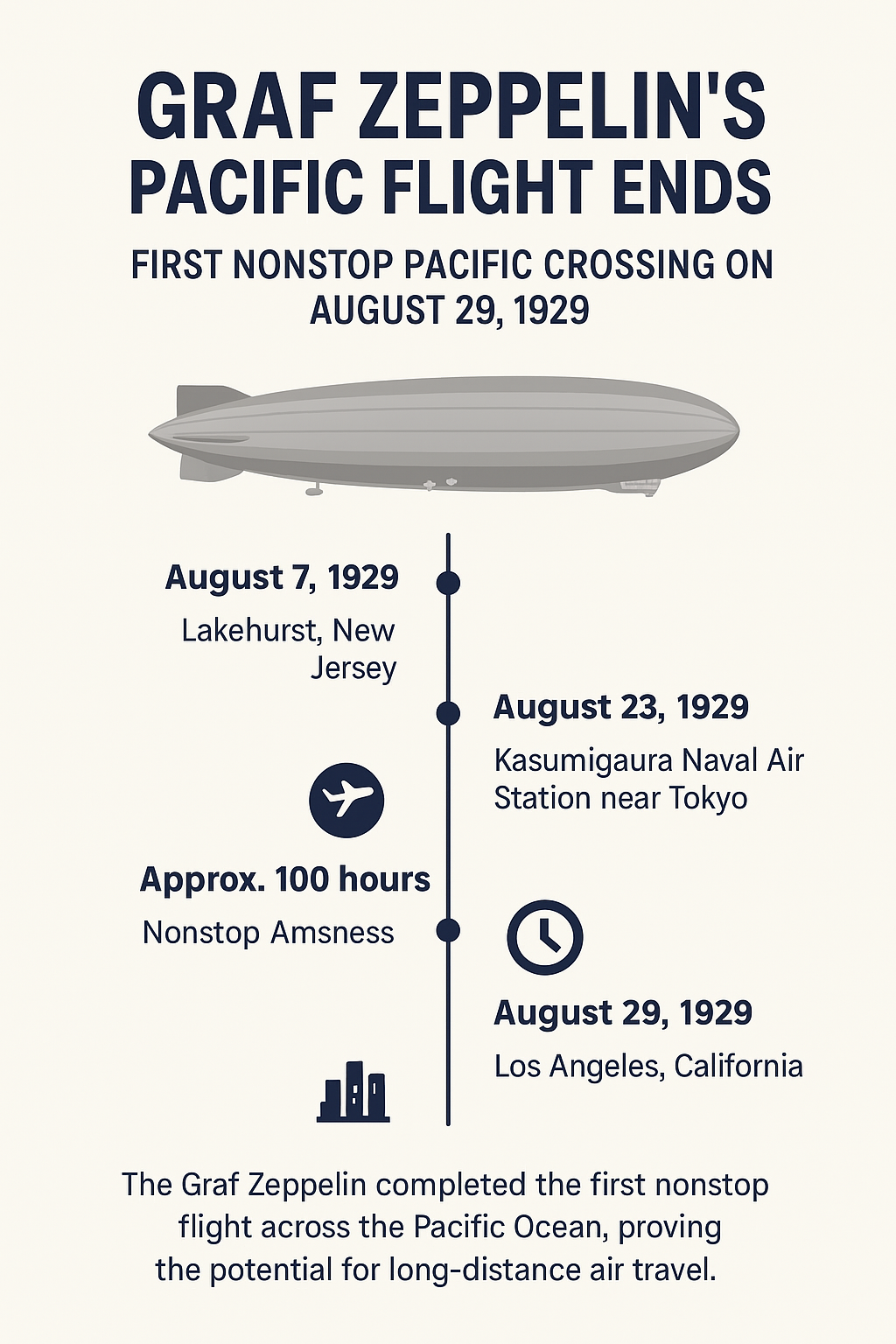
The Pacific flight was not an isolated event but part of the Graf Zeppelin’s round-the-world journey. Sponsored in part by American newspaper magnate William Randolph Hearst, the voyage began on August 7, 1929, departing from Lakehurst, New Jersey.
The planned route was ambitious:
- Lakehurst, New Jersey (USA) → Friedrichshafen (Germany) → Tokyo (Japan) → Los Angeles (USA) → back to Lakehurst.
The most challenging segment of this circumnavigation was the Tokyo to Los Angeles leg, which required flying nonstop across the vast Pacific Ocean.
The First Historic Pacific Flight (Tokyo to Los Angeles)
On August 23, 1929, the Graf Zeppelin departed from Kasumigaura Naval Air Station near Tokyo with a crew of 40 and 22 passengers on board. The Pacific crossing was estimated to take about 100 hours of continuous flight.
Challenges of the Journey
- Weather and Storms – The Pacific Ocean presented unpredictable weather conditions. The Zeppelin had to carefully navigate around storms to ensure safety.
- Navigation Accuracy – In an age before GPS, navigators relied on celestial navigation, compasses, and radio signals to stay on course. A single error could lead the airship off track.
- Fuel and Weight Management – The Zeppelin carried large amounts of fuel, and engineers had to carefully balance the airship’s buoyancy and stability throughout the journey.
Arrival in Los Angeles
After nearly 4 days (around 79 hours and 54 minutes) of continuous flight, the Graf Zeppelin arrived safely at Los Angeles, California, on August 29, 1929. Crowds gathered to witness the historic landing, and newspapers worldwide celebrated the success.
This achievement marked the first nonstop flight across the Pacific Ocean, proving that intercontinental air travel was possible and reliable.
Impact on Aviation History
The success of the Graf Zeppelin’s Pacific flight had far-reaching effects on aviation and global connectivity:
- Demonstrating Airship Potential
The flight proved that rigid airships could safely conduct long-distance flights across oceans, paving the way for transatlantic and transpacific passenger services. - Boosting International Prestige
Germany regained recognition as a leader in aviation technology through the Zeppelin program, while the round-the-world flight brought global attention to airship travel. - Media and Public Enthusiasm
Newspapers and radio broadcasts turned the Graf Zeppelin into an international sensation, sparking public fascination with airships and their luxurious travel experience. - Foundation for Future Aviation
Although airships were eventually overtaken by airplanes in speed and practicality, the Graf Zeppelin’s achievements inspired innovation in long-range aviation.
Passenger Experience on the Graf Zeppelin
Unlike cramped airplanes of the 1920s, the Graf Zeppelin offered a comfortable travel environment. Passengers enjoyed:
- Spacious cabins with bunks for sleeping
- A dining room with freshly prepared meals
- Observation windows to view the scenery below
- A quieter atmosphere compared to early airplanes
This made Zeppelin travel not only groundbreaking in terms of distance but also luxurious compared to the alternatives available at the time.
The Legacy of the First Historic Pacific Flight
The Pacific crossing of August 29, 1929 remains one of the greatest achievements in aviation history. While airships eventually declined after the 1937 Hindenburg disaster, the Graf Zeppelin’s voyages highlighted humanity’s determination to conquer distance and connect continents.
Today, the flight is remembered as a symbol of daring exploration, technological innovation, and the dream of global air travel.
Conclusion of First Historic Pacific Flight
The Graf Zeppelin’s nonstop Pacific flight, completed on August 29, 1929, was a turning point in aviation history. As the first airship to cross the Pacific without stopping, it showcased the possibilities of long-distance travel and captured the imagination of the world.
Although rigid airships eventually gave way to modern airplanes, the Graf Zeppelin’s historic journey stands as a remarkable example of human ambition, engineering excellence, and the relentless pursuit of progress.