
Introduction of Importance Ship’s Deck Equipment
Maritime transportation remains one of the most crucial elements in global trade and logistics. Every ship, regardless of its size or purpose, relies on specialized equipment to ensure safe navigation, efficient cargo handling, and reliable operation. Among these, Importance Ship’s Deck Equipment plays a vital role in the smooth functioning of maritime activities. From anchoring systems to cargo-handling gear, deck machinery ensures that vessels can operate safely in different conditions at sea and in port.
This article explores the importance of ship’s deck equipment, the various types used on modern vessels, and why proper maintenance is essential for efficiency and safety in maritime operations.
What is Ship’s Deck Equipment?
Ship’s deck equipment refers to the mechanical, hydraulic, and structural systems installed on a ship’s deck that support anchoring, mooring, cargo handling, and emergency functions. These components are designed to withstand harsh marine environments while ensuring the vessel’s stability, security, and operational performance.
Deck equipment is not just about convenience—it is an essential part of safety protocols and maritime law compliance. A malfunction in deck machinery can lead to accidents, cargo delays, or even catastrophic marine disasters.
Types of Ship’s Deck Equipment
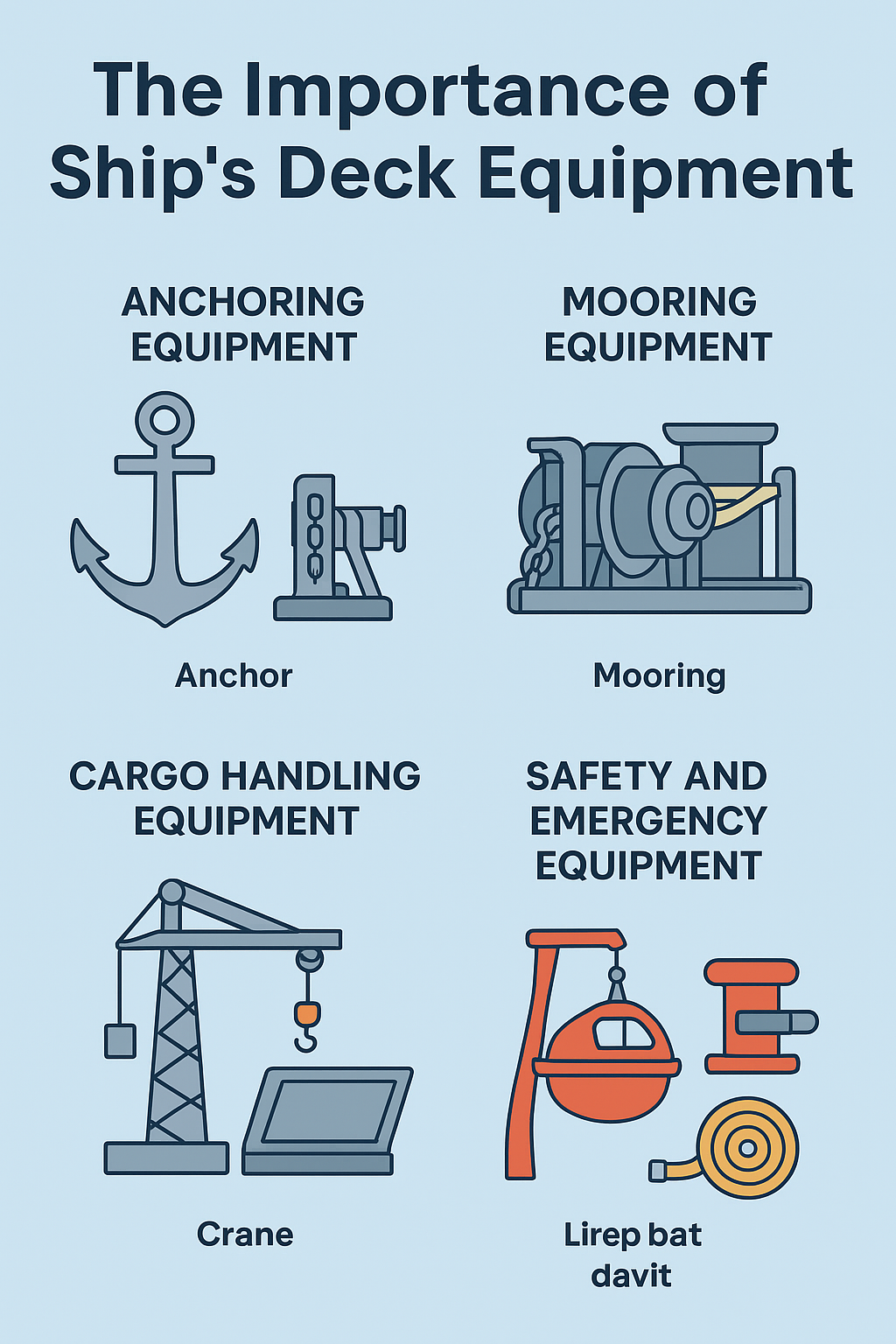
Different ships require different types of deck equipment depending on their purpose—whether they are cargo carriers, oil tankers, passenger liners, or naval vessels. Some of the most important ship’s deck equipment includes:
1. Anchoring Equipment
- Anchors and Anchor Chains – Used to secure the ship at a fixed position in shallow or deep waters.
- Windlass – A heavy-duty machine that raises or lowers anchors with the help of chains or cables.
Importance: Anchoring equipment ensures a ship remains stable against tides, currents, and winds while docked or waiting offshore.
2. Mooring Equipment
- Mooring Winches – Control ropes and cables used to secure a ship to a berth.
- Bollards and Capstans – Provide mechanical support for mooring lines.
Importance: Proper mooring prevents ship drift, collisions, and damage when a vessel is at port.
3. Cargo Handling Equipment
- Cranes and Derricks – For loading and unloading cargo.
- Hatch Covers – Protect cargo holds from seawater and external damage.
- Cargo Winches – Facilitate smooth cargo transfer between ship and shore.
Importance: These systems are essential for efficient trade operations, ensuring safe handling of heavy goods and containers.
4. Steering Gear System
- Rudders and Hydraulic Systems – Control ship direction during navigation.
Importance: Without reliable steering gear, maneuvering large vessels in narrow waterways or during docking becomes nearly impossible.
5. Safety and Emergency Equipment
- Lifeboat Davits – For launching lifeboats in emergencies.
- Firefighting Equipment on Deck – Includes hydrants, hoses, and foam systems.
- Rescue Boats and Recovery Gear – For emergency evacuation and rescue operations.
Importance: These tools protect crew and cargo in case of accidents, fires, or abandon-ship scenarios.
6. Deck Machinery for Specialized Ships
- Towing Winches – On tugboats for assisting larger ships.
- Hydraulic Ramps and Doors – On Ro-Ro ships for loading vehicles.
- Fishing Gear and Nets – On fishing vessels.
Importance: Specialized deck equipment ensures vessels perform their designated functions effectively.
Why is Importance Ship’s Deck Equipment?
1. Safety of Crew and Vessel
Deck equipment such as anchors, mooring winches, and firefighting systems are essential for preventing accidents at sea. A malfunction in mooring gear, for example, can result in collisions or groundings.
2. Efficiency in Maritime Operations
Modern trade depends on quick cargo transfer and reliable docking. Deck machinery like cranes and winches ensures faster turnaround times, which is crucial for global logistics.
3. Compliance with International Maritime Regulations
Organizations like the International Maritime Organization (IMO) set strict guidelines for ship safety. Proper deck equipment ensures compliance with these global standards, avoiding penalties or detentions.
4. Adaptability to Harsh Marine Environments
Ships face extreme weather, corrosive seawater, and heavy loads. Deck equipment is specifically designed to withstand these challenges, ensuring reliability in long voyages.
5. Cost Savings Through Efficiency
Well-maintained deck machinery reduces downtime, prevents accidents, and improves overall ship performance—leading to cost savings in the long run.
Best Practices for Deck Equipment Maintenance
To ensure maximum efficiency and safety, ship operators must follow proper maintenance practices:
- Regular Inspections – Check anchors, winches, and cranes for corrosion, cracks, or mechanical faults.
- Lubrication of Moving Parts – Prevents wear and tear in hydraulic and mechanical systems.
- Replacement of Worn Components – Chains, ropes, and cables should be replaced before failure.
- Compliance with Manufacturer Guidelines – Follow specific recommendations for operation and servicing.
- Crew Training – Proper handling of deck machinery reduces human error and prolongs equipment life.
Future of Ship’s Deck Equipment
With advancements in automation, robotics, and digital monitoring systems, the future of ship deck equipment looks promising. Smart sensors are increasingly integrated into winches, cranes, and steering systems to provide real-time diagnostics and predictive maintenance.
This trend will not only enhance safety and efficiency but also contribute to greener shipping practices by reducing fuel consumption and operational downtime.
Conclusion of Importance Ship’s Deck Equipment
Ship’s deck equipment forms the backbone of modern maritime operations. From ensuring safe anchorage and mooring to enabling efficient cargo handling and emergency preparedness, deck machinery is indispensable for every vessel.
By understanding the importance of ship’s deck equipment, investing in regular maintenance, and adopting modern technologies, shipping companies can guarantee safety, efficiency, and compliance with global standards.
In a world where maritime trade drives global economies, well-functioning deck equipment is not just an asset—it is a necessity.