
Importance of Ship’s Equipment ~ The maritime industry plays a pivotal role in global trade and transportation. Ships carry over 90% of the world’s goods, and their efficiency and safety depend significantly on the equipment they carry. From navigational tools to propulsion systems, ship’s equipment encompasses a wide array of technologies and components, each serving a critical function.
In this article, we will explore the significance of ship’s equipment, its types, and the role it plays in ensuring safe, compliant, and efficient maritime operations.
1. What is Ship’s Equipment?
Ship’s equipment refers to all the tools, systems, machinery, and devices installed on a vessel that are necessary for its operation, navigation, communication, safety, cargo handling, and life support. These are broadly categorized into:
- Navigational Equipment
- Communication Equipment
- Safety and Lifesaving Equipment
- Deck and Cargo Equipment
- Machinery and Engine Room Equipment
- Environmental Protection Equipment
Each category has its specific roles, and any deficiency in these systems can lead to operational delays or, worse, accidents at sea.
2. The Role of Importance of Ship’s Equipment in Maritime Safety
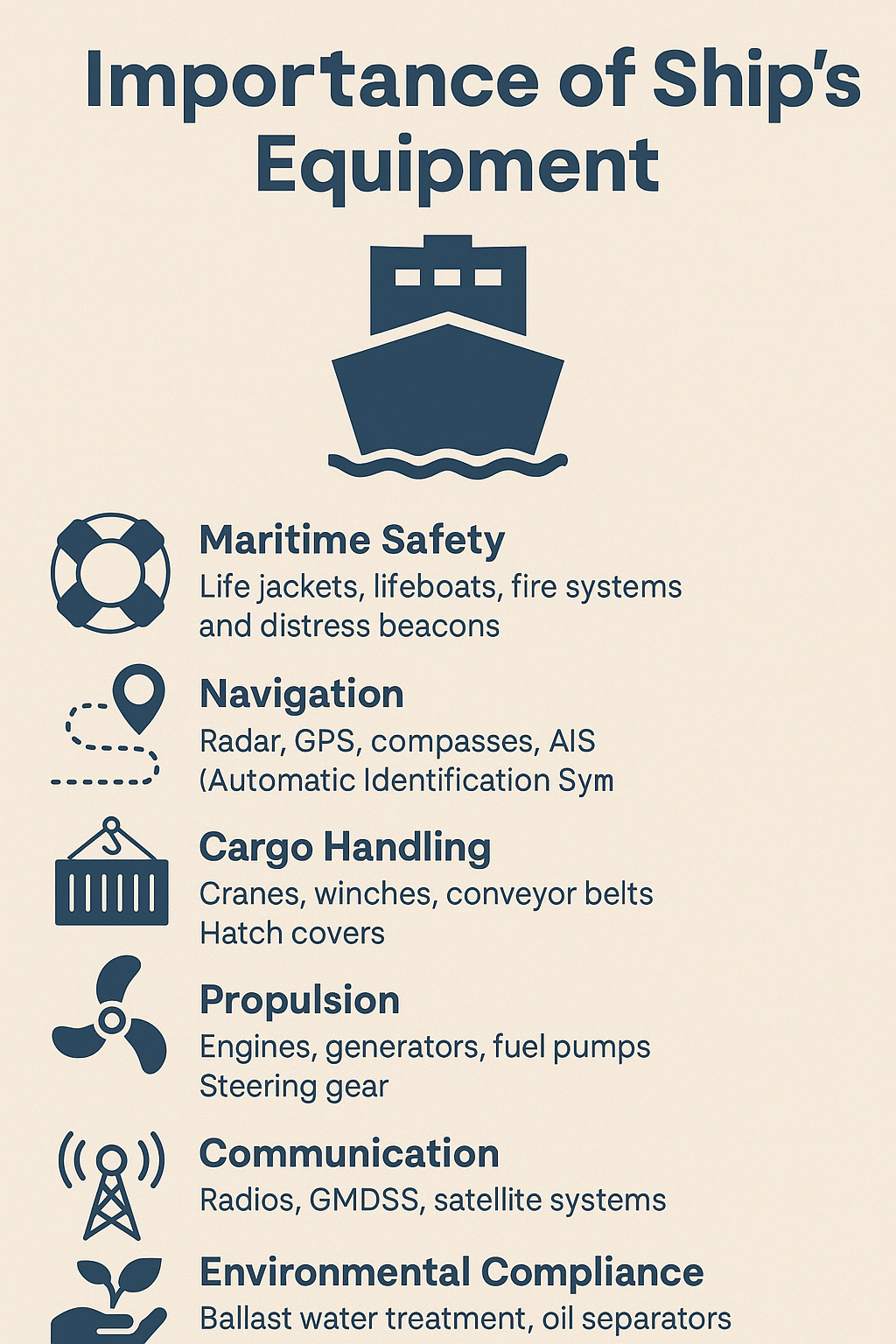
One of the primary reasons ship’s equipment is so vital is safety. The International Maritime Organization (IMO) mandates specific safety equipment for all ships under the SOLAS (Safety of Life at Sea) Convention.
Key safety equipment includes:
- Life Jackets and Lifeboats – For passenger and crew evacuation during emergencies.
- Fire Detection and Suppression Systems – To prevent onboard fires, a common cause of maritime disasters.
- Emergency Position Indicating Radio Beacons (EPIRBs) – To transmit a distress signal in case of shipwreck or capsizing.
- Survival Suits – Especially important in cold waters to protect against hypothermia.
Without this equipment, the risks of fatal incidents increase dramatically.
3. Navigational Importance of Ship’s Equipment: Preventing Collisions and Groundings
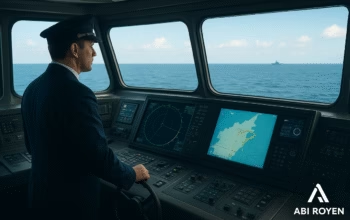
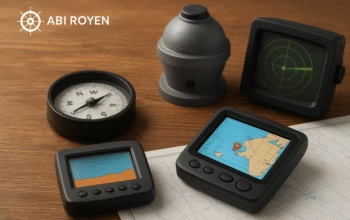
Accurate navigation is essential to avoid collisions, groundings, and getting lost at sea. Some of the core navigational tools include:
- Radar Systems – For detecting other vessels and obstacles in poor visibility.
- GPS and ECDIS – To determine the ship’s exact location and plot courses on digital nautical charts.
- Gyrocompasses and Magnetic Compasses – Essential for steering and direction.
- Automatic Identification System (AIS) – Helps ships identify and track nearby vessels to prevent collisions.
These instruments provide the situational awareness that captains and officers rely on daily.
4. Engine Room and Propulsion Importance of Ship’s Equipment: Driving the Vessel Forward
A ship’s movement depends on its propulsion system, which includes the engine, propeller, and associated machinery. Equipment in this area ensures power generation, engine cooling, fuel supply, and steering.
Key components include:
- Main Engine – Converts fuel into mechanical energy.
- Generators and Alternators – Supply electrical power to the entire ship.
- Fuel Pumps and Filters – Maintain a continuous and clean fuel supply.
- Steering Gear – Directs the rudder to steer the vessel.
Failure of propulsion equipment at sea can be disastrous, leading to drifting or grounding.
5. Cargo Handling Importance of Ship’s Equipment: Enabling Global Trade
For merchant and cargo ships, efficient cargo handling is essential. Equipment such as:
- Cranes and Winches
- Conveyor Belts
- Hydraulic Systems
- Hatch Covers
These tools ensure safe and efficient loading/unloading of containers, bulk goods, or liquids. Damaged or faulty cargo equipment can delay shipping schedules and cause financial losses.
6. Communication Systems: Staying Connected at Sea
Communication is essential not only for coordination but also for emergencies. Ships use:
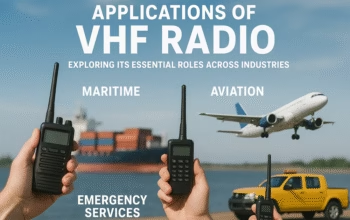
- VHF and MF/HF Radios – For voice communication with other ships and coastal authorities.
- GMDSS (Global Maritime Distress and Safety System) – A standardized communication system for emergencies.
- Satellite Phones and Internet Systems – For long-distance data and voice communication.
Clear communication enhances safety, operational coordination, and crew welfare.
7. Environmental Compliance Importance of Ship’s Equipment
Modern ships must comply with international environmental regulations such as MARPOL. Specialized equipment helps reduce pollution and ensure sustainable operations:
- Ballast Water Treatment Systems
- Oil Water Separators (OWS)
- Exhaust Gas Cleaning Systems (Scrubbers)
- Sewage and Garbage Treatment Units
Non-compliance with environmental standards can lead to hefty fines, detentions, and reputational damage.
8. Routine Maintenance and Inspection of Ship’s Equipment
Equipment on ships is constantly exposed to harsh marine conditions—saltwater, vibration, heat, and pressure. Regular maintenance is crucial:
- Planned Maintenance System (PMS) is used onboard to schedule inspections.
- Condition Monitoring Tools detect early signs of wear or malfunction.
- Spare Parts Inventory must be kept updated to replace faulty items quickly.
A well-maintained vessel is more reliable, safer, and cost-effective in the long run.
9. Training and Crew Competency
Ship’s equipment is only effective when operated by trained personnel. IMO’s STCW (Standards of Training, Certification, and Watchkeeping) requires crew members to be proficient in using all shipboard equipment relevant to their duties.
Simulation-based training, onboard drills, and refresher courses ensure the crew can handle the equipment during routine and emergency scenarios.
10. Conclusion of Importance of Ship’s Equipment
The importance of ship’s equipment cannot be overstated. Whether for safety, navigation, communication, cargo handling, or environmental protection, every system plays a vital role in ensuring smooth and secure maritime operations.
For ship owners, operators, and marine engineers, investing in high-quality equipment, conducting regular maintenance, and ensuring crew competency are non-negotiable elements of a successful voyage.
With increasing global demand and stricter regulations, modern ships must be better equipped than ever before—technologically advanced, well-maintained, and fully compliant with international maritime standards.
Want more maritime insights and technical resources?
Visit Abi Royen — your trusted source for marine technology, ship systems, and electrical engineering topics.