Introduction
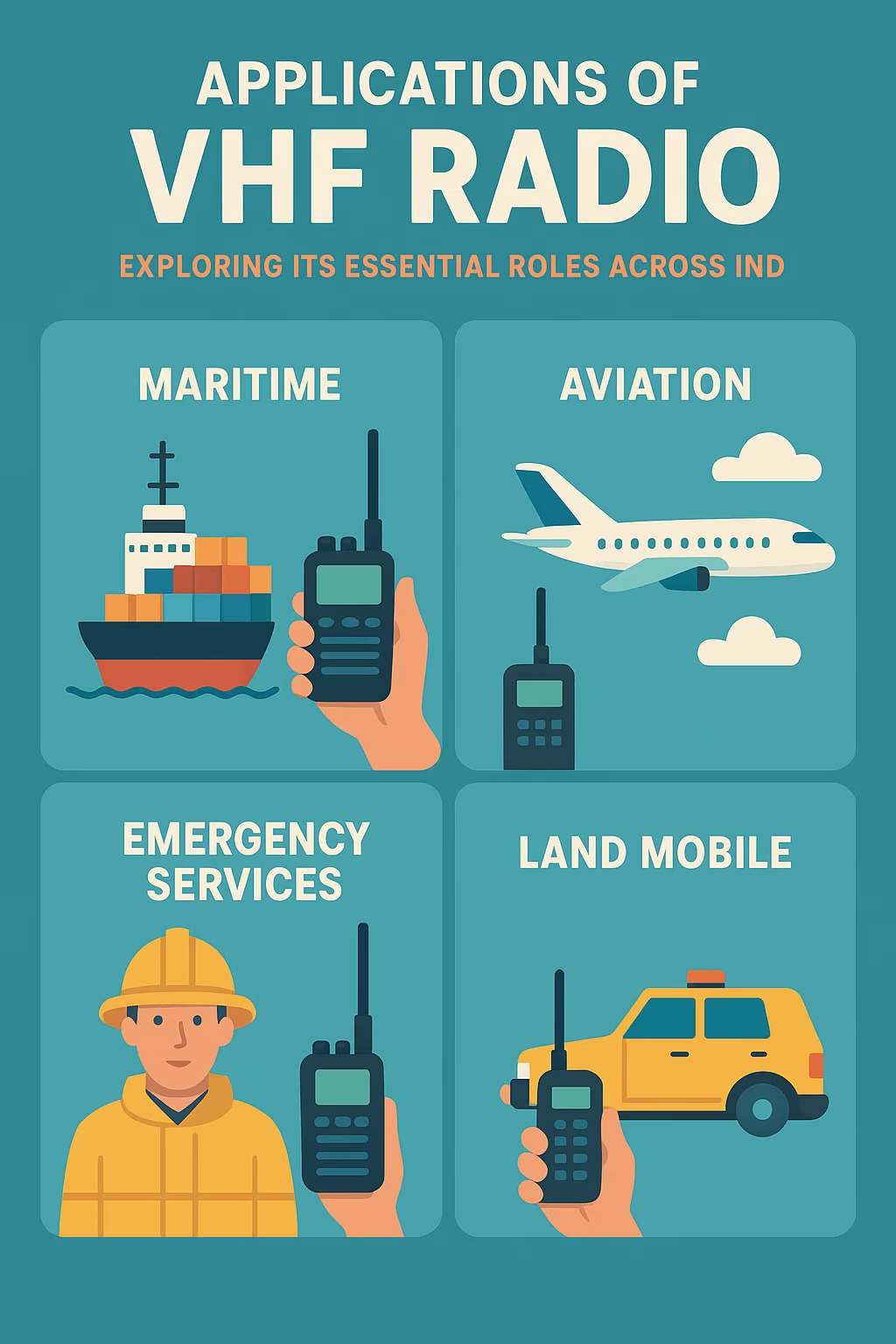
Applications VHF radio ~ Very High Frequency (VHF) radios have become a cornerstone of wireless communication in a variety of industries. Operating between 30 MHz and 300 MHz, VHF radios are known for their ability to transmit clear voice communications over short to medium distances, especially in open spaces. These radios are widely used in maritime, aviation, land mobile radio services, emergency response, and more.
In this article, we explore the key applications of VHF radio, how they function in each environment, and why this technology remains critical despite the rise of satellite and cellular communications.
1. Applications VHF Radio: Maritime Communication
1.1 Ship-to-Ship and Ship-to-Shore Communication
One of the most common uses of VHF radio is in maritime communication. Ships use VHF radios for both ship-to-ship and ship-to-shore communication. These radios help with:
- Navigational safety
- Port operations
- Weather updates
- Emergency calls (Channel 16 is reserved for distress)
The Global Maritime Distress and Safety System (GMDSS) mandates the use of VHF radios on commercial vessels, reinforcing their importance in ensuring safety at sea.
1.2 Coastal Surveillance and Port Authority
Port authorities and coast guards rely on VHF radios to monitor marine traffic, issue navigational warnings, and coordinate search and rescue operations. Its line-of-sight range is ideal for nearshore communication.
2. Applications VHF Radio: Aviation Communication
2.1 Air Traffic Control (ATC)
VHF radio is the primary communication method between pilots and air traffic control towers. Pilots use specific VHF frequencies to communicate location, altitude, and flight plans. This enables:
- Controlled landings and takeoffs
- Avoidance of in-air collisions
- Coordination during emergencies
The clarity and reliability of VHF radio signals make them suitable for use in congested airspace and around airports.
2.2 Pilot-to-Pilot Communication
Aircraft in the same vicinity often communicate using VHF radios to coordinate positioning and avoid conflicts. VHF frequencies above 118 MHz are typically reserved for aviation use.
3. Applications VHF Radio: Emergency and Disaster Response
3.1 Public Safety and First Responders
Emergency services such as police, fire departments, and paramedics depend on VHF radios for real-time, mission-critical communication. During natural disasters or major accidents, these radios provide:
- Immediate coordination between agencies
- Continued operation during cellular network failure
- Group communication in rescue zones
VHF’s ability to penetrate forested and rural areas makes it more effective than UHF in certain outdoor emergency scenarios.
3.2 Search and Rescue (SAR) Operations
Search and rescue teams, both in maritime and mountainous areas, use VHF radios for locating victims and coordinating rescue logistics. Because VHF can travel longer distances over open terrain, it’s often used with repeaters to extend range.
4. Applications VHF Radio: Land Mobile Radio (LMR) Systems
4.1 Industrial and Commercial Use
Industries like construction, agriculture, and logistics use VHF radios for efficient internal communication. These radios help with:
- Coordination between teams on large job sites
- Worker safety communication
- Managing logistics in remote areas
VHF is preferred in rural environments due to its superior range and minimal interference in open fields.
4.2 Public Transportation
VHF radios play an essential role in buses, trains, and other public transport systems for dispatch and route coordination. Transit authorities use VHF to keep systems synchronized and to respond quickly to incidents.
5. Applications VHF Radio: Amateur and Recreational Use
5.1 Amateur Radio Operators (HAM)
Licensed HAM radio operators use VHF bands for non-commercial communication, experimenting with antennas, digital modes, and emergency preparedness. Popular VHF frequencies include 144–148 MHz (2-meter band).
5.2 Outdoor Enthusiasts
Hikers, hunters, and adventurers carry VHF handheld radios to stay in touch in areas without cellular service. These radios offer:
- Weather channel access
- Location coordination
- Emergency contact with rescue teams
Many VHF radios are waterproof and rugged, ideal for rough environments.
6. Applications VHF Radio: Broadcasting and Communication Infrastructure
6.1 FM Radio Broadcasting
FM radio stations use the VHF band (88 MHz to 108 MHz) for transmitting audio signals. This makes VHF one of the primary backbones of terrestrial broadcasting, offering:
- Wide coverage
- High-fidelity sound
- Compatibility with vehicle and home radios
6.2 Two-Way Radio Systems
Business and public agencies utilize two-way VHF radio systems for secure, closed-group communication. These systems are often integrated into larger dispatch or repeater networks to cover larger areas.
Advantages of VHF Radio
- Wider Coverage in Open Areas: VHF performs better than UHF in rural and over-water environments.
- Cost-Effective: Equipment and licensing are generally affordable.
- Reliable: VHF radios are less prone to congestion in certain frequencies.
- Simple to Operate: Especially useful in time-sensitive operations.
Challenges and Limitations
While VHF radios are powerful tools, they do come with limitations:
- Line-of-Sight Dependency: Signal quality decreases in urban or mountainous areas.
- Limited Bandwidth: VHF has less spectrum available compared to higher frequencies.
- Interference: Susceptible to electrical noise in certain environments.
Conclusion of Applications VHF Radio
From keeping ships safe at sea to guiding aircraft in crowded skies, and from disaster response to everyday industrial use, VHF radio remains a vital communication tool across sectors. Its robustness, reliability, and affordability continue to make it indispensable in scenarios where dependable voice communication is non-negotiable.
As technologies evolve, VHF radio still holds its ground due to its resilience in real-world operations where other systems might fail. Whether you’re navigating the ocean, flying at 30,000 feet, or managing a construction site, VHF radio proves its worth time and again.
If you’re exploring more about communication systems and radio technologies, visit more insightful articles on Abi Royen — your source for engineering knowledge and innovations.