Introduction of Why Fixed Resistors Important
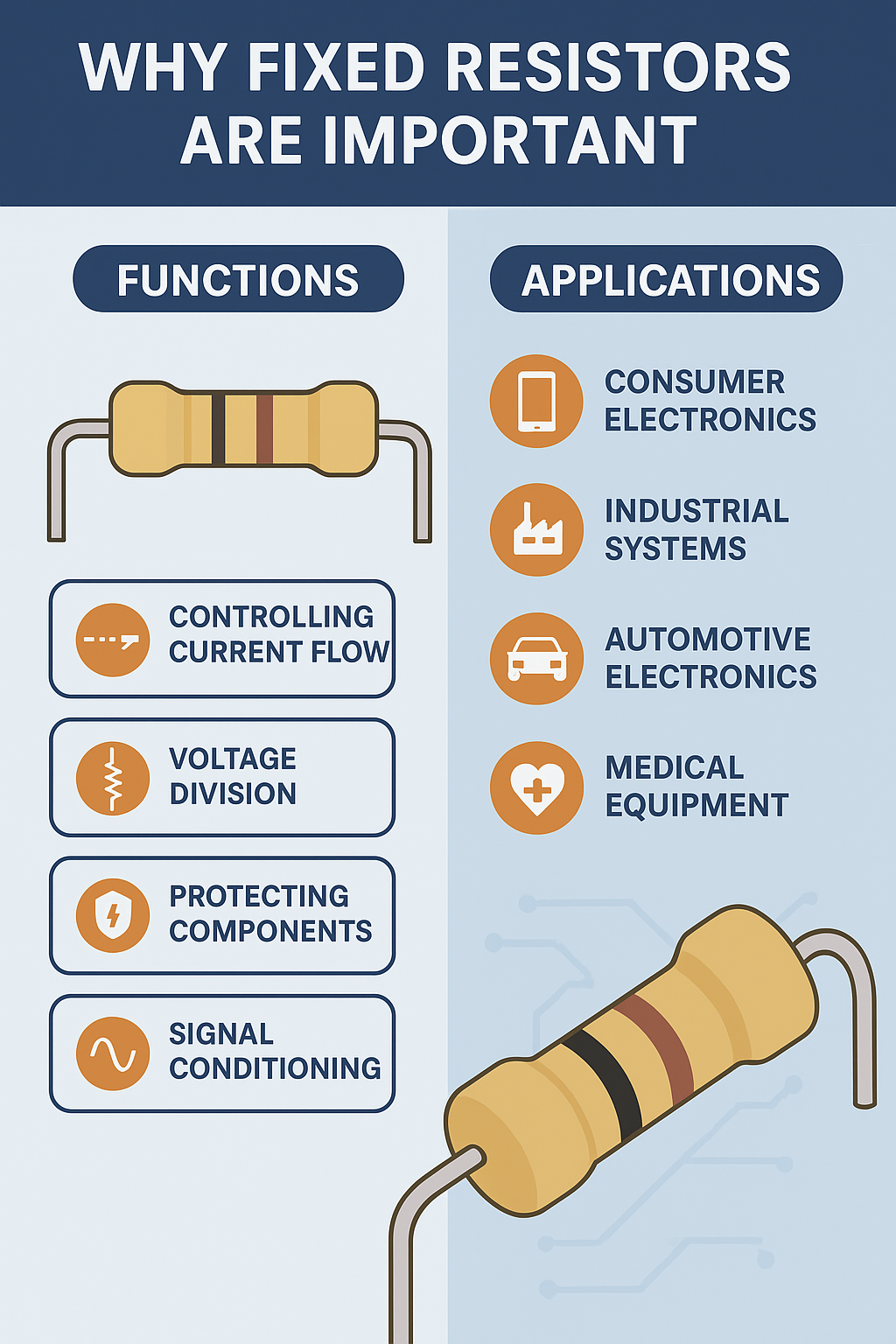
Why Fixed Resistors Important ~ Every modern electronic device—from smartphones to industrial machinery—relies on small but essential components that ensure proper operation. Among these, the fixed resistor plays one of the most crucial roles. Despite being one of the simplest passive components in electronics, its importance cannot be underestimated. Fixed resistors are widely used to control current, divide voltage, protect circuits, and stabilize operations across countless applications.
In this article, we will explore why fixed resistors are important, their fundamental functions, advantages, types, and real-world applications. Understanding this component is vital for engineers, hobbyists, and anyone interested in how electronics work.
What Is a Fixed Resistor?
A fixed resistor is a passive electronic component designed to provide a constant resistance value. Unlike variable resistors (such as potentiometers), fixed resistors do not allow adjustment of resistance. Their primary purpose is to limit or regulate the flow of electrical current within a circuit.
Fixed resistors are usually defined by their resistance value (ohms), tolerance, and power rating. They are available in different materials, such as carbon film, metal film, and wire-wound, depending on the required precision and application.
Why Fixed Resistors Important in Electronics
1. Controlling Current Flow
Electrical circuits require precise current regulation to prevent damage. Fixed resistors restrict the amount of current passing through sensitive components like LEDs, microcontrollers, or transistors. Without them, components could burn out due to excessive current.
2. Voltage Division
Fixed resistors are essential in creating voltage dividers. By connecting two resistors in series, they split the input voltage into smaller, manageable levels. This is widely used in sensor circuits, amplifiers, and power supplies.
3. Protecting Components
Expensive or delicate components are protected by resistors acting as current limiters. For example, LEDs are always paired with resistors to ensure they receive safe operating current.
4. Signal Conditioning
In analog circuits, resistors help filter, attenuate, or shape signals. By working with capacitors and inductors, resistors form filters that eliminate unwanted noise or stabilize signals.
5. Stabilizing Circuit Operation
Electronic devices require stable and predictable behavior. Fixed resistors provide reliability since their resistance does not change significantly with time (except under extreme conditions).
6. Heat Management
Resistors convert excess electrical energy into heat, preventing other components from overheating. Their power rating determines how much energy they can safely dissipate.
Advantages of Fixed Resistors
- Simplicity: Easy to use and integrate into any circuit.
- Low Cost: Affordable and widely available.
- Reliability: Provide consistent resistance values over long periods.
- Variety: Available in different resistance ranges, tolerances, and power ratings.
- Compatibility: Work in both low-power and high-power applications.
Types of Fixed Resistors
- Carbon Film Resistors – Low-cost and commonly used in general electronics.
- Metal Film Resistors – Provide higher precision and stability, suitable for measurement circuits.
- Wire-Wound Resistors – Handle high power, often used in industrial and high-current applications.
- Thick Film and Thin Film Resistors – Found in surface-mount technology (SMT), widely used in compact devices like smartphones.
Applications of Fixed Resistors
Consumer Electronics
- Regulating current in smartphones, televisions, and laptops.
- Protecting LED indicators and display circuits.
Industrial Systems
- Power control in motors, sensors, and automation systems.
- Ensuring accuracy in measurement instruments.
Automotive Electronics
- Used in lighting systems, battery management, and engine control units.
Communication Devices
- Stabilizing signal transmission in radios, routers, and satellites.
Medical Equipment
- Ensuring precision in diagnostic devices like ECG machines and infusion pumps.
The Role of Fixed Resistors in Education and Learning
Fixed resistors are also one of the first components introduced in electronics education. Students and beginners learn Ohm’s Law and circuit basics using resistors. Their simplicity makes them excellent teaching tools for understanding voltage, current, and resistance relationships.
Future of Fixed Resistors
Even with advancements in semiconductors and integrated circuits, fixed resistors remain indispensable. Their role may be simple, but they continue to support innovations in IoT devices, renewable energy systems, and advanced robotics. As circuits become smaller and more powerful, surface-mount resistors (SMD) are becoming the standard in modern electronics.
Conclusion of Why Fixed Resistors Important
Fixed resistors may seem small and ordinary, but they are the backbone of electronic circuits. They regulate current, protect components, divide voltage, and ensure reliable performance across all industries. Without fixed resistors, most of the electronic devices we use daily would not function safely or efficiently.
Understanding their importance helps engineers and hobbyists design better, safer, and more efficient systems. In short, fixed resistors are small in size but huge in impact.