

Fixed Resistors in Circuits ~ In the world of electronics, resistors are among the most fundamental components. Despite their simple design and low cost, they play a crucial role in controlling the flow of electrical current in circuits. One of the most widely used types is the fixed resistor, which has a constant resistance value that does not change under normal operating conditions.
This article will explore the definition, function, types, characteristics, and applications of fixed resistors in circuits. We will also discuss why they remain indispensable in modern electronic design despite the advancement of digital and programmable components.
What Are Fixed Resistors?
A fixed resistor is a passive electronic component designed to provide a specific, unchanging resistance to the flow of electric current. Unlike variable resistors (such as potentiometers), their resistance value is set during manufacturing and cannot be adjusted.
Fixed resistors are commonly made from carbon film, metal film, or wire wound materials, and they are available in a wide range of resistance values, power ratings, and tolerance levels.
In circuit diagrams, resistors are represented by the symbol “R” and are measured in ohms (Ω).
Functions of Fixed Resistors in Circuits
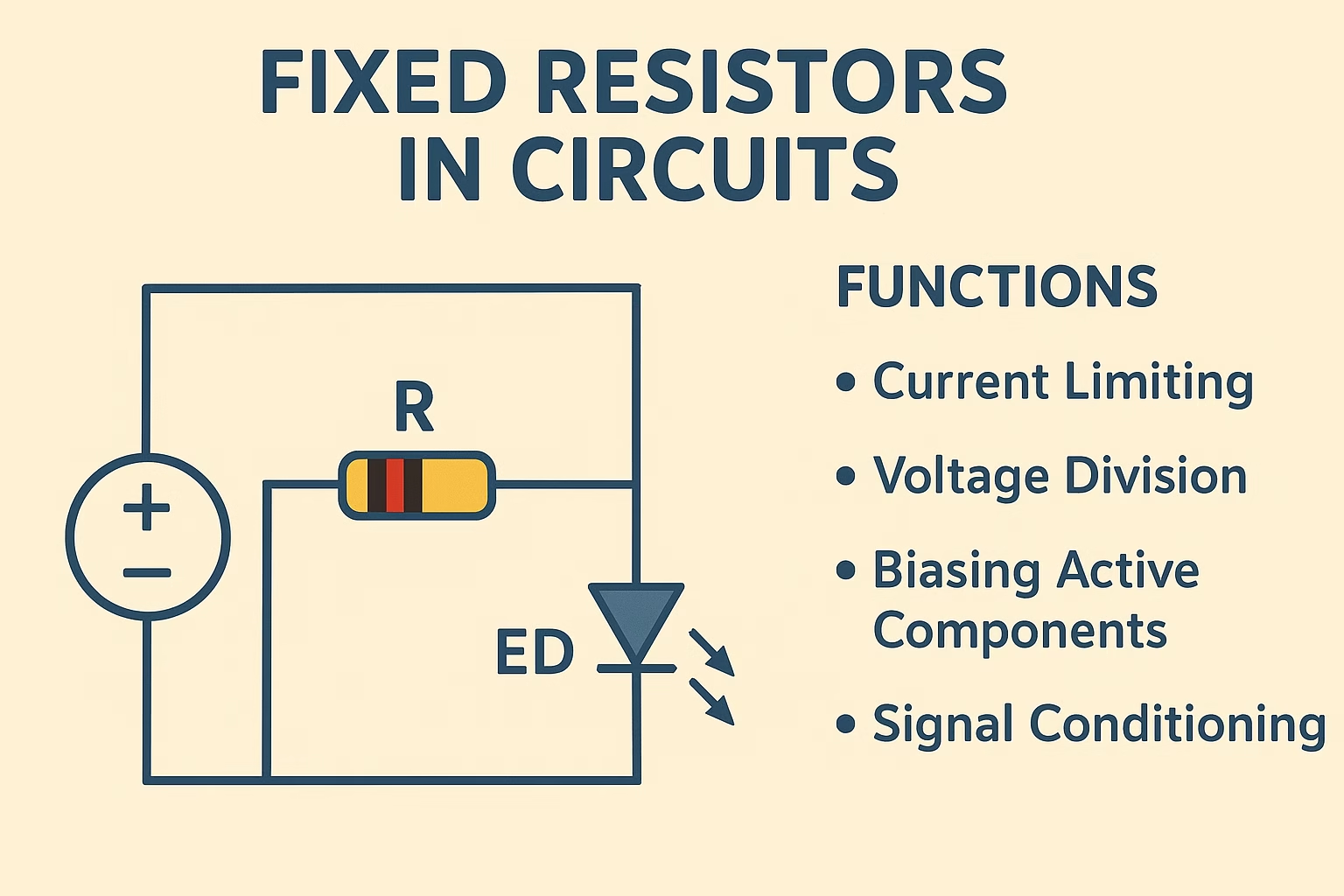
Fixed resistors are critical for maintaining stability and protecting sensitive electronic components. Their main functions include:
1. Fixed Resistors in Circuits: Current Limiting
Resistors control the flow of current to prevent damage to components like LEDs, transistors, and integrated circuits. For example, an LED requires a resistor to limit current and prevent it from burning out.
2. Voltage Division
Fixed resistors are often arranged in series to create a voltage divider circuit, which provides a specific fraction of voltage to other parts of the circuit.
3. Biasing Active Components
In circuits with transistors or operational amplifiers, resistors set the proper biasing conditions to ensure stable operation.
4. Signal Conditioning
They can attenuate signals, filter noise, or form part of RC (resistor-capacitor) timing networks.
5. Fixed Resistors in Circuits: Heat Dissipation
By converting excess electrical energy into heat, resistors protect other components from overloading.
Types of Fixed Resistors
Fixed resistors come in different materials and constructions, each suited for specific applications:
1. Carbon Composition Resistors
- Made from a mixture of carbon powder and binder.
- Affordable but less precise.
- Commonly used in general-purpose circuits.
2. Carbon Film Resistors
- Manufactured by depositing a carbon film on a ceramic substrate.
- Provide better stability and tolerance than carbon composition resistors.
3. Metal Film Resistors
- Built using a thin metal film.
- Highly accurate, with low noise and temperature coefficient.
- Suitable for precision applications.
4. Wire-Wound Resistors
- Made by winding a metal wire (usually nichrome) around a ceramic core.
- Capable of handling high power loads.
- Used in power electronics and industrial equipment.
5. Metal Oxide Resistors
- Constructed with a metal oxide film.
- High-temperature resistance and durability.
- Commonly used in high-voltage circuits.
Characteristics of Fixed Resistors
When selecting a resistor, engineers consider several parameters:
- Resistance Value (Ω): Determines how much it resists current flow.
- Tolerance (%): Indicates how accurate the resistance value is compared to its nominal value.
- Power Rating (W): Defines how much power it can safely dissipate.
- Temperature Coefficient (ppm/°C): Shows how resistance changes with temperature.
- Noise Level: Especially important in audio and precision circuits.
Applications of Fixed Resistors in Circuits
Fixed resistors are found in almost every electronic device, from small gadgets to large industrial systems. Some practical applications include:
- LED Circuits – A resistor in series with an LED ensures the correct current flows through it.
- Power Supplies – Used for voltage regulation and load balancing.
- Radio and Audio Equipment – For tuning, signal control, and noise filtering.
- Computers and Microcontrollers – Biasing and pull-up/pull-down resistors in digital logic circuits.
- Automotive Electronics – For controlling dashboard lights, sensors, and control units.
- Household Appliances – Found in TVs, washing machines, air conditioners, and more.
Advantages of Fixed Resistors
- Cost-effective and widely available.
- Stable performance under normal conditions.
- Simple to use in circuit design.
- Wide variety of values and sizes.
- Durable for both low-power and high-power applications.
Limitations of Fixed Resistors
- Resistance value cannot be adjusted once manufactured.
- Some types (like carbon composition) have low precision.
- Temperature sensitivity in certain resistor materials.
Fixed Resistors vs Variable Resistors
| Feature | Fixed Resistor | Variable Resistor |
|---|---|---|
| Resistance Value | Constant | Adjustable |
| Precision | High (depends on type) | Moderate |
| Applications | General-purpose, stable circuits | Volume control, tuning, adjustable circuits |
| Cost | Low | Higher |
Why Fixed Resistors Remain Important
Even though modern electronics include programmable ICs, digital controllers, and smart sensors, fixed resistors remain fundamental. Their simplicity, reliability, and affordability make them irreplaceable in nearly every electronic device. Without them, stable circuit operation would be impossible.
Conclusion of Fixed Resistors in Circuits
Fixed resistors may seem like simple, low-cost components, but their role in circuits is essential. From current limiting and voltage division to signal conditioning and heat dissipation, they provide stability and protection to electronic systems.
By understanding the types, characteristics, and applications of fixed resistors, engineers and hobbyists alike can design reliable circuits that function safely and efficiently.
Whether in a smartphone, a home appliance, or an industrial machine, fixed resistors prove that sometimes, the simplest components are the most indispensable.