
Introduction of Types of Level Instrumentation
Types of Level Instrumentation ~ In industrial operations, the accurate measurement of liquid and solid levels is critical for ensuring safety, efficiency, and consistent product quality. Whether in chemical plants, oil refineries, food processing, pharmaceuticals, or water treatment facilities, level instrumentation plays a key role in monitoring materials within tanks, silos, and pipelines.
Level measurement devices, also known as level instruments, are used to detect and control the height or depth of liquids, powders, or granular substances. They help avoid overflow, ensure process stability, and optimize resource usage. However, not all industries require the same type of instrument; different types of level instrumentation are designed for specific applications and conditions.
This article explores the most widely used types of level instrumentation, their working principles, advantages, and applications.
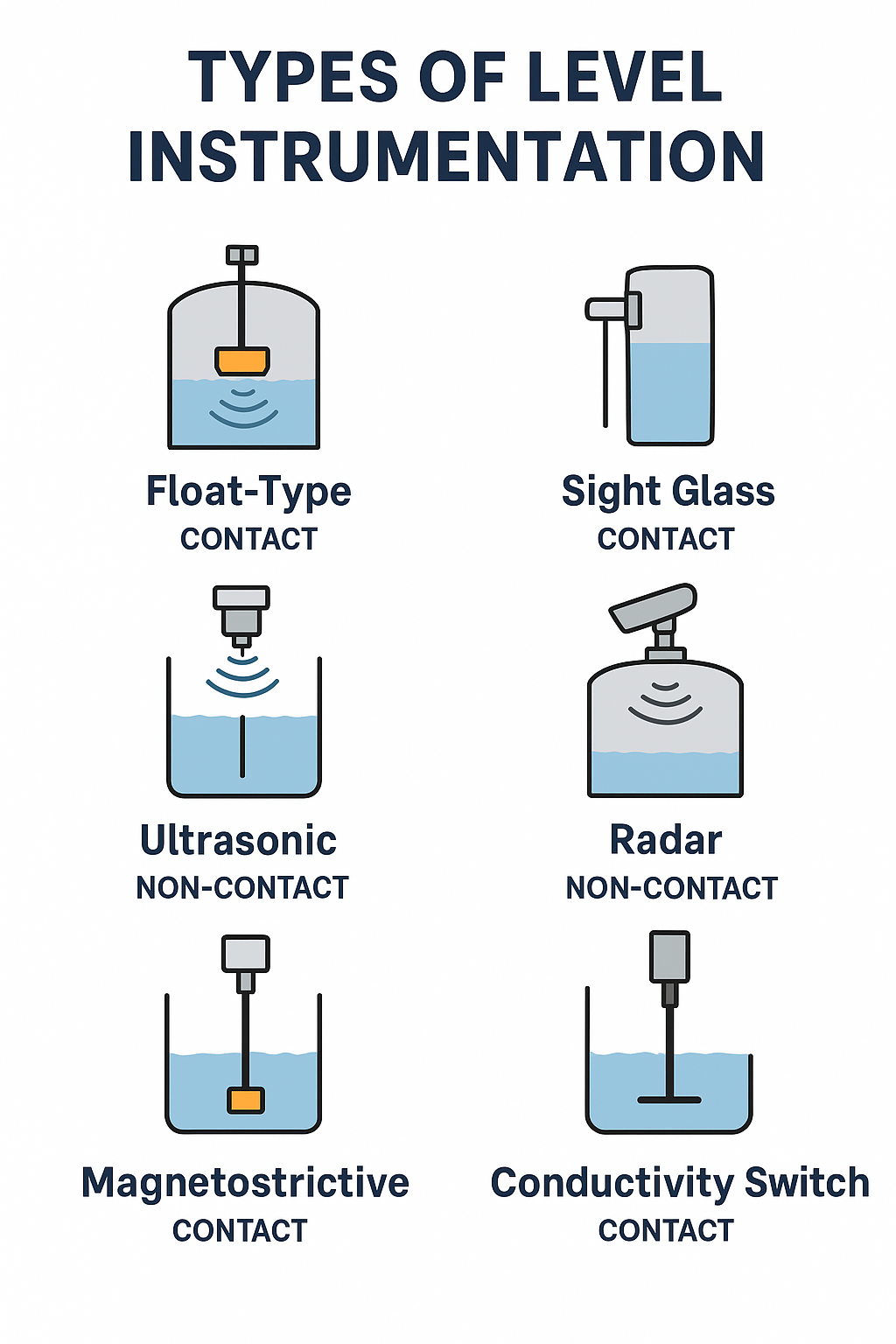
1. Types of Level Instrumentation: Float-Type Level Instruments
Float-type level measurement is one of the oldest and simplest technologies. A buoyant float moves up and down with the liquid surface, and its motion is mechanically or magnetically transmitted to a gauge or switch.
Working Principle:
- A float rises and falls according to liquid levels.
- The movement is transferred to an indicator or a switch.
Advantages:
- Simple and reliable.
- Cost-effective.
- Suitable for basic applications.
Applications:
- Water tanks in residential and industrial systems.
- Fuel storage monitoring.
- Food and beverage industry.
2. Types of Level Instrumentation: Sight Glass Level Indicators
A sight glass provides a direct visual observation of the liquid level inside a tank or vessel. It is a transparent tube or glass mounted externally on the tank.
Working Principle:
- The liquid in the sight glass is at the same level as the liquid in the tank, due to hydrostatic balance.
Advantages:
- Easy to read visually.
- No complex electronics required.
Applications:
- Boiler water level monitoring.
- Low-pressure storage tanks.
- Small-scale industrial use.
3. Ultrasonic Level Instruments
Ultrasonic sensors use high-frequency sound waves to measure the distance between the sensor and the liquid or solid surface.
Working Principle:
- The device emits ultrasonic pulses.
- Pulses reflect back after hitting the surface.
- The time taken to return is used to calculate the level.
Advantages:
- Non-contact measurement.
- Suitable for corrosive or hazardous materials.
- Can measure both liquids and solids.
Applications:
- Wastewater treatment plants.
- Food and beverage tanks.
- Bulk solid silos.
4. Types of Level Instrumentation: Radar Level Instruments
Radar level transmitters are among the most advanced technologies in level measurement. They use microwave signals to detect the level of materials inside a vessel.
Working Principle:
- Microwaves are transmitted towards the material surface.
- The reflected signal is measured.
- Distance is calculated to determine the level.
Advantages:
- Highly accurate.
- Works well in extreme conditions (pressure, temperature).
- Non-contact measurement possible.
Applications:
- Oil and gas industry.
- Chemical processing plants.
- High-pressure tanks.
5. Capacitance Level Instruments
These devices use changes in capacitance to detect material levels. A probe inside the tank acts as one plate of a capacitor, while the tank wall acts as another.
Working Principle:
- The dielectric constant changes as the level rises or falls.
- This change alters the capacitance, which is measured and converted into a level reading.
Advantages:
- Can measure liquids, powders, and granular materials.
- Works with non-conductive substances.
Applications:
- Cement silos.
- Grain storage.
- Petrochemical tanks.
6. Types of Level Instrumentation: Hydrostatic Level Instruments
Also known as pressure-based level instruments, they measure the hydrostatic pressure at the bottom of a tank.
Working Principle:
- Pressure at the bottom of the tank is directly proportional to the liquid height.
Advantages:
- Simple and cost-effective.
- Works well for open tanks and water reservoirs.
Applications:
- Municipal water supply.
- Dams and reservoirs.
- Underground storage tanks.
7. Magnetostrictive Level Transmitters
These instruments combine magnetic float technology with precision electronic measurement.
Working Principle:
- A magnetic float moves with the liquid level.
- The transmitter detects the float’s position using magnetostrictive pulses.
Advantages:
- Very accurate.
- Provides continuous measurement.
- Durable and reliable.
Applications:
- Petrochemical storage.
- Pharmaceutical manufacturing.
- Food processing.
8. Types of Level Instrumentation: Conductivity Level Switches
These are mostly used for point-level detection in conductive liquids.
Working Principle:
- Electrodes are placed at certain points in the tank.
- When liquid touches the electrode, conductivity completes a circuit.
Advantages:
- Low cost.
- Reliable for conductive liquids.
Applications:
- Water and wastewater treatment.
- Acid and alkaline tanks.
- Simple industrial tanks.
Comparison of Level Instrumentation Technologies
| Type | Contact/Non-Contact | Accuracy | Best For |
|---|---|---|---|
| Float | Contact | Medium | Simple water/fuel tanks |
| Sight Glass | Contact | Medium | Boilers, low-pressure tanks |
| Ultrasonic | Non-Contact | High | Liquids & solids in open tanks |
| Radar | Non-Contact | Very High | Harsh conditions, oil & gas |
| Capacitance | Contact | High | Powders, grains, petrochemicals |
| Hydrostatic | Contact | Medium | Water reservoirs, dams |
| Magnetostrictive | Contact | Very High | Precision industries |
| Conductivity Switch | Contact | Low-Medium | Simple conductive liquid tanks |
Conclusion of Types of Level Instrumentation
Level instrumentation is a vital part of industrial process control, ensuring safety, efficiency, and reliability in operations. The choice of level instrument depends on the material being measured, environmental conditions, and required accuracy.
From traditional float systems to advanced radar and magnetostrictive transmitters, industries have a wide range of technologies available. By understanding the different types of level instrumentation, engineers and operators can choose the most suitable solution for their applications.
As industries continue to advance, new technologies such as smart sensors and IoT-based monitoring will further improve the accuracy and reliability of level measurement systems.