
Main Functions of Capacitors ~ Capacitors are fundamental components in almost every electronic device we encounter today—from smartphones and laptops to power systems and industrial machines. Despite their small size, capacitors serve a variety of crucial functions in electrical and electronic circuits. Understanding their main functions helps engineers, technicians, and hobbyists design more effective and reliable systems.
In this article, we will explore the main functions of capacitors, explain how they work in different applications, and highlight examples of real-world usage.
What is a Capacitor?
A capacitor is a two-terminal passive electronic component that stores electrical energy in an electric field. It typically consists of two conductive plates separated by a dielectric (insulating material). When a voltage is applied across the plates, electrons accumulate on one plate, creating a potential difference.
The ability of a capacitor to store charge is measured in farads (F). Although farads are a large unit, most everyday capacitors operate in microfarads (μF), nanofarads (nF), or picofarads (pF).
1. Main Functions of Capacitors: Energy Storage
Main Functions of Capacitors: Temporary Energy Reservoir
One of the primary functions of a capacitor is to store and release electrical energy. This characteristic is essential in circuits where a stable energy source is needed temporarily or where the supply is intermittent.
Example Applications:
- Camera flashes: Capacitors store energy and release it quickly to produce a strong flash.
- Power backup: In memory chips and microcontrollers, capacitors provide short-term power during voltage dips.
Key Benefit:
Energy storage smooths voltage levels, ensuring continuous operation during power glitches.
2. Main Functions of Capacitors: Smoothing and Filtering
Function: Removing Voltage Fluctuations
Capacitors are extensively used in power supply circuits to filter out unwanted signals. They smooth out ripples in DC voltage after rectification, providing a clean and stable voltage to sensitive components.
Example Applications:
- Switch-mode power supplies (SMPS)
- Audio systems to reduce electrical noise
- DC adapters to stabilize voltage output
Capacitor Types Used:
- Electrolytic capacitors for low-frequency smoothing
- Ceramic capacitors for high-frequency filtering
Key Benefit:
Improves the quality and reliability of the power supply.
3. Main Functions of Capacitors: Signal Coupling and Decoupling
Function: AC Signal Transmission and DC Blocking
Capacitors are frequently used to couple AC signals from one circuit to another while blocking DC components. This is known as capacitive coupling. Conversely, decoupling capacitors remove unwanted noise or DC offsets from signal paths.
Coupling Capacitor:
Passes desired AC signals between stages of amplifiers without transferring DC voltage.
Decoupling Capacitor:
Placed close to microchips to isolate them from power supply noise.
Key Benefit:
Ensures clean signal transmission and protects circuit integrity.
4. Main Functions of Capacitors: Timing and Waveform Generation
Function: Creating Delays and Oscillations
Capacitors play a crucial role in timing circuits by charging and discharging in a predictable manner. This property is used in combination with resistors to control timing intervals, such as in clocks, timers, and oscillators.
Example Applications:
- 555 Timer circuits
- Oscillators in communication systems
- Pulse width modulation (PWM) circuits
Key Benefit:
Provides accurate control of signal timing and waveform generation.
5. Main Functions of Capacitors: Power Conditioning
Function: Maintaining Voltage Stability
In sensitive electronic circuits, capacitors help regulate voltage levels and protect components from voltage spikes and dips. They act as buffers that absorb sudden changes in voltage.
Example Applications:
- Voltage regulators
- Battery-powered devices
- Renewable energy systems (solar inverters, etc.)
Key Benefit:
Protects components and enhances device longevity.
6. Main Functions of Capacitors: Motor Starters and Power Factor Correction
Function: Enhancing AC Motor Efficiency
In AC motor applications, capacitors are used to create a phase shift between current and voltage, which is crucial for single-phase motors to start and run efficiently. They are also used to correct power factor in industrial setups.
Example Applications:
- Ceiling fans
- Air conditioners
- Inductive load compensation in factories
Types of Capacitors:
- Start capacitors
- Run capacitors
- Power factor correction capacitors
Key Benefit:
Improves efficiency and reduces electricity consumption.
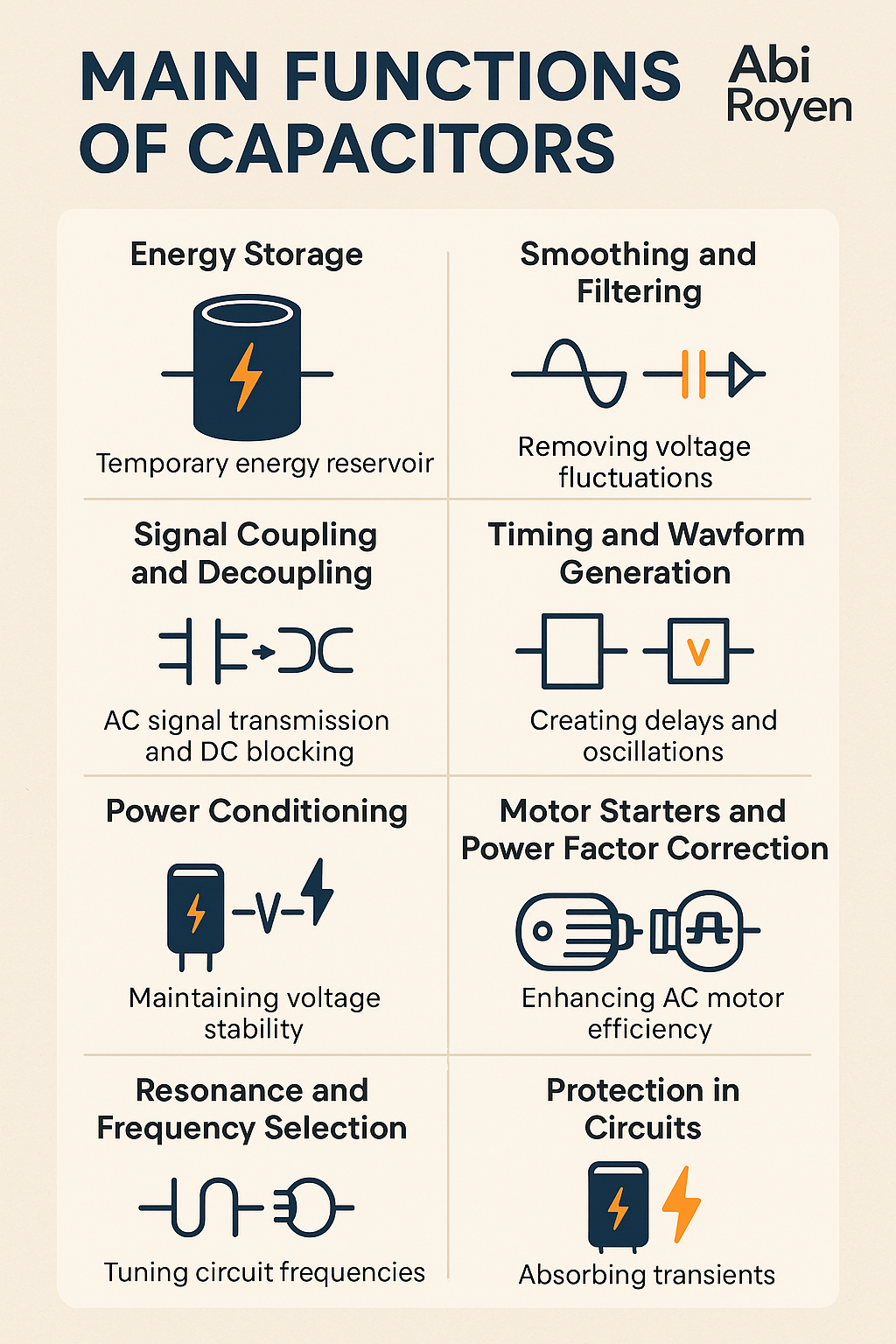
7. Main Functions of Capacitors: Resonance and Frequency Selection
Main Functions of Capacitors: Tuning Circuit Frequencies
Capacitors are used with inductors to form resonant circuits that can select or reject specific frequencies. These are essential in radio, TV, and wireless communication systems.
Example Applications:
- LC circuits in radios
- Band-pass filters
- Tuned circuits in oscillators
Key Benefit:
Enables frequency-specific signal processing.
8. Main Functions of Capacitors: Protection in Circuits
Main Functions of Capacitors: Absorbing Transients
Capacitors, especially ceramic disc and film capacitors, can absorb voltage spikes or surges caused by lightning, switching, or other anomalies. This protects sensitive electronic components.
Example Applications:
- Surge protectors
- Snubber circuits in relays
- Automotive electronics
Key Benefit:
Increases circuit reliability and prevents damage from electrical transients.
Conclusion: Main Functions of Capacitors
From storing energy to filtering signals, protecting circuits, and enhancing performance, capacitors play diverse roles in modern electronics. Their versatility allows engineers to design systems that are faster, more efficient, and more reliable.
Understanding these key functions empowers anyone working with electronics to choose the right capacitor type and value for their application. Whether you’re designing a high-speed computer circuit or a basic LED timer, the capacitor is a cornerstone of performance and stability.
About Abi Royen
At Abi Royen, we’re dedicated to providing in-depth knowledge and insights into passive electronic components. Our mission is to help professionals, students, and electronics enthusiasts better understand the building blocks of modern technology.