Introduction of Industrial Applications of Plumbing
Plumbing is often associated with residential and commercial buildings, but its role in the industrial sector is equally critical. Industrial applications of plumbing go far beyond supplying water and removing waste. They encompass complex piping systems, specialized materials, and advanced technologies that ensure smooth operations in factories, refineries, power plants, healthcare facilities, and more.
In industries where efficiency, safety, and compliance are top priorities, plumbing systems are engineered to withstand extreme pressures, high temperatures, and chemical exposure. This article explores the diverse industrial applications of plumbing, highlighting its importance in different sectors and its contribution to modern industrial sustainability.
1. The Role of Plumbing in Industrial Operations
In industrial environments, plumbing systems serve multiple essential functions:
- Water supply management – delivering clean water for processes and cooling.
- Process piping – transporting chemicals, gases, and steam safely.
- Wastewater treatment – removing and recycling industrial effluents.
- Fire protection systems – ensuring workplace safety with sprinkler and hydrant networks.
- Heating and cooling – regulating temperature for equipment and worker safety.
Unlike household plumbing, industrial plumbing requires specialized materials like stainless steel, PVC, copper, or high-performance alloys that can resist corrosion and chemical reactions.
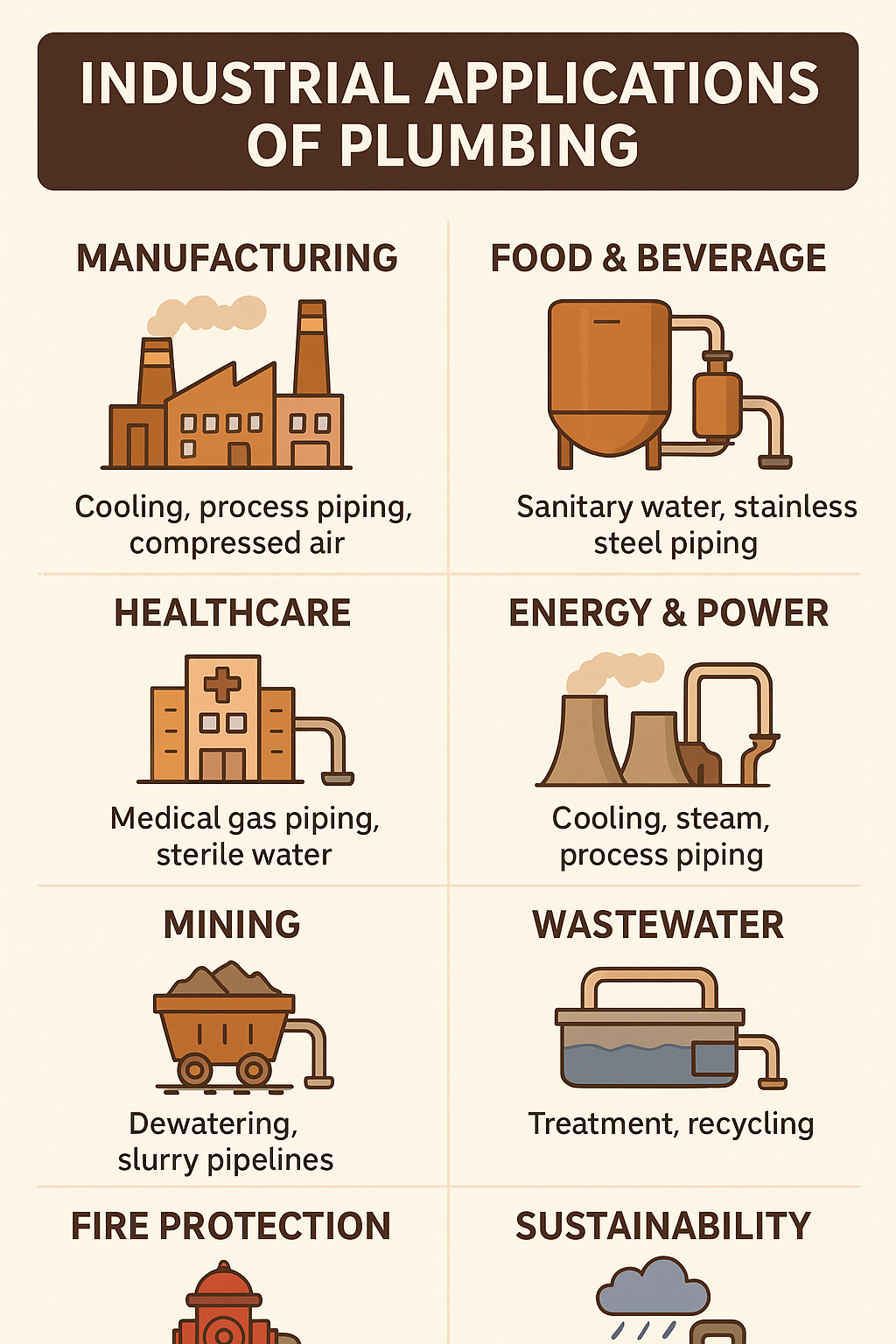
2. Plumbing in Manufacturing Industries
Manufacturing industries rely heavily on plumbing for smooth production. For example:
- Automotive plants use plumbing for cooling systems, hydraulic fluids, and compressed air piping.
- Textile industries depend on large volumes of water for dyeing and finishing processes.
- Pharmaceutical manufacturing requires ultra-pure water systems to maintain product integrity.
Plumbing systems in these environments are designed with strict adherence to international standards to avoid contamination and to maintain product quality.
3. Industrial Food and Beverage Industry
In food processing, hygiene and safety are critical. Plumbing ensures:
- Sanitary water supply for cleaning, cooking, and processing.
- Stainless steel piping to prevent contamination and bacterial growth.
- Steam piping for sterilization of equipment and packaging.
- Wastewater systems to handle organic waste and by-products.
For example, breweries use advanced plumbing systems to transport hot and cold liquids, maintain temperature control, and ensure a sterile environment throughout production.
4. Plumbing in Healthcare and Pharmaceuticals
Healthcare facilities depend on reliable plumbing for patient safety and sanitation. Industrial-scale plumbing provides:
- Medical gas piping for oxygen, nitrogen, and other essential gases.
- Sterile water supply for surgical procedures and equipment cleaning.
- Waste disposal systems to safely manage biohazard materials.
- Hot water and steam for sterilization in laboratories and operating rooms.
In pharmaceuticals, plumbing systems are crucial for maintaining ultra-pure water production, a requirement for drug formulation and testing.
5. Plumbing in Energy and Power Plants
Energy industries—including oil, gas, and renewable power plants—utilize plumbing systems for various operations:
- Cooling water circulation in power generation.
- Steam piping for turbines in thermal power plants.
- Process piping for transporting petroleum, gas, or chemicals.
- Safety systems such as fire suppression in hazardous areas.
Nuclear power plants also rely on highly specialized plumbing to circulate coolant and ensure reactor safety, highlighting the life-saving importance of these systems.
6. Industrial Plumbing in Mining and Heavy Industries
Mining and heavy industries depend on durable plumbing systems for:
- Dewatering systems to remove groundwater and ensure safe mining.
- Compressed air piping for powering drills and equipment.
- Slurry pipelines for transporting extracted minerals mixed with water.
- Dust suppression systems using high-pressure water sprays.
These applications demand pipes that can withstand abrasive materials and harsh environmental conditions.
7. Environmental Impact and Sustainable Plumbing
Modern industries are under pressure to adopt eco-friendly solutions. Plumbing plays a major role in sustainability by enabling:
- Water recycling and reuse through advanced filtration and treatment.
- Energy-efficient piping systems that reduce heat loss.
- Green plumbing technologies like rainwater harvesting in industrial facilities.
- Zero-liquid discharge (ZLD) systems that minimize water waste.
Sustainable plumbing not only reduces operational costs but also helps industries meet environmental regulations.
8. Challenges in Industrial Plumbing
Despite its importance, industrial plumbing faces unique challenges:
- High maintenance requirements due to constant wear and tear.
- Corrosion and scaling caused by chemicals and high temperatures.
- System complexity in large industrial plants.
- Regulatory compliance with strict health, safety, and environmental standards.
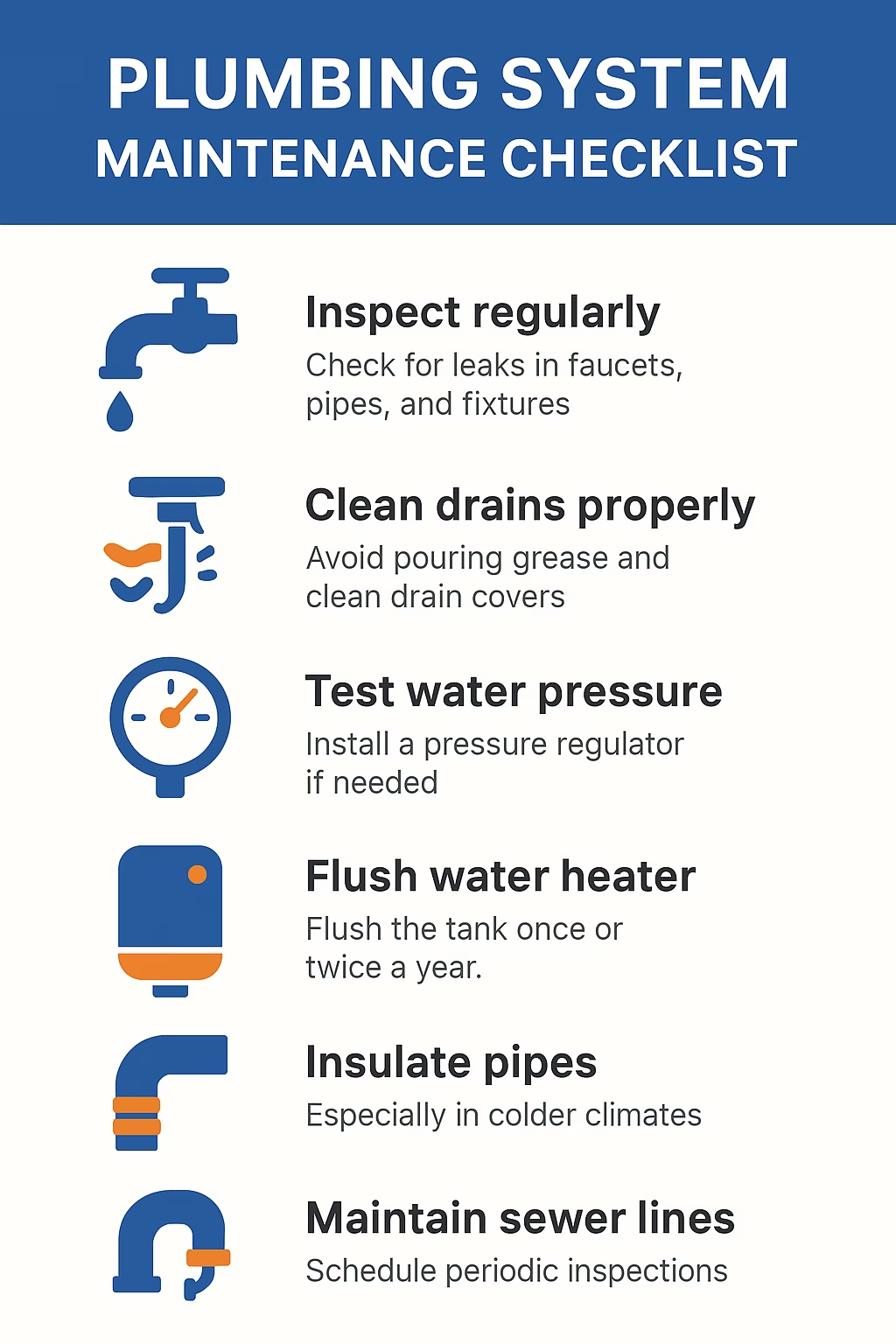
Overcoming these challenges requires advanced design, high-quality materials, and regular preventive maintenance.
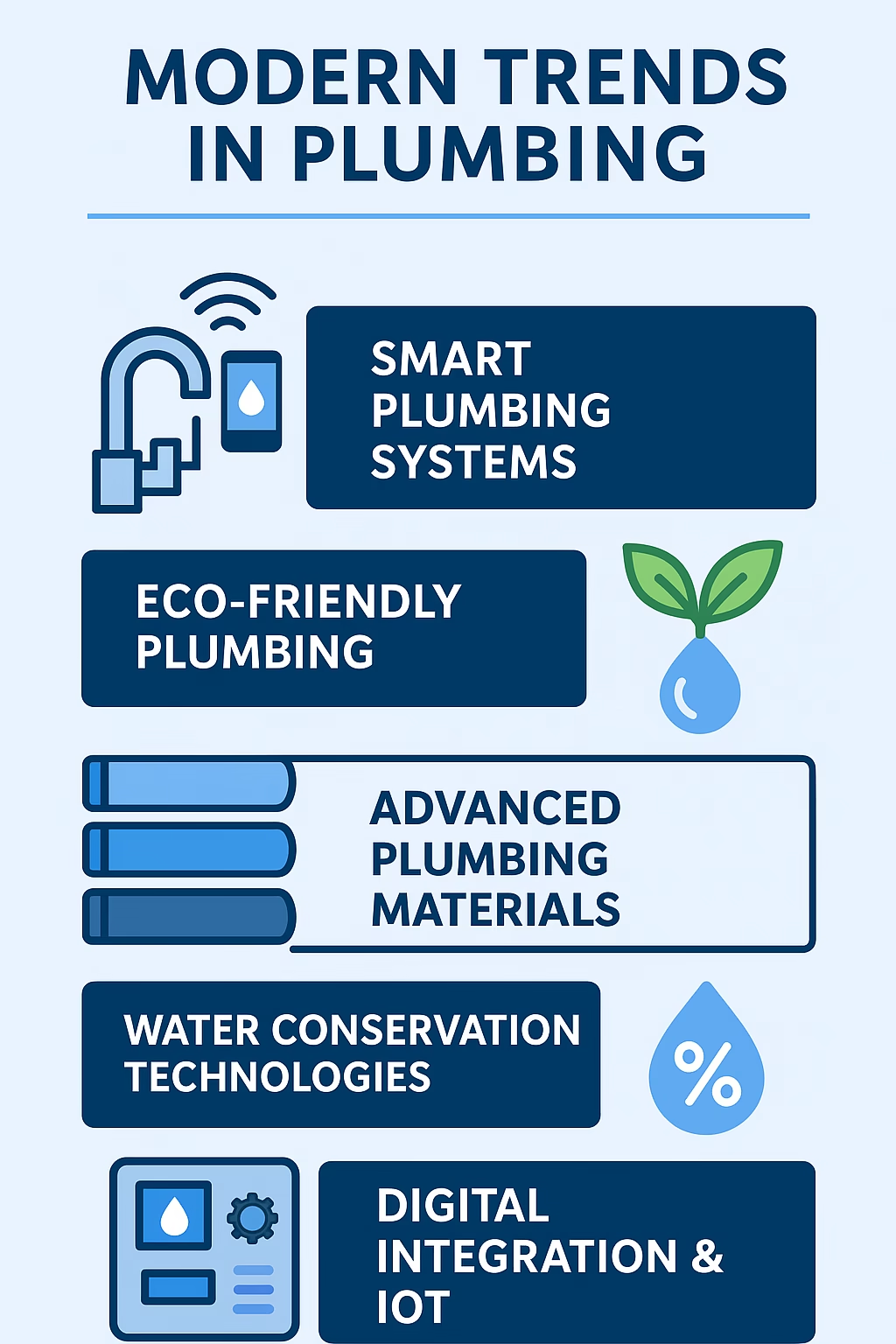
9. Future Trends in Industrial Plumbing
The future of industrial plumbing is shaped by innovation and digital technology:
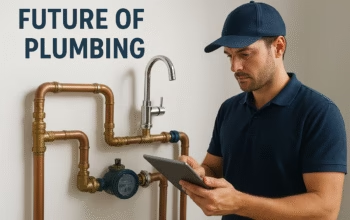
- Smart plumbing systems with sensors for real-time monitoring of leaks, pressure, and flow.
- Automation to control water distribution and treatment.
- 3D printing of plumbing components for custom industrial applications.
- AI-powered predictive maintenance to minimize downtime and prevent system failures.
These trends will continue to enhance efficiency, safety, and sustainability in industrial environments.
Conclusion of Industrial Applications of Plumbing
Industrial plumbing is an indispensable part of modern industry, supporting everything from manufacturing and healthcare to food processing and energy production. Its applications go beyond water supply and drainage, encompassing critical systems like process piping, fire protection, and wastewater treatment.
With the growing focus on efficiency, safety, and sustainability, industrial plumbing systems are evolving rapidly. By integrating advanced materials and smart technologies, industries can ensure reliable operations while reducing environmental impact.
In short, plumbing is not just about pipes and water—it is about powering industries, protecting lives, and driving innovation.