
Introduction of Early Computing Foundations History
Early Computing Foundations History ~ The history of computing is not just about machines; it is the story of human innovation, problem-solving, and the pursuit of efficiency. Today’s digital world, powered by smartphones, artificial intelligence, and supercomputers, is built upon centuries of discoveries and inventions that form the early foundations of computing history. From ancient counting tools like the abacus to theoretical concepts proposed by brilliant pioneers such as Charles Babbage and Ada Lovelace, the journey of computing reveals a fascinating evolution.
This article explores the early foundations of computing, shedding light on the inventions, ideas, and figures that laid the groundwork for the technologies we rely on today.
1. Ancient Counting Tools: The Birth of Computational Thinking
Long before electronic machines existed, humans sought tools to simplify calculations:
- The Abacus (circa 2400 BCE in Mesopotamia and later in China):
One of the earliest devices for arithmetic operations. It allowed merchants and traders to perform addition, subtraction, multiplication, and division efficiently. - The Antikythera Mechanism (circa 100 BCE, Greece):
An astonishing ancient analog device that predicted astronomical positions and eclipses. This mechanism is often considered the earliest known example of a mechanical computer.
These early tools demonstrated humanity’s need for organized computation and foreshadowed more sophisticated devices.
2. The Renaissance and Mechanical Inventions
The Renaissance period marked a resurgence of scientific curiosity and engineering innovations:
- John Napier (1550–1617):
Inventor of Napier’s Bones, a manual calculating device that simplified multiplication and division using rods. - Blaise Pascal (1623–1662):
Created the Pascaline, a mechanical calculator capable of performing basic arithmetic operations. - Gottfried Wilhelm Leibniz (1646–1716):
Improved upon Pascal’s work by inventing the Leibniz Wheel, which could handle more complex calculations like multiplication and division.
These devices may seem primitive compared to modern computers, but they established the foundation of mechanical computation.
3. Charles Babbage and the Concept of a Programmable Machine
No discussion on early computing history is complete without Charles Babbage (1791–1871), often called the “Father of the Computer.”
- The Difference Engine (1822):
Designed to automate polynomial calculations, reducing human error in mathematical tables. - The Analytical Engine (1837):
A revolutionary design that introduced the idea of a programmable machine. It included essential components such as:- The mill (analogous to today’s CPU)
- The store (equivalent to memory)
- Input and output mechanisms
This conceptual leap laid the groundwork for the general-purpose computers we use today.
4. Ada Lovelace: The First Computer Programmer
Working alongside Babbage, Ada Lovelace (1815–1852) is recognized as the world’s first programmer.
- She translated and expanded upon Italian mathematician Luigi Menabrea’s notes on the Analytical Engine.
- Lovelace introduced the idea of algorithms, foreseeing that computing machines could go beyond numbers and manipulate symbols, potentially composing music or creating art.
Her visionary contributions highlight the philosophical foundations of computing—machines as tools for creativity and logic, not just calculation.
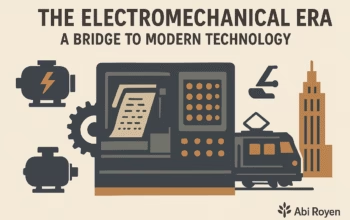
5. Early 20th-Century Developments: The Shift Toward Electronics
By the 20th century, computing was transitioning from mechanical devices to electromechanical and eventually electronic systems:
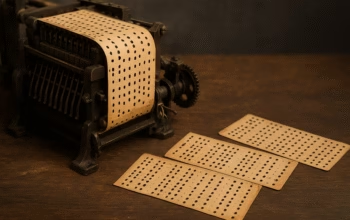
- Herman Hollerith (1860–1929):
Developed a punch card system to tabulate census data in 1890. His company later evolved into IBM. - Alan Turing (1912–1954):
Introduced the theoretical concept of the Turing Machine, a mathematical model that defines what it means for a system to be “computable.” His work laid the foundation for computer science. - Konrad Zuse (1910–1995):
Built the Z3 in 1941, considered the world’s first programmable digital computer.
These contributions represent the bridge between early mechanical ideas and modern electronic computation.

6. The Role of Early Computers in World War II
World War II accelerated computing innovation:
- Colossus (1943):
Built in Britain to break German codes, Colossus was the first programmable electronic computer. - ENIAC (1945, USA):
The first general-purpose electronic digital computer, capable of performing complex calculations for the U.S. military.
These wartime innovations showcased the practical power of computing and paved the way for post-war technological growth.
7. Philosophical and Theoretical Foundations
Beyond hardware, computing also rests on theoretical concepts:
- Boolean Algebra (George Boole, 1815–1864):
The mathematical system of logic that underpins digital circuit design. - Information Theory (Claude Shannon, 1948):
Defined the mathematical principles of data transmission and storage.
These frameworks remain essential in modern computer science and engineering.
8. Legacy of Early Computing Foundations
The early foundations of computing history reveal more than just technological progress—they highlight human ingenuity. Each milestone, from the abacus to the Analytical Engine, illustrates the constant drive to solve problems more efficiently.
Today’s supercomputers, artificial intelligence, and cloud technologies all trace their lineage back to these early inventions and ideas. By studying these foundations, we better appreciate the extraordinary journey that shaped modern computing.
Conclusion of Early Computing Foundations History
The early computing foundations history is a testament to centuries of innovation. Ancient counting tools evolved into mechanical calculators, which gave rise to programmable machines and eventually electronic computers. Visionaries like Charles Babbage, Ada Lovelace, and Alan Turing transformed computation from abstract concepts into tangible reality.
As we continue to advance into an era of quantum computing and artificial intelligence, it is essential to remember the roots of this digital revolution. The past not only explains where we come from but also guides where technology will take us.