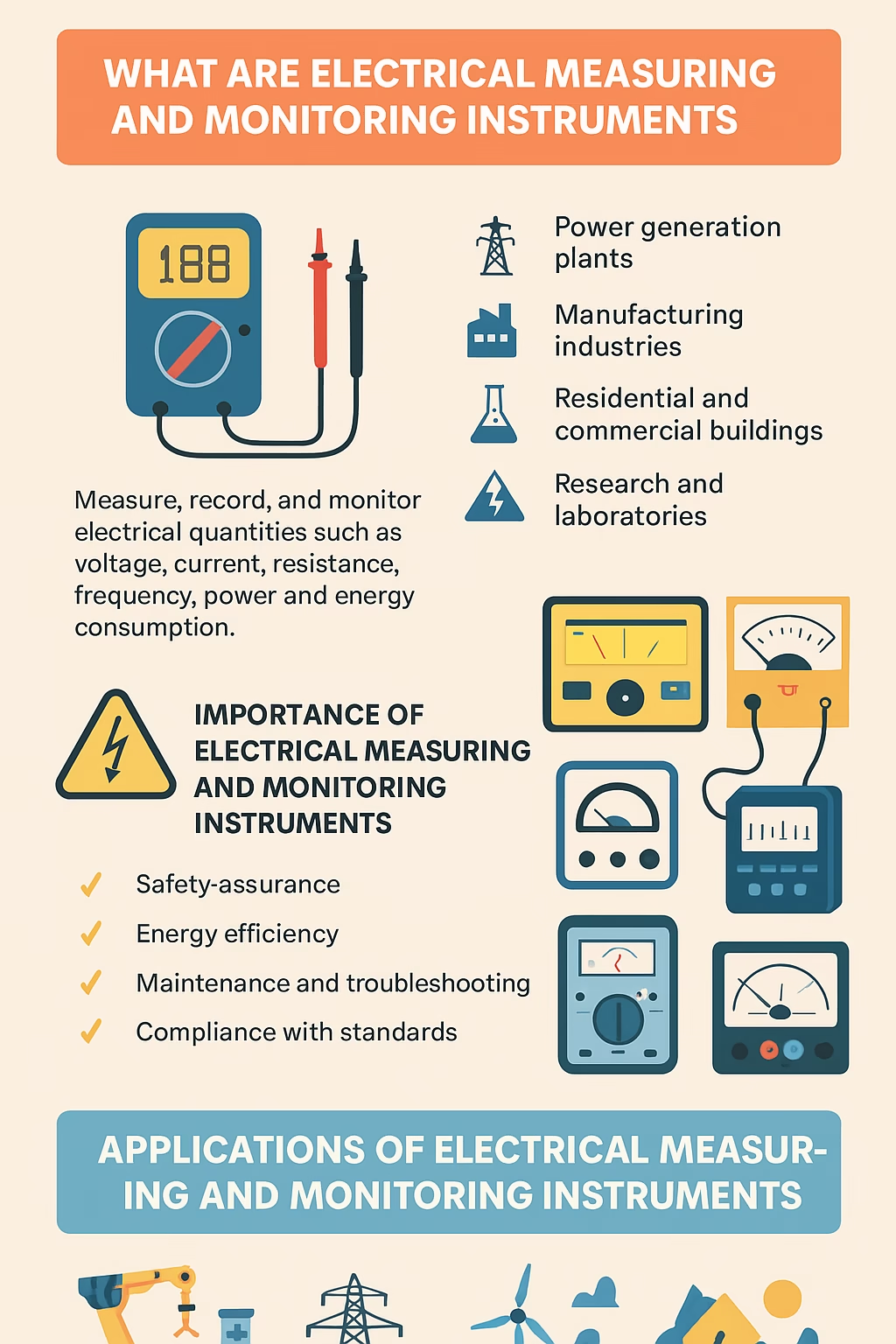

Introduction of Common Electrical Formulas
Electricity powers the modern world, and understanding how it works is essential for students, electricians, technicians, and engineers alike. At the heart of electrical engineering lies mathematics—specifically, the Common Electrical Formulas that allow us to calculate voltage, current, resistance, and power. These formulas provide the foundation for designing safe and efficient circuits, troubleshooting electrical systems, and improving energy efficiency.
In this article, we will cover the most widely used electrical formulas, explain their applications, and provide practical examples to help you master the basics. Whether you are preparing for exams, working on projects, or just refreshing your knowledge, this guide will serve as a handy reference.
Why Electrical Formulas Are Important
Formulas in electrical engineering are not just abstract concepts; they are practical tools used daily. Some of the key reasons why these formulas are important include:
- Designing Circuits – Engineers use formulas to calculate the correct values for voltage, current, and resistance when creating circuits.
- Troubleshooting – Electricians rely on formulas to find problems in electrical systems, such as determining if a component is overloaded.
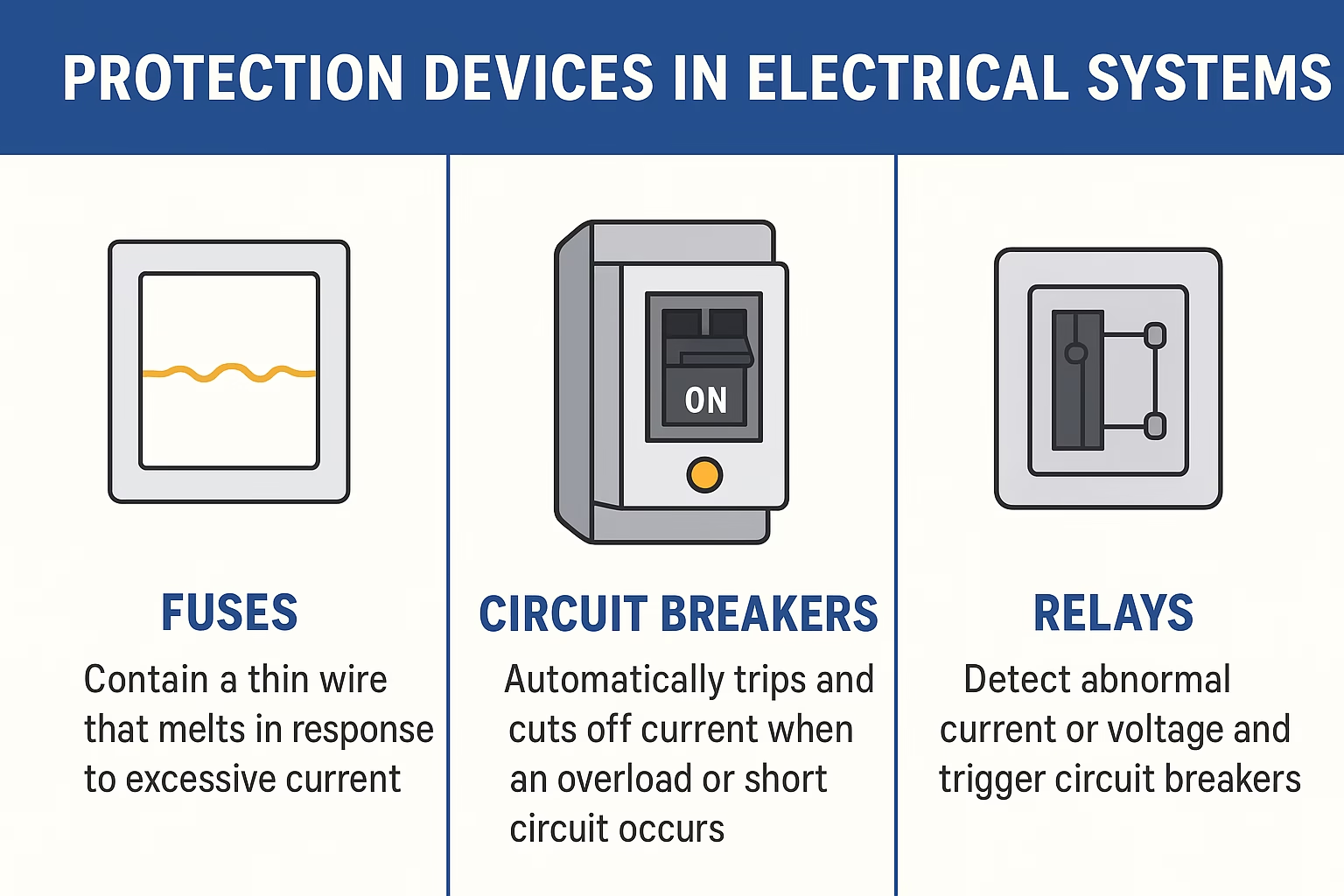
- Safety – Incorrect calculations can lead to overheating, short circuits, or even fires. Using the right formulas ensures safety.
- Efficiency – Calculations help optimize systems to reduce energy loss and improve performance.
Fundamental Electrical Quantities
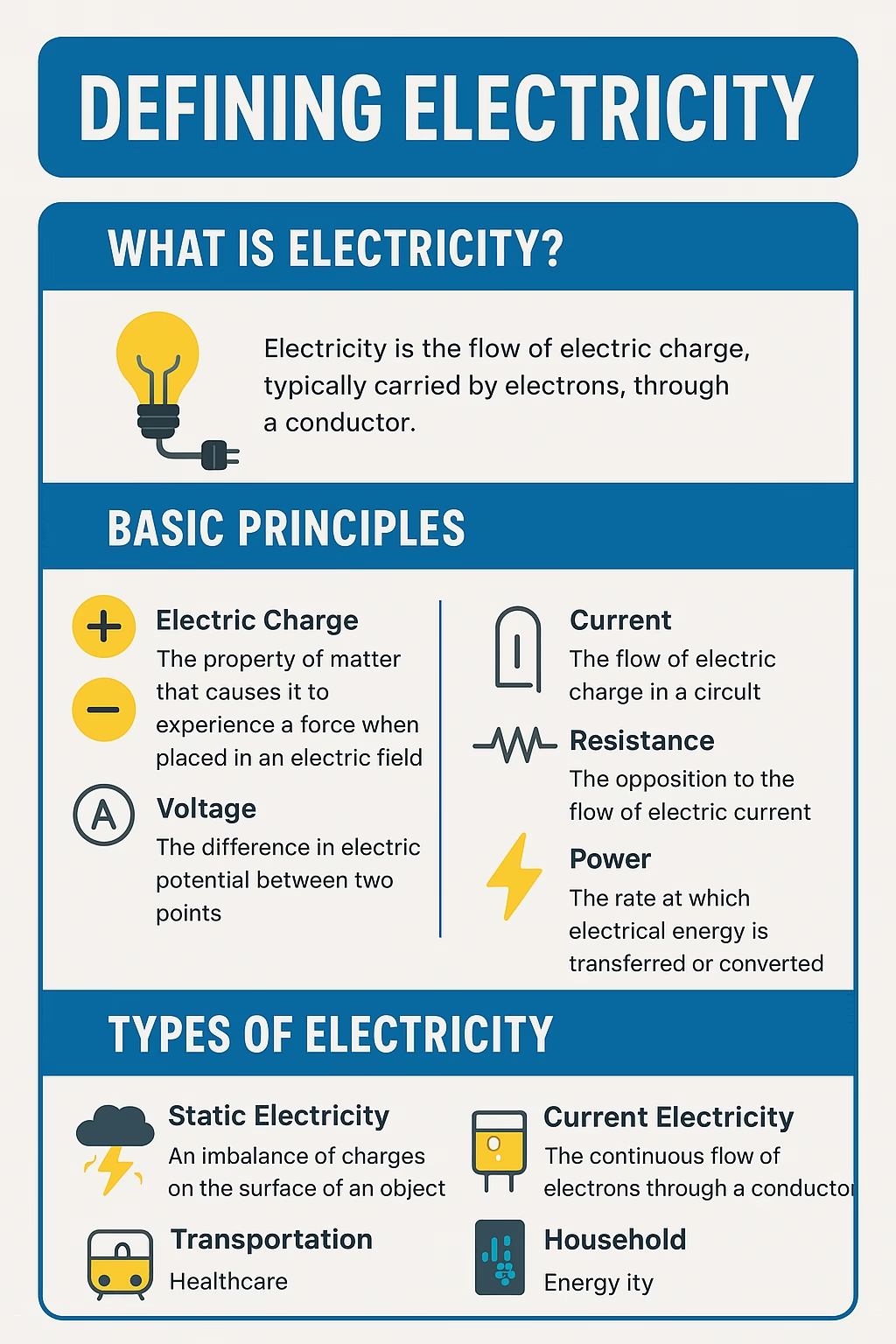
Before diving into the formulas, let’s recall the basic units of electricity:
- Voltage (V): The electrical potential difference, measured in volts (V).
- Current (I): The flow of electric charge, measured in amperes (A).
- Resistance (R): The opposition to current flow, measured in ohms (Ω).
- Power (P): The rate at which energy is consumed or produced, measured in watts (W).
These four quantities form the basis of most common electrical formulas.
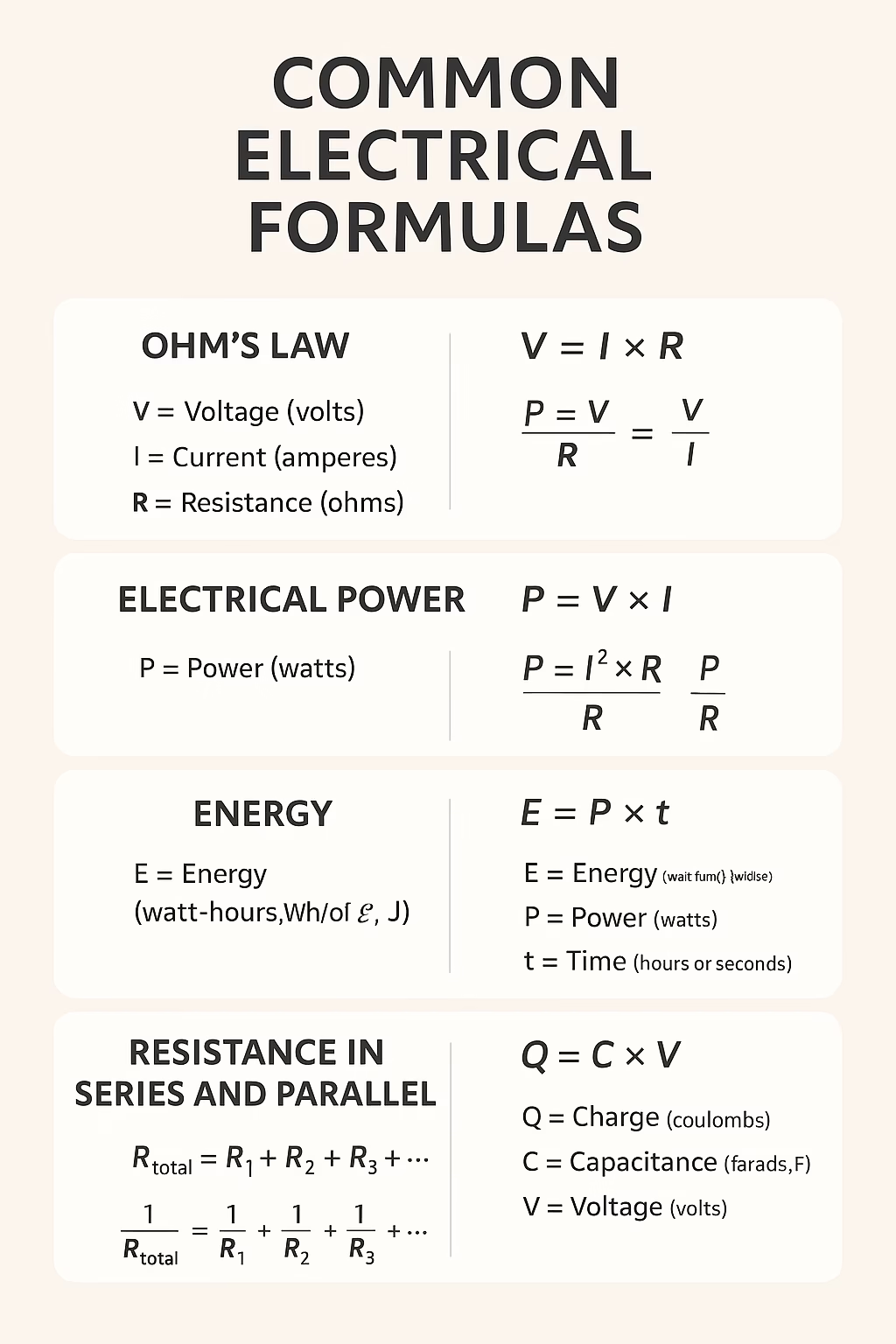
Common Electrical Formulas: Ohm’s Law
Perhaps the most important electrical formula is Ohm’s Law, discovered by Georg Simon Ohm. V=I×RV = I \times RV=I×R
Where:
- V = Voltage (volts)
- I = Current (amperes)
- R = Resistance (ohms)
From this equation, two other variations can be derived: I=VR,R=VII = \frac{V}{R}, \quad R = \frac{V}{I}I=RV,R=IV
Example:
If a 12 V battery is connected to a resistor of 6 Ω, the current is: I=VR=126=2 AI = \frac{V}{R} = \frac{12}{6} = 2 \,AI=RV=612=2A
Electrical Power Formulas
Power is another essential concept in electrical systems. The basic formula is: P=V×IP = V \times IP=V×I
But depending on what is known, other variations are used: P=I2×R,P=V2RP = I^2 \times R, \quad P = \frac{V^2}{R}P=I2×R,P=RV2
Example:
If a device operates at 220 V and draws 2 A of current, the power consumed is: P=V×I=220×2=440 WP = V \times I = 220 \times 2 = 440 \,WP=V×I=220×2=440W
Common Electrical Formulas: Energy
Electrical energy is the total power consumed over time: E=P×tE = P \times tE=P×t
Where:
- E = Energy (watt-hour, Wh or joules, J)
- P = Power (watts)
- t = Time (hours or seconds)
Example:
If a 100 W light bulb is used for 10 hours: E=100×10=1000 Wh=1 kWhE = 100 \times 10 = 1000 \,Wh = 1 \,kWhE=100×10=1000Wh=1kWh
Common Electrical Formulas: Resistance in Series and Parallel
When resistors are connected together, their total resistance depends on the type of connection.
- Series connection:
Rtotal=R1+R2+R3+…R_{total} = R_1 + R_2 + R_3 + \dotsRtotal=R1+R2+R3+…
- Parallel connection:
1Rtotal=1R1+1R2+1R3+…\frac{1}{R_{total}} = \frac{1}{R_1} + \frac{1}{R_2} + \frac{1}{R_3} + \dotsRtotal1=R11+R21+R31+…
Example:
Two resistors, 4 Ω and 6 Ω, are connected in parallel: 1Rtotal=14+16=512⇒Rtotal=2.4 Ω\frac{1}{R_{total}} = \frac{1}{4} + \frac{1}{6} = \frac{5}{12} \quad \Rightarrow \quad R_{total} = 2.4 \,\OmegaRtotal1=41+61=125⇒Rtotal=2.4Ω
Common Electrical Formulas: Capacitor
Capacitors store electrical energy, and their behavior depends on capacitance.
- Charge stored:
Q=C×VQ = C \times VQ=C×V
- Energy stored:
E=12CV2E = \frac{1}{2} C V^2E=21CV2
Where:
- Q = Charge (coulombs)
- C = Capacitance (farads, F)
- V = Voltage (volts)
Common Electrical Formulas: Inductor Formulas
Inductors store energy in the form of a magnetic field.
- Inductive reactance:
XL=2πfLX_L = 2 \pi f LXL=2πfL
Where:
- X_L = Inductive reactance (ohms)
- f = Frequency (Hz)
- L = Inductance (henry, H)
Common Electrical Formulas: Transformer Formulas
Transformers are essential in power distribution, and their basic formula is: VpVs=NpNs=IsIp\frac{V_p}{V_s} = \frac{N_p}{N_s} = \frac{I_s}{I_p}VsVp=NsNp=IpIs
Where:
- V_p, V_s = Primary and secondary voltage
- N_p, N_s = Number of turns in primary and secondary coils
- I_p, I_s = Primary and secondary current
Common Electrical Formulas: AC Power Formulas
In alternating current (AC) circuits, power is slightly more complex: P=V×I×cos(ϕ)P = V \times I \times \cos(\phi)P=V×I×cos(ϕ)
Where:
- φ (phi) = Phase angle between voltage and current
- cos(φ) = Power factor
This formula is important for calculating real power in industrial systems.
Practical Applications of Electrical Formulas
- Household Wiring – Calculating the load on circuits to prevent overloading.
- Electronics Design – Choosing the correct resistor or capacitor values in circuits.
- Power Plants – Managing power generation and distribution efficiency.
- Renewable Energy – Designing solar and wind systems with correct voltage and power levels.
- Automotive Systems – Ensuring batteries, alternators, and wiring function safely.
Common Mistakes When Using Electrical Formulas
- Unit Errors – Forgetting to convert milliamps to amps or kilowatts to watts.
- Ignoring Power Factor – In AC systems, not accounting for phase difference leads to inaccurate results.
- Overlooking Temperature Effects – Resistance changes with temperature, which can affect precision.
Conclusion
Mastering common electrical formulas is essential for anyone working in electronics, electrical engineering, or related fields. From Ohm’s Law to power, energy, and transformer calculations, these equations provide the foundation for designing, analyzing, and maintaining electrical systems.
By consistently applying these formulas, you can ensure safety, efficiency, and accuracy in your electrical projects. Whether you are a student studying the basics or a professional engineer managing complex systems, these formulas will remain indispensable throughout your career.