
Introduction of Characteristics of Diodes
Diodes are among the most fundamental components in the field of electronics. They play a crucial role in directing the flow of electrical current, acting as one-way valves for electricity. Understanding the characteristics of diodes is essential for anyone working with circuits, whether you are a student, hobbyist, or professional engineer.
This article explores the key properties, V-I (voltage-current) characteristics, different modes of operation, and various diode types used in modern electronic systems. By the end, you’ll have a solid grasp of how diodes function and why they are indispensable in circuit design.
What is a Diode?
A diode is a two-terminal semiconductor device that allows current to flow primarily in one direction. It is built using a p-n junction, where p-type (positive) and n-type (negative) semiconductor materials meet.
The anode (positive terminal) and cathode (negative terminal) define the diode’s orientation, which determines how it responds under applied voltage.
- Symbol of a Diode: A triangle pointing to a line, where the triangle represents the anode, and the line represents the cathode.
- Basic Function: Allows current to pass when forward biased, blocks current when reverse biased.
V-I Characteristics of Diodes
The most important way to understand a diode’s behavior is by examining its voltage-current (V-I) characteristics.
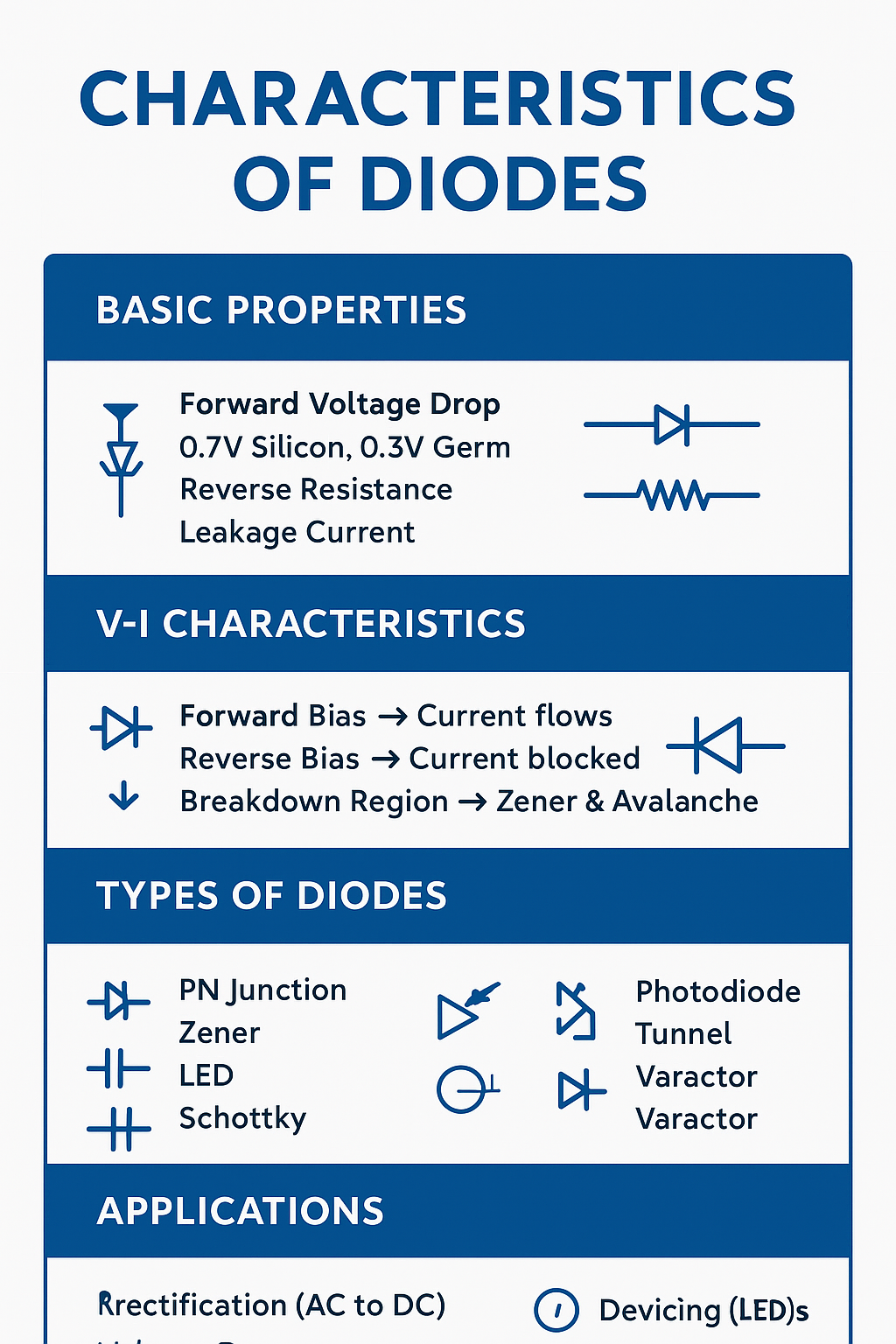
1. Characteristics of Diodes: Forward Bias Condition
- When the anode is connected to the positive terminal of a voltage source and the cathode to the negative terminal, the diode is said to be in forward bias.
- Current does not flow immediately; instead, the diode requires a minimum voltage known as the threshold or cut-in voltage.
- Silicon diodes: ~0.7 V
- Germanium diodes: ~0.3 V
- Once this voltage is reached, the diode conducts heavily, allowing current to pass almost freely.
2. Characteristics of Diodes: Reverse Bias Condition
- In reverse bias, the cathode is connected to the positive terminal and the anode to the negative terminal.
- In this state, the diode blocks current flow, except for a very small leakage current.
- This makes diodes extremely useful as rectifiers, converting AC to DC by allowing only one half of the waveform to pass.
3. Characteristics of Diodes: Breakdown Region
- If the reverse voltage is increased beyond a certain point, the diode enters breakdown.
- Two main breakdown mechanisms:
- Zener Breakdown (low-voltage, used in Zener diodes for regulation)
- Avalanche Breakdown (high-voltage, occurs when carriers gain enough energy to release more carriers).
- Modern diodes are designed to handle or prevent breakdown depending on application needs.
Key Characteristics of Diodes
Here are the most notable properties that define a diode’s operation:
- Forward Voltage Drop – The minimum voltage needed to make the diode conduct.
- Reverse Resistance – The diode’s ability to block current under reverse bias.
- Leakage Current – A tiny current that flows even in reverse bias, usually negligible.
- Breakdown Voltage – The maximum reverse voltage the diode can withstand before conducting.
- Reverse Recovery Time – The time a diode takes to switch from conducting to blocking state.
- Capacitance Effect – Diodes exhibit junction capacitance, especially important in high-frequency applications.
Types of Characteristics of Diodes
Different types of diodes are designed to exploit specific electrical characteristics:
1. Standard PN Junction Diode
- Used in rectification circuits.
- Characterized by forward voltage (~0.7 V for silicon).
2. Zener Diode
- Operates in reverse breakdown region.
- Provides voltage regulation in power supplies.
3. Light Emitting Diode (LED)
- Emits light when forward biased.
- Forward voltage depends on color (typically 1.8–3.3 V).
4. Schottky Diode
- Very low forward voltage drop (~0.2–0.3 V).
- Extremely fast switching, used in power electronics.
5. Photodiode
- Converts light into current.
- Operates in reverse bias for sensing applications.
6. Tunnel Diode
- Shows negative resistance region in its V-I curve.
- Used in high-frequency oscillators.
7. Varactor Diode
- Works as a variable capacitor.
- Widely used in RF circuits and frequency modulation.
Applications of Diodes Based on Characteristics of Diodes
The unique characteristics of diodes make them suitable for a wide variety of electronic applications:
- Rectification: Converting AC to DC in power supplies.
- Signal Clipping and Clamping: Shaping waveforms in communication circuits.
- Voltage Regulation: Zener diodes maintain constant voltage levels.
- Switching Applications: Schottky diodes are ideal for fast switching in digital logic.
- Lighting: LEDs are used in displays, indicators, and general illumination.
- Protection Circuits: Diodes prevent reverse polarity damage in sensitive electronics.
- RF Design: Varactor and tunnel diodes enable tuning and oscillation.
Advantages and Limitations of Diodes
Advantages:
- Small size and low cost.
- High reliability in circuit protection.
- Wide variety for specialized applications.
Limitations:
- Non-linear behavior limits analog signal processing.
- Voltage drop can cause power loss in sensitive circuits.
- Temperature dependency affects performance in extreme environments.
Future of Diode Technology
Advancements in semiconductor materials like Gallium Nitride (GaN) and Silicon Carbide (SiC) are pushing diode performance beyond traditional silicon. These materials offer:
- Higher efficiency
- Better heat resistance
- Faster switching speeds
As electronic devices become smaller and more energy-efficient, diodes will continue to evolve to meet modern demands.
Conclusion of Characteristics of Diodes
Diodes may seem simple at first glance, but their characteristics and applications form the backbone of modern electronics. From rectification in power supplies to lighting in LEDs, diodes are indispensable components that enable countless technologies we rely on daily.
Understanding the forward and reverse bias behavior, V-I characteristics, breakdown mechanisms, and diode types helps engineers and hobbyists design efficient, reliable, and innovative circuits.