Introduction
Advantages of Automation ~ Automation has become one of the most influential drivers of technological advancement in the 21st century. From manufacturing lines and financial services to healthcare and home devices, automation plays a crucial role in improving efficiency, accuracy, and productivity. Businesses across the globe are adopting automated systems to remain competitive, while individuals are experiencing the benefits of automation in their daily routines.
This article explores the advantages of automation, focusing on its applications in various industries, its impact on businesses, and how it shapes our modern world.
1. Advantages of Automation: Increased Efficiency
One of the most significant advantages of automation is the improvement in efficiency. Machines and automated systems can perform repetitive tasks faster and more accurately than humans.
For example, in the manufacturing industry, robotic arms can assemble products continuously without fatigue. Similarly, in logistics, automated conveyor belts and sorting systems streamline warehouse operations, ensuring goods move faster from production to customers.
Efficiency improvements mean businesses can deliver more in less time, leading to faster turnaround and greater customer satisfaction.
2. Advantages of Automation: Enhanced Productivity
Automation allows businesses to produce more output with the same or fewer resources. Machines can operate 24/7 without breaks, unlike human workers who require rest and shifts.
This round-the-clock productivity is especially valuable in industries like:
- Automotive manufacturing, where production lines need to meet global demand.
- Data processing, where artificial intelligence (AI) and software automation handle millions of transactions within seconds.
- Customer service, with chatbots providing instant responses across different time zones.
By integrating automation, organizations significantly boost their productivity while maintaining quality standards.
3. Advantages of Automation: Cost Reduction
Although automation requires an initial investment in technology, the long-term cost savings are substantial. Automated systems reduce labor costs, minimize human errors, and lower waste production.
For instance, precision robotics in the electronics industry reduce defective products, saving companies millions of dollars annually. In agriculture, automated irrigation systems reduce water usage, cutting operational costs while improving crop yield.
Over time, the reduction in expenses makes automation one of the most profitable investments for businesses.
4. Advantages of Automation: Improved Accuracy and Consistency
Unlike human workers, automated systems do not suffer from fatigue, distraction, or inconsistencies. This ensures higher accuracy and uniform results.
For example:
- In healthcare, automated diagnostic machines detect diseases with greater precision than manual methods.
- In finance, automated algorithms analyze data without emotional bias, ensuring consistent decision-making.
- In food production, automated systems maintain hygiene and quality standards more reliably.
Consistency in output strengthens brand trust and reduces risks for companies.
5. Advantages of Automation: Enhanced Safety
Automation improves workplace safety by handling dangerous tasks that would put human workers at risk.
Industries such as mining, oil and gas, and chemical processing use robots and automated systems to manage hazardous environments. For example:
- Drones inspect oil rigs, reducing the risk of accidents for workers.
- Automated machinery handles toxic chemicals, protecting human health.
By reducing exposure to danger, automation helps create safer working environments.
6. Advantages of Automation: Scalability and Flexibility
Automation allows companies to scale their operations quickly. Whether a business needs to increase production or expand into new markets, automated systems can adapt without significant additional costs.
For instance:
- E-commerce platforms use automated inventory management to handle seasonal demand fluctuations.
- Cloud-based software automation allows businesses to upgrade capacity instantly as customer needs grow.
This flexibility is critical in today’s fast-paced business environment, where companies must respond to changing market conditions rapidly.
7. Better Resource Management
Automation contributes to optimal resource utilization, reducing waste and promoting sustainability.
Examples include:
- Smart energy management systems that adjust electricity consumption in real-time.
- Automated irrigation systems that optimize water use in agriculture.
- Predictive maintenance in manufacturing that prevents unnecessary equipment replacement.
As industries strive toward eco-friendly solutions, automation supports both cost savings and environmental responsibility.
8. Advantages of Automation: Data-Driven Insights
One of the most powerful advantages of automation is its ability to collect and analyze data. Automated systems track performance, detect inefficiencies, and provide real-time insights for decision-making.
For example:
- In retail, automated analytics track customer preferences, enabling personalized marketing.
- In healthcare, automation collects patient data, improving treatment strategies.
- In logistics, automated systems optimize delivery routes to reduce fuel consumption.
Data-driven insights empower businesses to make smarter decisions and gain a competitive edge.
9. Improved Customer Experience
Automation plays a crucial role in enhancing the customer experience. From online shopping to customer service, automation ensures speed, convenience, and personalization.
Examples include:
- Chatbots providing instant assistance 24/7.
- Automated checkout systems reducing waiting times in retail stores.
- Recommendation engines suggesting products based on user behavior.
By offering seamless interactions, automation increases customer satisfaction and loyalty.
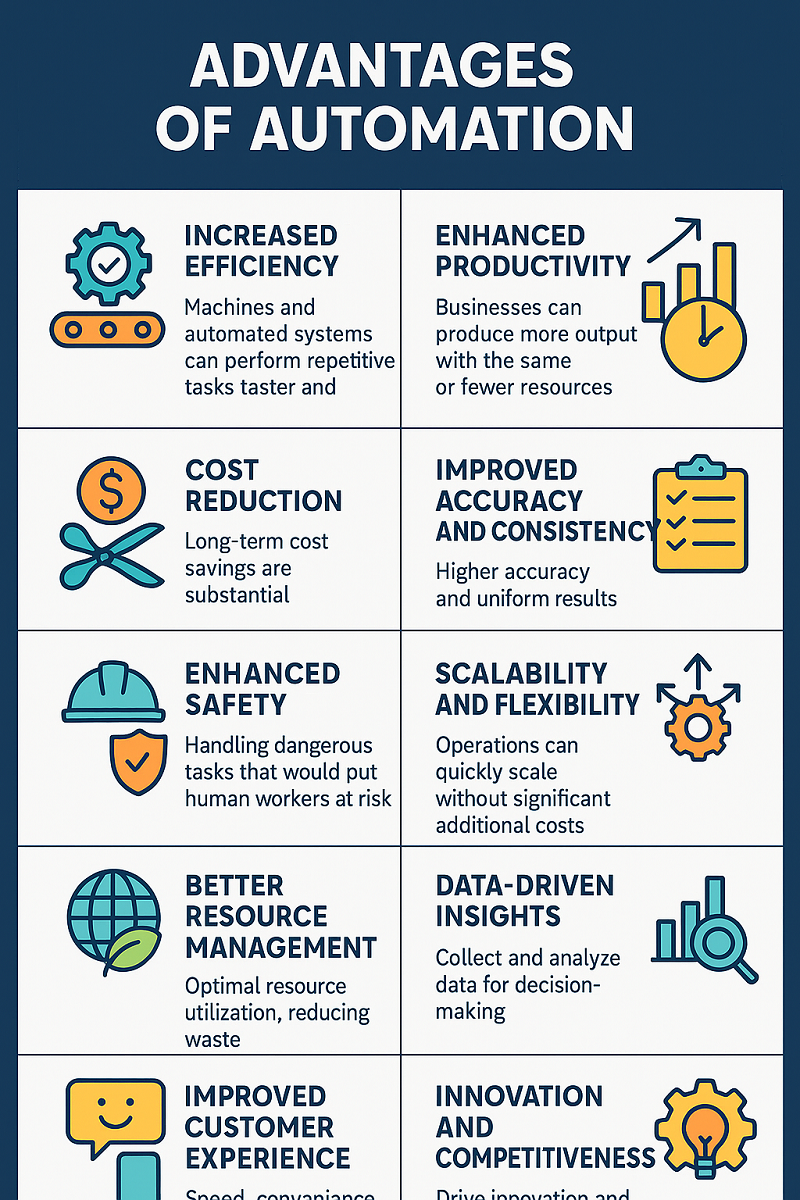
10. Advantages of Automation: Innovation and Competitiveness
Finally, automation drives innovation and competitiveness. Companies that adopt automation can innovate faster, offering new products and services while staying ahead of competitors.
For example:
- Autonomous vehicles are revolutionizing the transportation industry.
- Smart factories are setting new standards in industrial production.
- AI-driven automation is creating new possibilities in personalized healthcare.
By leveraging automation, businesses not only survive but thrive in today’s digital economy.
Conclusion
The advantages of automation extend far beyond cost savings and efficiency. From improving safety and accuracy to enabling innovation and better customer experiences, automation is reshaping industries and transforming the way we live and work.
As technology continues to advance, the role of automation will only expand, offering even greater opportunities for businesses and individuals alike. For companies looking to remain competitive in the digital age, embracing automation is not an option—it’s a necessity.