
In the world of maritime navigation, accurate measurement of a ship’s speed is crucial for safety, efficiency, and operational performance. One of the essential instruments used on vessels to achieve this is the speed log. Whether it is a cargo ship, naval vessel, or passenger liner, the speed log plays a vital role in ensuring accurate navigation and fuel management.
This article will explore the definition, types, working principles, and modern applications of speed logs, providing valuable insights for maritime students, professionals, and technology enthusiasts.
📌 What is a Speed Log?
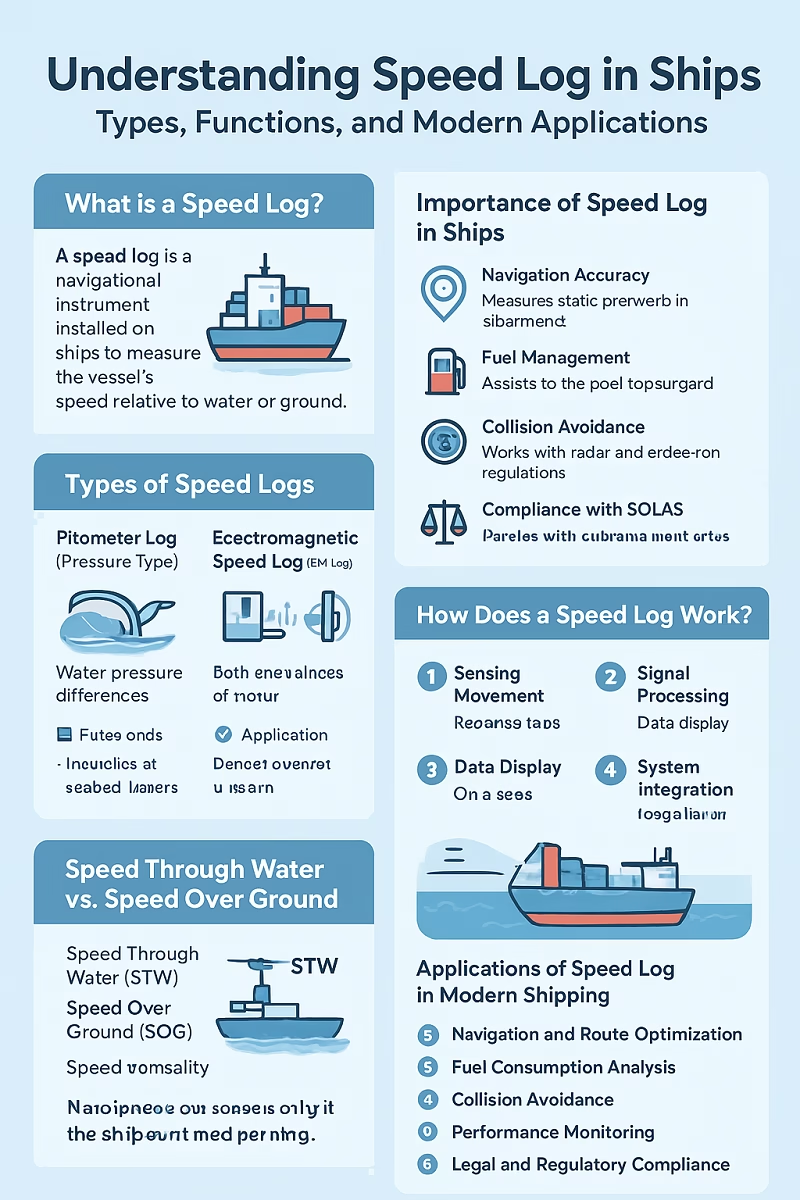
A speed log is a navigational instrument installed on ships to measure the vessel’s speed relative to water or ground. The data obtained from the speed log is vital for navigation, voyage planning, and fuel consumption analysis.
Speed logs are usually integrated with other systems such as:
- Voyage Data Recorder (VDR)
- Automatic Radar Plotting Aid (ARPA)
- Integrated Navigation Systems (INS)
By doing so, the speed log contributes to the accuracy of overall ship operations.
📌 Importance of Speed Log in Ships
The primary importance of a speed log lies in safe and efficient navigation. Here are several key reasons why speed logs are indispensable on ships:
- Navigation Accuracy – Helps in determining the ship’s exact position along with GPS.
- Fuel Management – Assists in calculating optimal fuel usage based on speed and resistance.
- Collision Avoidance – Works with radar and ARPA to avoid collisions at sea.
- Compliance with SOLAS – Ships over a certain tonnage are required to have speed logs installed according to international maritime regulations.
- Performance Monitoring – Helps engineers and officers assess the vessel’s operational efficiency.
📌 Types of Speed Logs
There are several types of speed logs used in ships. Each operates on different principles of physics and technology:
1. Pitometer Log (Pressure Type)
- Working Principle: Measures water pressure difference between static and dynamic pressure ports.
- Application: Mostly used in older vessels or submarines.
- Limitation: Accuracy decreases with shallow waters and high-speed currents.
2. Electromagnetic Speed Log (EM Log)
- Working Principle: Based on Faraday’s Law of Electromagnetic Induction, when a conductor (seawater) moves through a magnetic field, a voltage is induced.
- Advantages: Reliable, easy to maintain, and widely used.
- Limitation: Measures speed relative to water, not ground.
3. Doppler Speed Log (DSL)
- Working Principle: Uses the Doppler effect by transmitting sound waves into the water and measuring the frequency shift of reflected waves.
- Advantages: Can measure both speed through water and speed over ground.
- Application: Commonly installed in modern commercial vessels and warships.
4. Satellite-Based Speed Log
- Working Principle: Utilizes GPS signals to calculate speed over ground.
- Advantages: Highly accurate and less affected by water conditions.
- Limitation: May not function properly in GPS-denied environments.
📌 How Does a Speed Log Work?
The working principle of a speed log depends on its type. However, the general process involves:
- Sensing Movement – Detecting the ship’s movement relative to water or seabed.
- Signal Processing – Converting the detected signals into electrical impulses.
- Data Display – Showing real-time speed information on the ship’s bridge console.
- System Integration – Transmitting data to other navigational systems for enhanced accuracy.
📌 Speed Through Water vs. Speed Over Ground
It is essential to understand the difference between:
- Speed Through Water (STW): The ship’s speed relative to surrounding water mass.
- Speed Over Ground (SOG): The actual speed of the ship relative to the seabed or Earth’s surface.
Factors such as currents, tides, and wind can cause a significant difference between STW and SOG. For precise navigation, both parameters must be considered.
📌 Applications of Speed Log in Modern Shipping
Speed logs are more than just speed indicators—they serve multiple applications in today’s shipping industry:
- Navigation and Route Optimization
- Used with GPS and ECDIS to determine the best possible route.
- Fuel Consumption Analysis
- By correlating speed with engine output, fuel usage can be optimized.
- Collision Avoidance
- Provides accurate speed data to radar and ARPA systems for tracking nearby vessels.
- Performance Monitoring
- Helps shipowners evaluate the efficiency of propellers, hull design, and engine performance.
- Legal and Regulatory Compliance
- Required by the International Maritime Organization (IMO) under SOLAS regulations.
📌 Challenges and Limitations of Speed Logs
While highly useful, speed logs face some limitations:
- Marine Growth on Sensors – Can affect accuracy.
- Water Conditions – Turbulence and salinity variations may cause errors.
- Maintenance Needs – Regular calibration is essential.
- Cost – Advanced systems like Doppler logs are expensive.
📌 Future of Speed Logs
With the advancement of digitalization and smart shipping, speed logs are evolving to integrate with:
- IoT (Internet of Things) for real-time monitoring.
- Big Data Analytics for predictive maintenance.
- AI-assisted navigation for autonomous ships.
Future ships will likely rely on hybrid systems, combining Doppler, GPS, and electromagnetic technologies for maximum reliability.
📌 Conclusion
The speed log is an indispensable instrument in modern maritime navigation. From traditional pitometer logs to advanced Doppler and satellite-based systems, these devices ensure safe, efficient, and regulation-compliant ship operations. As shipping moves toward automation and digital transformation, speed logs will continue to play a critical role in enhancing navigation safety and operational efficiency.
For maritime professionals, engineers, and students, understanding the principles, types, and applications of speed logs is not just theoretical knowledge—it is a cornerstone of modern marine engineering.