Introduction
The global shipping industry depends heavily on advanced technologies to ensure safety, efficiency, and effective communication at sea. One of the most crucial innovations in modern maritime navigation is the Automatic Identification System (AIS). Developed to improve situational awareness and reduce the risk of collisions, AIS has become a standard tool for vessels worldwide.
This article explores the definition, working principle, components, benefits, and applications of AIS in maritime navigation. It also highlights the role of AIS in supporting global trade, environmental protection, and the future of smart shipping.
What is the Automatic Identification System (AIS)?
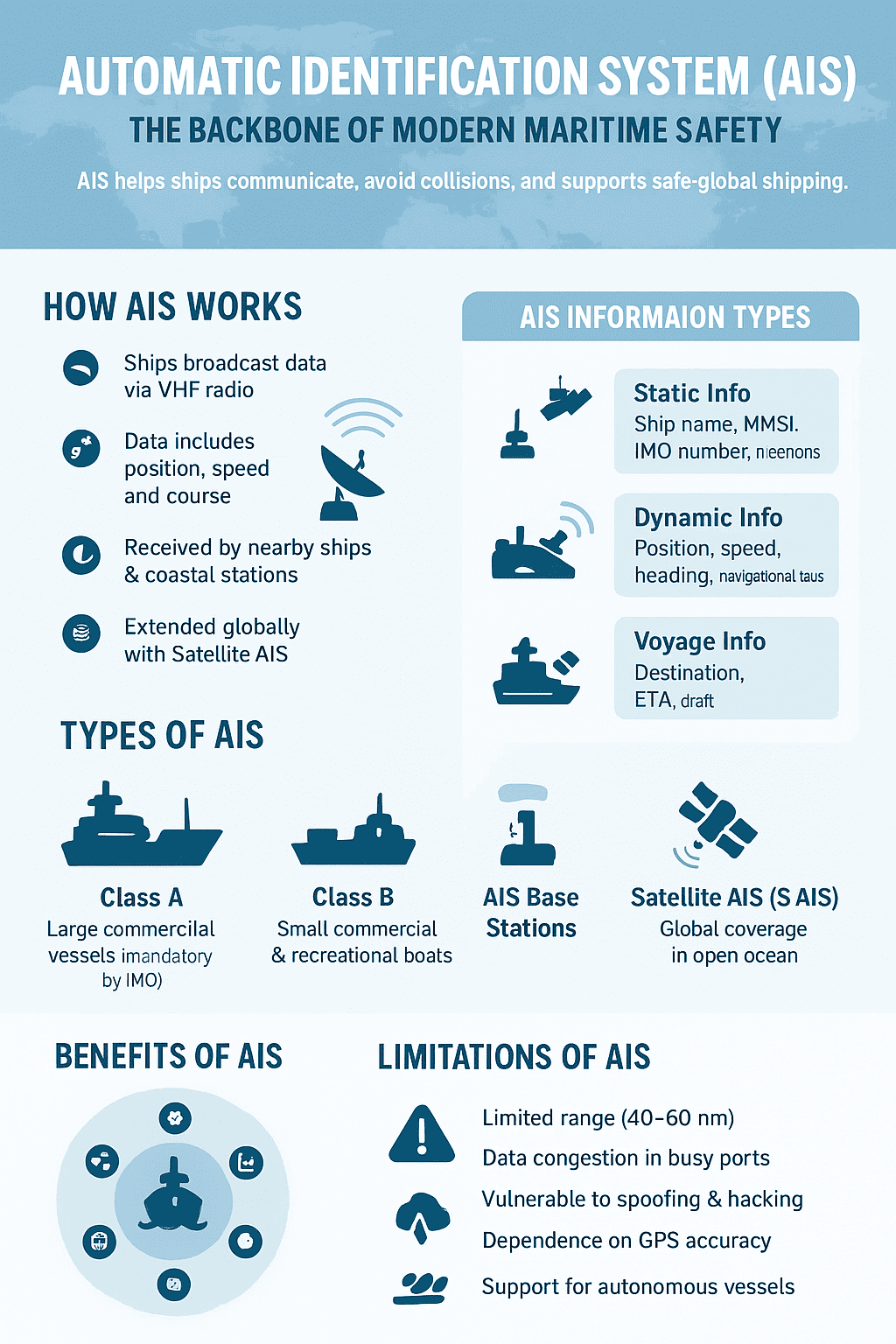
The Automatic Identification System (AIS) is an automatic tracking system used on ships and by vessel traffic services (VTS) to identify and locate ships. AIS transmits essential navigational data such as a ship’s identity, position, course, and speed through VHF radio frequencies.
It was originally mandated by the International Maritime Organization (IMO) under the Safety of Life at Sea (SOLAS) convention to improve maritime safety. Today, AIS is widely used for:
- Preventing ship collisions
- Enhancing port and coastal monitoring
- Supporting search and rescue operations
- Providing real-time vessel information for authorities and shipping companies
How Does Automatic Identification System (AIS) Work?
AIS relies on VHF radio signals to transmit data between ships and coastal stations. It functions similarly to air traffic control systems for aircraft, but for ships.
Each AIS-equipped vessel has a transceiver that automatically broadcasts data at regular intervals, including:
- Static information: Ship name, IMO number, call sign, MMSI (Maritime Mobile Service Identity), type of vessel, and dimensions.
- Dynamic information: Ship’s position (via GPS), speed over ground (SOG), course over ground (COG), and navigational status.
- Voyage-related information: Destination, estimated time of arrival (ETA), and draft.
This information is received by other nearby ships and shore-based AIS stations, allowing vessels and authorities to track maritime traffic in real time.
Components of Automatic Identification System (AIS)
The AIS system consists of several essential components:
- AIS Transceiver – Installed on ships to send and receive AIS signals.
- GPS Receiver – Provides accurate positioning data.
- VHF Antennas – Used for transmitting and receiving AIS data over marine radio frequencies.
- AIS Base Stations – Coastal stations that collect and relay AIS information to vessel traffic services (VTS).
- AIS Software & Display Systems – Integrated into Electronic Chart Display and Information Systems (ECDIS) or standalone displays for navigational awareness.
Types of Automatic Identification System (AIS) Systems
AIS systems are categorized based on their capabilities and applications:
- Class A AIS
- Mandatory for all SOLAS-compliant vessels (cargo ships, tankers, and passenger ships).
- Transmits at high power with faster update rates.
- Provides detailed information for large commercial vessels.
- Class B AIS
- Used by smaller commercial vessels and recreational boats.
- Lower transmission power and slower update rates compared to Class A.
- More affordable and suitable for non-SOLAS vessels.
- AIS Base Stations
- Operated by coastal authorities for monitoring maritime traffic.
- Satellite AIS (S-AIS)
- Extends AIS coverage beyond coastal areas into the open ocean.
- Provides global ship-tracking capabilities for governments, shipping companies, and international organizations.
Advantages of Automatic Identification System (AIS) in Maritime Navigation
The adoption of AIS has revolutionized maritime safety and global shipping. Its benefits include:
- Collision Avoidance
- AIS provides real-time ship movement data, helping navigators avoid accidents, especially in congested waters.
- Enhanced Maritime Safety
- Authorities can monitor vessel movements and identify potential risks.
- Efficient Vessel Traffic Management
- Port authorities use AIS data to manage traffic flow, reduce congestion, and improve docking efficiency.
- Search and Rescue Operations
- AIS aids in locating vessels in distress, providing accurate positioning data to rescue teams.
- Maritime Security
- Authorities use AIS to monitor suspicious vessels, illegal fishing, and smuggling activities.
- Environmental Protection
- AIS supports tracking of ships carrying hazardous materials, preventing accidents and environmental disasters.
- Global Trade Facilitation
- Shipping companies use AIS data for better fleet management, reducing fuel costs and improving logistics.
Applications of Automatic Identification System (AIS)
AIS has diverse applications across the maritime industry:
- Commercial Shipping – For tracking cargo ships, tankers, and passenger liners.
- Fishing Industry – Prevents illegal fishing and supports sustainable practices.
- Port Management – Enhances efficiency in docking, cargo handling, and departure scheduling.
- Coastal Surveillance – Monitors national waters for security and environmental compliance.
- Research & Environmental Studies – Used by marine scientists to study ship traffic and its impact on marine ecosystems.
- Recreational Boating – Provides safety and situational awareness for yachts and private vessels.
Challenges and Limitations of AIS
While AIS is highly effective, it does have certain limitations:
- Signal Range – Standard AIS has limited range (40–60 nautical miles).
- Data Overload – In busy shipping areas, AIS signals can become congested.
- Security Risks – AIS signals are unencrypted and can be spoofed by malicious actors.
- Dependence on GPS – Accuracy relies heavily on satellite navigation systems.
The Future of Automatic Identification System
As technology advances, AIS continues to evolve with new features and integrations:
- Integration with IoT and Big Data – For real-time fleet analytics.
- Improved Satellite AIS – Offering better global coverage.
- AI-driven AIS Monitoring – Detecting anomalies and enhancing maritime cybersecurity.
- Green Shipping Initiatives – Using AIS data to optimize fuel efficiency and reduce emissions.
AIS will play a vital role in smart shipping, autonomous vessels, and digital ports, shaping the future of global maritime trade.
Conclusion
The Automatic Identification System (AIS) has become a cornerstone of modern maritime navigation and safety. By providing real-time vessel information, AIS reduces the risk of collisions, enhances port operations, supports search and rescue missions, and strengthens maritime security.
As shipping continues to expand in a globalized world, AIS will remain essential for ensuring safe, efficient, and sustainable maritime operations.