Introduction
Automation has become one of the most transformative forces of the modern world. From factory production lines to the software systems that power businesses, automation has streamlined operations, increased efficiency, and reduced the reliance on repetitive human tasks. But not all automation is the same. There are different types of automation, each with unique characteristics, benefits, and areas of application.
In this article, we will explore the major types of automation, including industrial automation, office automation, IT automation, robotic process automation (RPA), home automation, and business process automation (BPA). By understanding these categories, businesses and individuals can make informed decisions about integrating automation into their processes.
1. Types of Automation: Industrial Automation
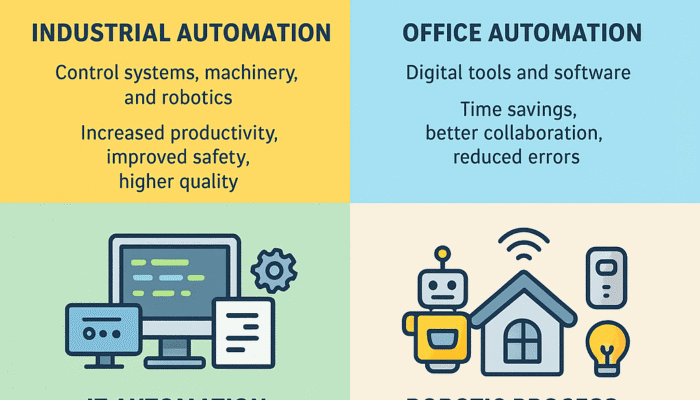
Industrial automation is one of the oldest and most widely used forms of automation. It refers to the use of control systems, machinery, and robotics to handle production tasks with minimal human intervention.
Key Features:
- Relies on technologies such as Programmable Logic Controllers (PLCs), SCADA systems, and robotics.
- Used in industries like manufacturing, oil & gas, chemical processing, food & beverage, and automotive.
- Helps maintain high accuracy and consistency in production.
Benefits:
- Increased productivity: Machines work faster and longer than humans.
- Improved safety: Reduces exposure to hazardous environments.
- Higher quality: Precision systems minimize errors.
Example: A car manufacturing plant using robotic arms to weld, paint, and assemble vehicles on a production line.
Read More about Industrial Automation: Transforming Modern Manufacturing and Beyond
2. Types of Automation: Office Automation
Office automation involves the use of digital tools and software to carry out administrative tasks. Instead of handling repetitive paperwork, employees use automated systems for data management, communication, and reporting.
Key Features:
- Includes applications like Microsoft Office, Google Workspace, and document management systems.
- Automation of scheduling, data storage, communication, and reporting.
- Reduces time spent on manual tasks such as filing, printing, and distributing documents.
Benefits:
- Time savings for administrative work.
- Better collaboration with shared digital platforms.
- Reduced errors in data entry and communication.
Example: An HR department using an automated payroll system that calculates salaries, tax deductions, and employee benefits.
Read More about The Future of Office Automation: Streamlining Workflows and Boosting Productivity
3. Types of Automation: IT Automation
IT automation refers to the use of software to create repeatable instructions and processes that reduce the need for human intervention in IT operations.
Key Features:
- Includes server management, cloud provisioning, application deployment, and system monitoring.
- Popular tools include Ansible, Puppet, Chef, and Jenkins.
- Supports both on-premises and cloud-based infrastructure.
Benefits:
- Faster deployment of IT resources.
- Lower costs by reducing manual maintenance.
- Enhanced reliability with automated monitoring and issue detection.
Example: A company using IT automation tools to automatically scale cloud servers during peak traffic times.
Read More about The Future of IT Automation: Driving Efficiency and Innovation in the Digital Era
4. Types of Automation: Robotic Process Automation (RPA)
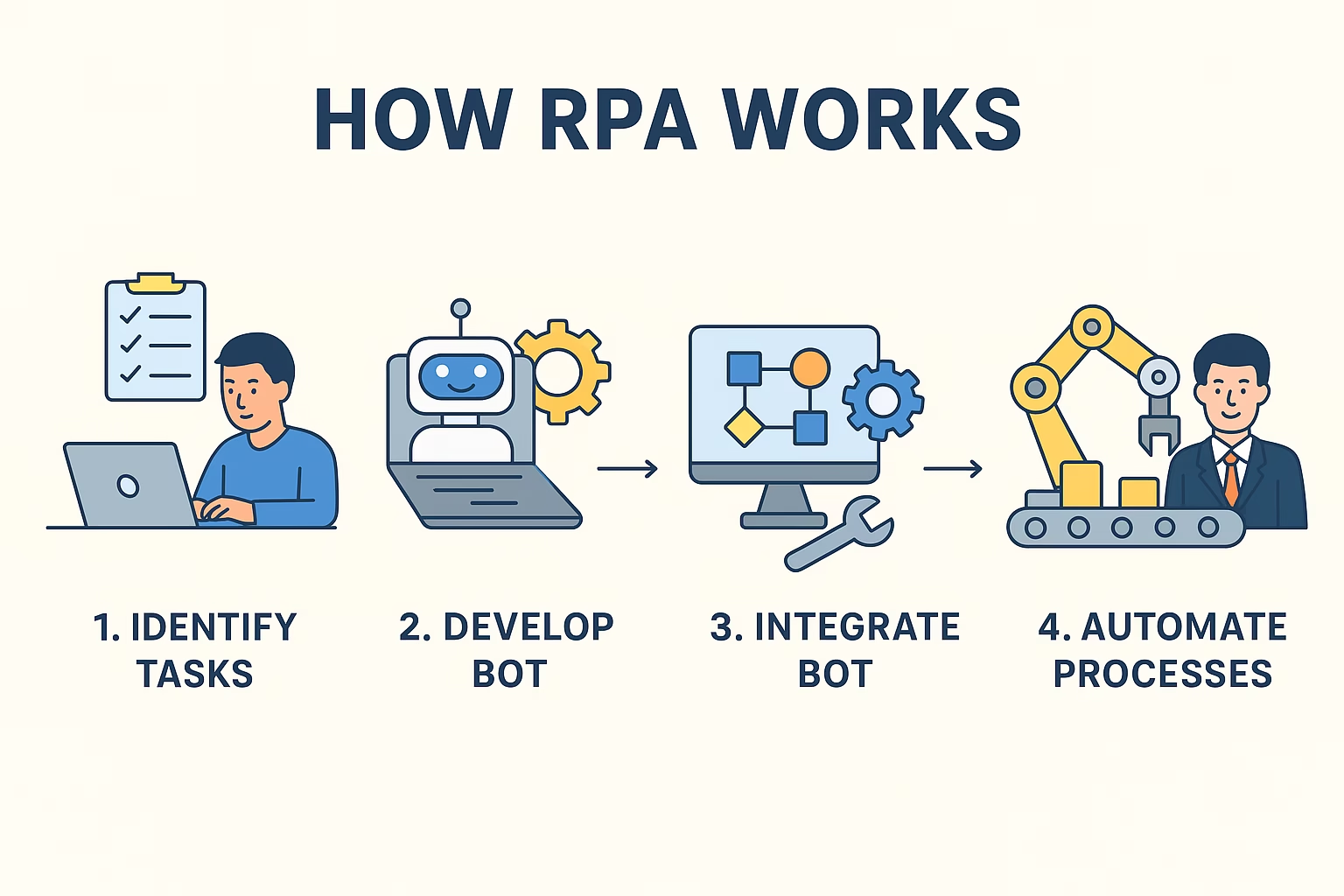
RPA focuses on automating rule-based, repetitive business processes using software robots (bots). Unlike traditional automation, RPA doesn’t require deep system integration but works on top of existing applications.
Key Features:
- Automates tasks like invoice processing, customer onboarding, and data entry.
- Works with multiple applications simultaneously.
- No need to change the underlying IT infrastructure.
Benefits:
- Cost efficiency: Reduces labor costs significantly.
- Quick implementation compared to custom-built automation systems.
- Scalability: Easily expand to more processes.
Example: A bank deploying RPA bots to automatically verify customer documents for loan approvals.
Read More about Robotic Process Automation (RPA): Transforming Business Efficiency Through Automation
5. Home Automation
Home automation, often referred to as smart home technology, uses IoT (Internet of Things) devices to control household appliances and systems remotely.
Key Features:
- Smart devices such as thermostats, lights, security systems, and voice assistants.
- Controlled via smartphone apps or voice commands.
- Integrates with platforms like Amazon Alexa, Google Home, and Apple HomeKit.
Benefits:
- Convenience: Control appliances with a single device.
- Energy savings through smart power usage.
- Improved security with smart locks and cameras.
Example: A smart home system that automatically adjusts lighting, temperature, and door locks when the homeowner leaves.
Read More about The Future of Smart Living: A Complete Guide to Home Automation
6. Types of Automation: Business Process Automation (BPA)
BPA focuses on streamlining end-to-end business processes using automation technologies. It often integrates multiple systems, applications, and workflows.
Key Features:
- Goes beyond simple tasks to cover entire processes.
- Used in areas such as supply chain management, finance, marketing, and HR.
- Can include AI and machine learning for decision-making.
Benefits:
- Improved efficiency across multiple departments.
- Reduced operational costs.
- Better decision-making with real-time data analysis.
Example: An e-commerce company using BPA to automatically manage inventory, process customer orders, and update delivery tracking.
Read More about Business Process Automation (BPA): Definition, Benefits, and Applications
7. Types of Automation: Autonomous Automation (AI & ML Integration)
The most advanced form of automation involves Artificial Intelligence (AI) and Machine Learning (ML). Unlike rule-based systems, these technologies allow machines to learn, adapt, and make decisions independently.
Key Features:
- Self-learning systems with predictive analytics.
- Applications in self-driving cars, predictive maintenance, and chatbots.
- Uses large datasets to improve accuracy over time.
Benefits:
- Smarter decision-making beyond predefined rules.
- Greater adaptability to changing conditions.
- High efficiency with minimal supervision.
Example: Predictive maintenance in factories where AI analyzes sensor data to forecast equipment failures before they occur.
Read More about Autonomous Automation: How AI and Machine Learning are Redefining the Future of Automation
Conclusion of Types of Automation
Automation has evolved from simple mechanical systems to complex AI-driven solutions. Each type of automation—whether industrial, office, IT, RPA, home, BPA, or autonomous—serves a distinct purpose in improving efficiency, reducing costs, and enhancing productivity.
As businesses and individuals continue to embrace automation, the key to success lies in choosing the right type of automation for the right application. From manufacturing floors to everyday homes, automation will continue to shape the future of work and lifestyle.