In the world of maritime operations, communication is the lifeline that connects ships with other vessels, ports, coastal stations, and rescue services. Without proper communication systems, even the most advanced ship could face significant risks. Whether for navigation, safety, or operational efficiency, communication equipment on ships plays a critical role in ensuring smooth and secure voyages.
This article explores the essential types of communication equipment used on ships, their functions, international requirements, and their importance in modern maritime operations.
Why Communication Equipment is Vital on Ships
Ships often operate in remote areas, far away from land-based communication networks. At sea, quick and reliable communication ensures:
- Safety of crew and passengers – By allowing distress signals and emergency calls.
- Efficient operations – By coordinating with ports, shipping companies, and other vessels.
- Navigation support – By receiving weather reports, navigational warnings, and route updates.
- Compliance with international regulations – Such as SOLAS (Safety of Life at Sea) and GMDSS (Global Maritime Distress and Safety System).
Without effective communication tools, maritime transport would be exposed to severe risks, including collisions, delays, and ineffective emergency responses.
Types of Communication Equipment on Ships
Ships are equipped with a wide range of communication devices, each serving specific functions. Below are the most common and essential ones:
1. VHF Radio (Very High Frequency Radio)
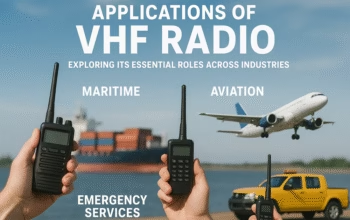
VHF radios are the most commonly used communication devices on ships. They operate in the 30–300 MHz range and are primarily used for short-range communication, up to about 20–30 nautical miles.
- Used for ship-to-ship and ship-to-shore communication.
- Channel 16 (156.8 MHz) is the international distress, safety, and calling frequency.
- Essential for navigation, collision avoidance, and emergency reporting.
2. MF/HF Radio (Medium and High-Frequency Radio)
Unlike VHF, MF/HF radios provide long-range communication, covering hundreds to thousands of nautical miles.
- Operates in the 300 kHz to 30 MHz range.
- Used for long-distance communication with coast stations and other ships.
- Supports distress calls via DSC (Digital Selective Calling).
3. Satellite Communication Systems (SATCOM)
Satellite communication has revolutionized maritime communication by offering global coverage.
- Enables voice calls, emails, internet access, and real-time data sharing.
- Vital for long voyages in remote oceanic regions.
- Common systems include Inmarsat, Iridium, and VSAT.
SATCOM ensures that ships remain connected even when sailing across vast oceans.
4. GMDSS (Global Maritime Distress and Safety System)
The GMDSS is an internationally mandated system that ensures ships can send automated distress alerts worldwide.
- Required for all SOLAS-compliant vessels.
- Integrates VHF, MF/HF radios, EPIRBs, NAVTEX, and satellite systems.
- Automatically alerts rescue coordination centers in emergencies.
This system is one of the most important safety measures in modern maritime operations.
5. EPIRB (Emergency Position Indicating Radio Beacon)
An EPIRB is a critical emergency device that transmits a ship’s location to satellites when activated.
- Used in life-threatening situations such as sinking or fire.
- Sends distress signals directly to search and rescue authorities.
- Works automatically when submerged in water.
6. AIS (Automatic Identification System)
AIS enhances maritime safety by automatically exchanging ship information.
- Provides details like ship name, position, speed, and course.
- Used for collision avoidance and traffic monitoring.
- Required on all passenger and large commercial ships.
7. NAVTEX (Navigational Telex)
NAVTEX is an international system that broadcasts maritime safety information.
- Provides weather forecasts, navigational warnings, and safety messages.
- Operates in the 518 kHz and 490 kHz bands.
- Essential for voyage planning and safety at sea.
8. Intercom and Public Address Systems
For internal ship communication, intercoms and PA systems are crucial.
- Used for crew coordination, announcements, and emergency alerts.
- Ensures all personnel receive vital instructions simultaneously.
9. SSAS (Ship Security Alert System)
This system is used to report security threats such as piracy.
- Sends a silent alert to maritime authorities.
- Provides the ship’s identity and location.
- Enhances security in high-risk waters.

International Regulations for Communication Equipment
To ensure global maritime safety, several international organizations regulate ship communication systems:
- SOLAS Convention (Safety of Life at Sea) – Requires ships to carry communication and distress equipment.
- IMO (International Maritime Organization) – Establishes global maritime communication standards.
- ITU (International Telecommunication Union) – Allocates frequencies for maritime radio communication.
Compliance with these regulations is mandatory for all commercial vessels.
Modern Trends in Communication Equipment Technology
Maritime communication continues to evolve with technological advancements. Some recent trends include:
- Integration of IoT (Internet of Things): Real-time monitoring of ship systems via satellite.
- Digitalization of Navigation: Cloud-based reporting and communication with port authorities.
- Cybersecurity Measures: Protecting communication systems from cyber threats.
- AI-Assisted Communication: Automated voice alerts and smart data processing.
These innovations enhance both safety and efficiency in global shipping operations.
Conclusion of Communication Equipment
Effective communication is the backbone of safe and efficient maritime operations. From traditional VHF radios to advanced satellite systems, each piece of equipment plays a vital role in ensuring connectivity at sea. International regulations like SOLAS and GMDSS make it mandatory for ships to carry essential devices, guaranteeing safety and quick emergency responses.
As technology advances, communication systems are becoming more reliable, digitalized, and globally connected, shaping the future of maritime transport. Whether for navigation, emergency, or day-to-day coordination, communication ships equipment remains indispensable for the shipping industry.