
Steam boilers are integral components in many industrial operations, serving as the heart of thermal systems used for power generation, heating, sterilization, and various manufacturing processes. Understanding the different types of steam boilers is essential for engineers, plant managers, and technicians looking to optimize efficiency, reduce operational costs, and ensure safety compliance.
In this article, we will explore the various types of steam boilers, their construction, working principles, advantages, and ideal applications.
🔍 What is a Steam Boiler?
A steam boiler is a closed vessel that heats water to generate steam using fuel combustion or electricity. The generated steam is then used for various mechanical or heating applications across industries like food processing, chemical manufacturing, textile production, pharmaceuticals, and power generation.
🔠 Classification of Steam Boilers
Steam boilers are classified based on several criteria:
1. Based on Boiler Tube Content
- Fire-Tube Boilers
- Water-Tube Boilers
2. Based on Fuel Source
- Gas-Fired Boilers
- Oil-Fired Boilers
- Electric Boilers
- Biomass-Fired Boilers
- Coal-Fired Boilers
3. Based on Pressure
- Low-Pressure Boilers (Below 15 psi)
- High-Pressure Boilers (Above 15 psi)
4. Based on Mobility
- Stationary Boilers
- Portable Boilers
🔥 Types of Steam Boilers
Let’s examine the most commonly used steam boilers in detail:
🔹 1. Types of Steam Boilers: Fire-Tube Boiler
Working Principle:
Hot gases produced from fuel combustion pass through tubes surrounded by water. Heat transfer occurs from the hot gases to the water.
Common Designs:
- Lancashire Boiler
- Cochran Boiler
- Locomotive Boiler
Advantages:
- Simple design and easy operation
- Low initial cost
- Compact structure
Applications:
- Small-scale industries
- Heating systems
- Railway locomotives
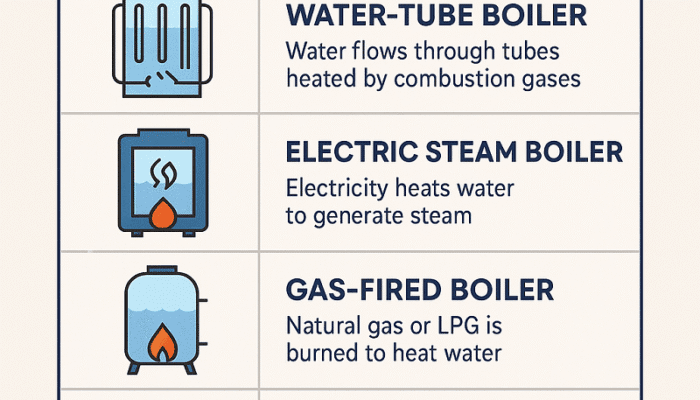
🔹 2. Types of Steam Boilers: Water-Tube Boiler
Working Principle:
Water flows through tubes heated externally by hot combustion gases. These boilers are suitable for high-pressure applications.
Common Designs:
- Babcock and Wilcox Boiler
- Stirling Boiler
Advantages:
- Handles higher pressures and temperatures
- Faster steam generation
- Safer under high-pressure operation
Applications:
- Power plants
- Chemical processing plants
- Refineries
🔹 3. Types of Steam Boilers: Electric Steam Boiler
Working Principle:
Electricity is used to generate heat via resistive elements, converting water into steam.
Advantages:
- Zero emissions
- No fuel storage needed
- High thermal efficiency
Applications:
- Hospitals and labs
- Food & beverage sterilization
- Small to medium-scale industries
Limitation:
- High operating cost due to electricity consumption
🔹 4. Types of Steam Boilers: Gas-Fired Boiler
Fuel Source: Natural gas or LPG
Advantages:
- Clean burning with minimal pollutants
- Lower operating cost compared to oil boilers
- Quick start-up
Applications:
- Commercial buildings
- Laundry and dry-cleaning services
- Process heating
🔹 5. Types of Steam Boilers: Oil-Fired Boiler
Fuel Source: Diesel, furnace oil, or other petroleum derivatives
Advantages:
- High energy content per liter
- Readily available in remote areas
Applications:
- Industrial process heating
- Power backup systems
Limitation:
- Higher carbon emissions than gas
🔹 6. Types of Steam Boilers: Biomass-Fired Boiler
Fuel Source: Organic material such as wood chips, sawdust, or agricultural waste
Advantages:
- Renewable and eco-friendly
- Reduces carbon footprint
- Cost-effective in regions with biomass availability
Applications:
- Agro-industrial applications
- Green manufacturing plants
🔹 7. Types of Steam Boilers: Coal-Fired Boiler
Fuel Source: Bituminous or anthracite coal
Advantages:
- Low fuel cost
- High heating value
Applications:
- Large industrial facilities
- Thermal power plants
Limitations:
- High emissions
- Requires more space and maintenance
🏭 Boiler Selection Criteria
Choosing the right type of steam boiler depends on multiple factors:
- Steam Demand: Continuous or intermittent
- Operating Pressure and Temperature
- Fuel Availability and Cost
- Space Constraints
- Environmental Regulations
- Maintenance Capability
📊 Comparison Table: Fire-Tube vs. Water-Tube Boiler
| Feature | Fire-Tube Boiler | Water-Tube Boiler |
|---|---|---|
| Steam Pressure | Low to Medium | High |
| Steam Generation Rate | Moderate | High |
| Maintenance | Easier | Requires expertise |
| Cost | Lower initial cost | Higher initial cost |
| Safety | Lower at high pressure | Higher at high pressure |
🌱 Environmental Considerations
With global emissions regulations tightening, industries are shifting toward:
- Electric Boilers (zero-emission systems)
- Biomass Boilers (carbon-neutral fuel)
- Condensing Boilers (high efficiency, low emissions)
Energy audits and emission studies are crucial before installation.
🧰 Applications of Steam Boilers
Steam boilers are used in:
- Textile Industry: Dyeing, drying, and pressing
- Food Processing: Sterilization and cooking
- Power Plants: Steam turbines
- Hospitals: Autoclaves and space heating
- Chemical Industry: Reaction vessels and distillation
- Laundries: Presses and ironing equipment
✅ Conclusion of Types of Steam Boilers
Steam boilers are vital in industrial operations, and selecting the correct type significantly affects operational efficiency, safety, and cost. Whether you need a compact fire-tube boiler for a small plant or a large-capacity water-tube boiler for power generation, understanding your application requirements is key.
By knowing the types of steam boilers, their advantages, and specific use cases, you can make a more informed decision tailored to your industry needs.
📢 Looking for Reliable Industrial Steam Boilers?
Visit Abi Royen for expert guidance and high-quality thermal systems tailored for your industry.