Introduction
A locomotive boiler is a type of fire-tube boiler designed primarily for use in railway steam locomotives. As one of the oldest and most iconic steam-producing devices, this boiler has played a crucial role in powering early trains and industrial machinery. It’s known for its robust construction, efficient steam generation, and ability to operate in dynamic environments.
Although its usage has declined with the advent of diesel and electric engines, locomotive boilers are still widely studied and admired for their historical and mechanical significance.
What is a Locomotive Boiler?
A locomotive boiler is a horizontal fire-tube boiler with multiple fire tubes running through a cylindrical shell that contains water. Hot gases generated by the combustion of fuel travel through these tubes and transfer heat to the surrounding water, turning it into steam. The generated steam is then used to power pistons or turbines in locomotives.
This type of boiler is portable, self-contained, and high-pressure, making it perfect for mobile applications like steam locomotives.
Key Features of a Locomotive Boiler
- Type: Fire-tube, horizontal
- Orientation: Horizontal
- Portability: Designed for mobility (on wheels)
- Fuel: Coal, wood, or oil (traditionally coal)
- Steam Pressure: Typically around 150-250 psi
- Efficiency: Moderate thermal efficiency (~60-70%)
Main Components of a Locomotive Boiler
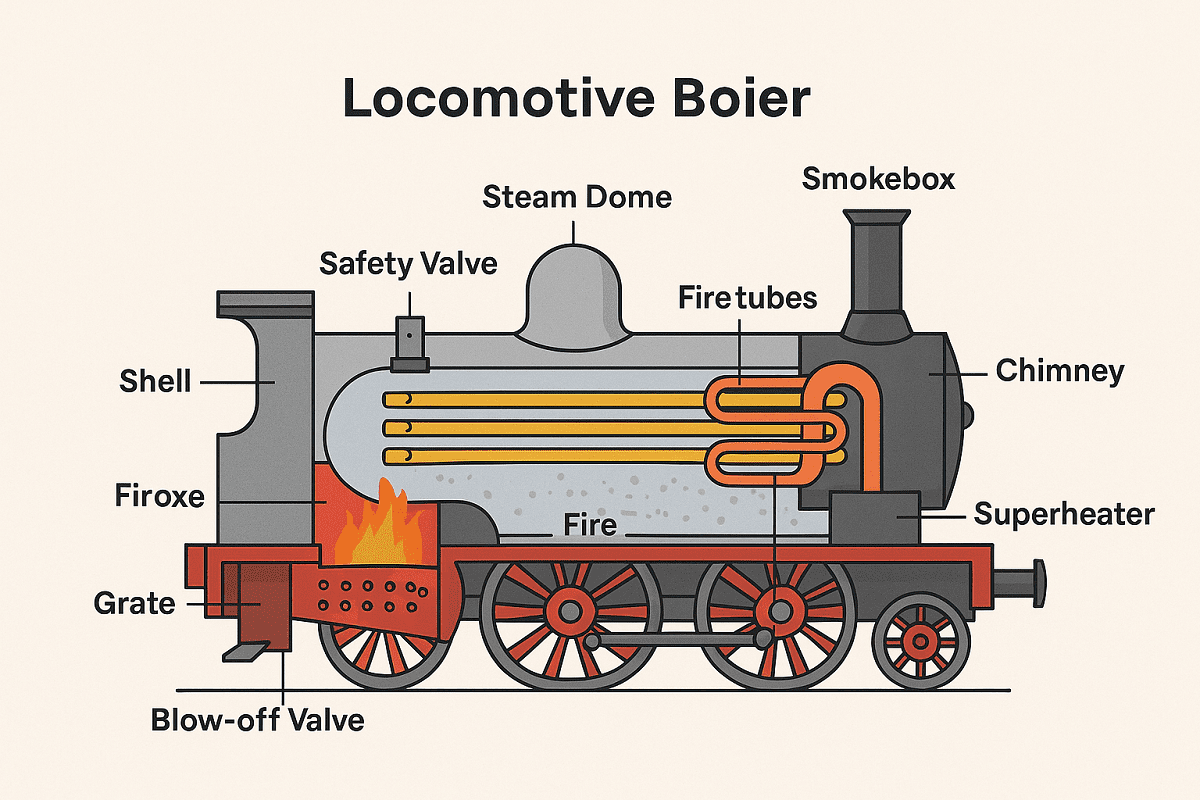
- Shell:
The cylindrical outer body that holds water and steam. - Fire Tubes:
Numerous small tubes through which hot gases pass and transfer heat to the water. - Grate:
The surface where fuel (usually coal) is burned. - Firebox:
Enclosed space where the combustion of fuel takes place. - Smokebox:
Collects exhaust gases from the fire tubes before they exit through the chimney. - Chimney (Exhaust Stack):
Releases smoke and gases from the smokebox into the atmosphere. - Steam Dome:
A dome-shaped projection that helps collect dry steam. - Superheater:
Optional component used to increase the temperature and energy content of the steam. - Safety Valve:
Ensures pressure does not exceed safe limits. - Blow-off Valve:
Used for removing sludge or sediment from the boiler.
Working Principle of a Locomotive Boiler
- Fuel Combustion:
Fuel is placed on the grate and burned in the firebox. The resulting hot gases pass through fire tubes running the length of the boiler. - Heat Transfer:
As hot gases move through the fire tubes, they transfer heat to the surrounding water. - Steam Formation:
The heated water turns into steam, which rises and accumulates in the steam dome. - Steam Usage:
The dry steam is collected and sent to the engine’s pistons, where it expands and performs mechanical work to move the locomotive. - Exhaust:
Combustion gases exit through the smokebox and chimney, completing the cycle.
Advantages of Locomotive Boilers
- Portable Design:
Easy to mount on trains, making them ideal for mobile applications. - Rapid Steam Generation:
Due to the large heating surface area and high combustion rates. - Compact Structure:
Integrates all components within a confined space. - Simple Construction:
Easier to manufacture and maintain in comparison to complex water-tube boilers.
Disadvantages of Locomotive Boilers
- Limited Capacity:
Not suitable for large-scale industrial steam requirements. - Moderate Efficiency:
Lower efficiency compared to water-tube and modern high-pressure boilers. - Manual Operation:
Requires constant human monitoring and fuel feeding. - Prone to Soot Accumulation:
Fire tubes often require regular cleaning due to soot buildup.
Applications of Locomotive Boilers
- Steam Locomotives:
The primary and most iconic application. These boilers powered early train engines across the world. - Steam Cranes:
Used to power portable cranes and construction equipment in the early industrial era. - Mobile Steam Engines:
Used in portable steam engines in agricultural and field machinery. - Educational Demonstrations:
Frequently used in engineering institutions for teaching boiler mechanics and steam generation principles. - Heritage and Museum Railways:
Many locomotive boilers are preserved and operated in railway museums and heritage steam lines.
Comparison with Other Boilers
| Feature | Locomotive Boiler | Water-Tube Boiler | Fire-Tube Boiler (Scotch) |
|---|---|---|---|
| Orientation | Horizontal | Vertical/Horizontal | Horizontal |
| Pressure | Medium | High | Medium |
| Portability | High (mobile) | Low (stationary) | Low |
| Steam Capacity | Moderate | High | Moderate |
| Efficiency | Moderate (~70%) | High (~90%) | Moderate |
| Application | Mobile engines | Power plants, industries | Heating, small industries |
Maintenance of a Locomotive Boiler
To ensure safe and efficient operation, locomotive boilers require routine maintenance:
- Regular cleaning of fire tubes to prevent soot accumulation
- Inspection of safety valves for proper pressure relief
- Checking for scale or sediment buildup
- Lubrication of moving parts
- Testing of water level indicators and gauges
Conclusion
The locomotive boiler remains a symbol of engineering ingenuity and steam power innovation. Despite being largely replaced by modern technologies, its significance in the evolution of steam engines and rail transportation cannot be understated. It offers a simple yet effective way to generate steam on the move, combining portability with respectable performance.
Understanding how locomotive boilers work not only provides insight into historical technology but also enriches knowledge in the broader field of thermodynamics and mechanical engineering.