Boilers are indispensable components in industrial systems where heat generation and steam production are vital. One of the most well-known and historically significant boiler types is the Horizontal Return Tubular (HRT) Boiler. This fire-tube boiler has stood the test of time due to its simplicity, efficiency, and reliability in various industrial processes. In this article, we will explore the design, function, advantages, limitations, and common applications of Horizontal Return Tubular Boilers.
🔧 What is a Horizontal Return Tubular Boiler?
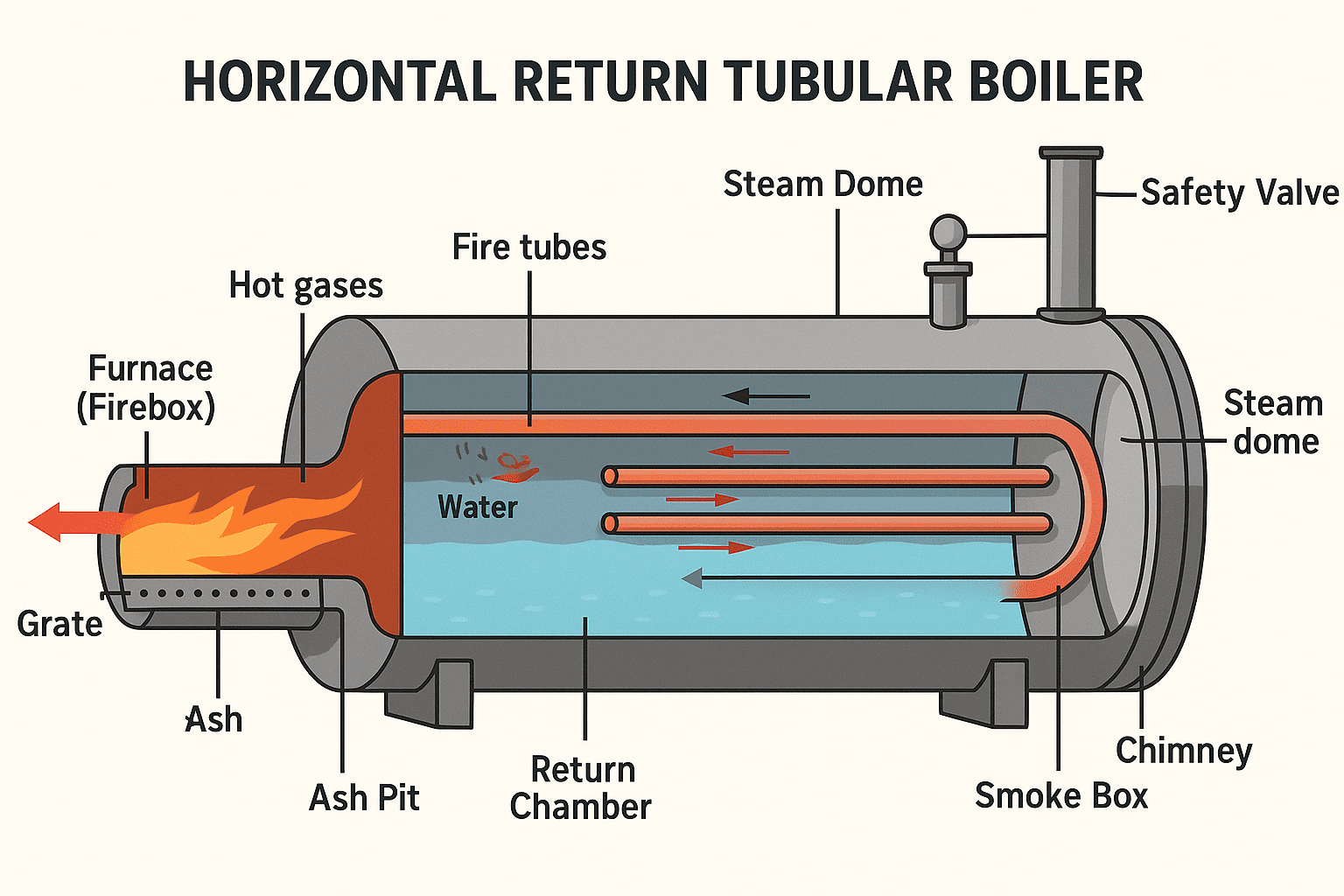
A Horizontal Return Tubular Boiler is a type of fire-tube boiler where hot gases pass through tubes that are surrounded by water. The boiler features a horizontal cylindrical shell with the tubes arranged longitudinally inside. It gets its name from the fact that the flue gases “return” in a horizontal direction after combustion.
This boiler type was widely used during the early days of steam power, especially in textile mills and early manufacturing industries. Though modern alternatives are available, the HRT boiler remains relevant in certain industries due to its robust design and ease of operation.
🧱 Construction and Components
The Horizontal Return Tubular Boiler consists of the following main parts:
- Shell
A large cylindrical horizontal vessel that holds water and steam. - Furnace (Firebox)
Located at one end of the shell, where fuel is burned to generate hot gases. - Fire Tubes
Multiple horizontal tubes through which the hot gases pass. The tubes are submerged in water. - Return Chamber
A chamber that redirects the flue gases back through a second set of fire tubes, increasing heat transfer efficiency. - Smoke Box and Chimney
These expel the cooled flue gases safely into the atmosphere after they’ve transferred most of their heat. - Grate and Ash Pit
Located below the furnace for solid fuel combustion and ash collection. - Steam Dome and Safety Valve
Collects the generated steam and regulates internal pressure for safety.
⚙️ Working Principle
The operation of an HRT boiler follows the fire-tube boiler principle. Here’s a simplified step-by-step process:
- Fuel Combustion
Solid, liquid, or gaseous fuel is burned in the furnace. This generates high-temperature flue gases. - Heat Transfer
The hot gases pass through the fire tubes submerged in water. Heat is transferred to the water, converting it into steam. - Return Path
After passing through the first set of tubes, the gases enter a return chamber and flow back through a second path of tubes. - Steam Collection
The steam produced rises and is collected in the steam dome for distribution to the system. - Exhaust
The cooled gases exit through the smokebox and chimney.
This double-pass configuration enhances heat transfer and increases thermal efficiency.
✅ Advantages of Horizontal Return Tubular Boilers
- Simple and Sturdy Construction
The design is easy to fabricate and maintain, making it ideal for long-term use. - High Heat Transfer Efficiency
The return path increases heat transfer surface area. - Low Initial Cost
The materials and construction methods are generally less expensive than complex boiler systems. - Ease of Maintenance
Fire tubes are easily accessible for cleaning and inspection. - Adaptable to Different Fuels
Can use coal, wood, oil, or gas, offering flexibility in operation.
❌ Limitations Horizontal Return Tubular Boilers
- Large Footprint
The horizontal design requires more floor space, which can be a constraint in compact installations. - Low Steam Pressure
It typically operates at lower pressures than modern water-tube boilers. - Slow Steam Generation
The system may take longer to reach full steam pressure. - Not Ideal for High Load Fluctuations
It is better suited for steady and consistent loads.
🏭 Industrial Applications
Although less common today, Horizontal Return Tubular Boilers are still in use in various industries where high-pressure steam is not essential. Common applications include:
- Textile Manufacturing
For drying, dyeing, and heating processes. - Food Processing Plants
Used for cooking, sterilization, and cleaning applications. - Laundries
Providing steam for pressing and cleaning. - Brewery and Distillery Operations
For heating and fermentation process control. - Power Generation (Historical Use)
Used in early steam engines and locomotives.
🔄 Comparison Horizontal Return Tubular Boilers with Other Boiler Types
| Boiler Type | Orientation | Pressure Range | Efficiency | Applications |
|---|---|---|---|---|
| Horizontal Return Tubular | Horizontal | Low to Medium | Moderate | Food, textile, laundry |
| Water-Tube Boiler | Vertical/Inclined | High | High | Power generation, large industries |
| Vertical Fire-Tube Boiler | Vertical | Low | Low | Small-scale heating |
| Scotch Marine Boiler | Horizontal | Medium to High | High | Marine and industrial applications |
🧰 Maintenance Tips
To ensure safe and efficient operation of HRT boilers, regular maintenance is crucial:
- Daily Checks: Water level, pressure, and temperature.
- Weekly: Clean fire tubes and inspect burner/furnace.
- Monthly: Test safety valves and control systems.
- Annually: Conduct a full internal inspection, check for scaling, corrosion, and replace worn-out components.
📈 Efficiency Enhancements Horizontal Return Tubular Boilers
While HRT boilers are inherently simple, their efficiency can be improved by:
- Using Economizers
To preheat feedwater using exhaust gases. - Installing Insulation
Reduces heat loss from the shell and piping. - Automated Controls
Modern control systems optimize fuel usage and temperature regulation.
🌱 Environmental Considerations
- Emission Control:
Incorporating low-NOx burners or scrubbers can reduce air pollutants. - Fuel Switching:
Transitioning from coal or wood to natural gas can improve efficiency and reduce carbon footprint.
📌 Conclusion of Horizontal Return Tubular Boilers
The Horizontal Return Tubular Boiler remains a reliable and effective choice in specific industrial scenarios where low to medium-pressure steam is sufficient. Its simplicity, cost-effectiveness, and adaptability make it a popular choice in traditional industries. While newer boiler technologies offer higher efficiency and pressure ratings, the HRT boiler holds historical and practical value that continues to support operations worldwide.
For industries looking to balance performance, maintenance, and budget—especially in the textile, food, or laundry sectors—the HRT boiler is still a worthy consideration.
If you’re exploring boiler solutions for your business or educational purposes, visit Abi Royen for more in-depth guides and technical resources.