
1. Introduction to Radar Technology
Radar (Radio Detection and Ranging) technology plays a crucial role in a wide range of modern applications, from air traffic control and weather monitoring to automotive safety systems and military defense. At the heart of any radar system lies the radar transmitter, a critical component responsible for generating and sending high-frequency electromagnetic signals.
The primary function of a radar transmitters is to emit pulses of radio frequency (RF) energy into the environment. These pulses then travel through the air, reflect off objects (targets), and return to the radar receiver. By analyzing the time delay, frequency shift, and strength of these reflected signals, radar systems can determine the location, speed, and movement of targets.
2. What is a Radar Transmitter?
A radar transmitter is an electronic device that generates and radiates electromagnetic waves, usually in the radio or microwave frequency range. It is one of the fundamental parts of a radar system, working in tandem with the receiver, antenna, and signal processor.
The typical structure of a radar transmitters includes:
- RF oscillator or signal generator
- Modulator
- Power amplifier
- Waveguide or coaxial cable
- Antenna interface
Radar transmitters are designed to operate at specific frequencies depending on the application (e.g., X-band, S-band, L-band) and must deliver sufficient power to detect objects at long ranges.
3. Function and Operation of Radar Transmitter
The radar transmitters performs several key functions:
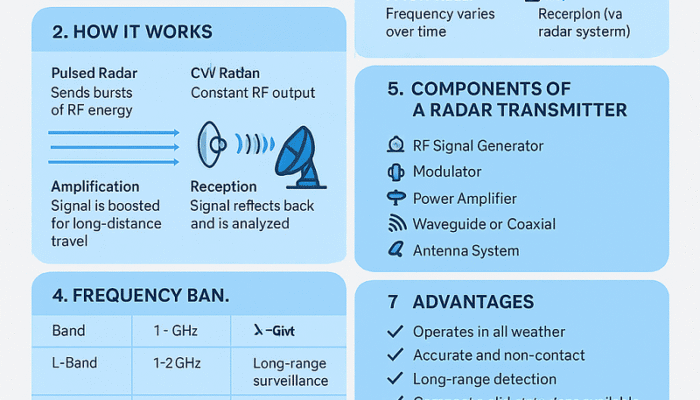
- Signal Generation: A stable oscillator or frequency synthesizer generates a carrier signal.
- Modulation: The signal is modulated to form pulses or continuous waves (CW), depending on the radar type.
- Amplification: A high-power amplifier boosts the modulated signal to a suitable level for transmission.
- Transmission: The amplified signal is fed to the antenna, which radiates it into the environment as an electromagnetic wave.
The timing and shape of the transmitted signal greatly influence the radar’s resolution, range, and sensitivity. High-power radar transmitters are capable of detecting small objects at long distances, making them indispensable for both civilian and military applications.
4. Types of Radar Transmitter
Radar transmitters can be categorized based on waveform type, frequency band, and amplification technology.
A. Based on Signal Waveform:
- Pulsed Radar Transmitters: Emit high-energy RF pulses with silent intervals. Common in air traffic control and weather radar.
- Continuous Wave (CW) Transmitters: Transmit a continuous signal. Used in speed detection and Doppler radar.
- Frequency-Modulated Continuous Wave (FMCW): Vary the frequency over time. Useful in automotive radar and altimeters.
B. Based on Frequency Band:
- L-Band (1–2 GHz): Long-range surveillance and ATC.
- S-Band (2–4 GHz): Weather radar and ship navigation.
- C-Band (4–8 GHz): Weather and satellite communication.
- X-Band (8–12 GHz): High-resolution imaging radar.
- Ku/K/Ka-Band: Used in short-range and high-resolution applications.
C. Based on Amplification Method:
- Klystron Transmitters: High-power vacuum tubes with excellent frequency stability.
- Magnetron Transmitters: Compact, cost-effective, often used in marine and weather radar.
- Solid-State Transmitters: Use transistors like GaN or LDMOS, offering reliability and compact design.
5. Applications of Radar Transmitter
Radar transmitters are central to numerous applications across industries:
A. Aviation and Aerospace
- Air traffic control systems rely on radar transmitters for tracking aircraft.
- Weather radar systems monitor precipitation, storms, and wind patterns.
- Aircraft use onboard radar for collision avoidance and landing assistance.
B. Automotive Industry
- Advanced driver assistance systems (ADAS) use FMCW radar for obstacle detection, adaptive cruise control, and lane departure alerts.
C. Maritime Navigation
- Ships and boats use radar transmitters to detect landmasses, other vessels, and weather hazards.
D. Military and Defense
- Surveillance and targeting radar.
- Missile guidance and threat detection.
- Ground-penetrating radar (GPR) for detecting underground threats.
E. Industrial and Scientific Use
- Radar level transmitters in tanks and silos for measuring material levels.
- Speed detection radar used by law enforcement.
- Seismology and environmental monitoring.
6. Advantages of Modern Radar Transmitter
- High Accuracy: Capable of precise distance and speed measurements.
- Weather Independence: Operates effectively in fog, rain, and darkness.
- Non-Contact Measurement: Ideal for industrial applications where physical contact is not feasible.
- Long Range: Especially in military and aerospace uses.
- Compact Design: Modern solid-state transmitters radar are lightweight and energy-efficient.
7. Challenges and Considerations
While radar transmitters are powerful tools, they also come with challenges:
- EMI (Electromagnetic Interference): High RF power can interfere with other systems.
- Size and Heat Dissipation: High-power tubes like klystrons require cooling and space.
- Regulatory Compliance: Must operate within specified frequency bands and power limits set by regulatory bodies (e.g., FCC, ITU).
- Maintenance: Tube-based systems require periodic servicing and replacement.
8. Legal and Regulatory Framework
Radar transmitters must comply with regional and international regulations. These include:
- Frequency Allocation: Allocated by the International Telecommunication Union (ITU).
- Power Emission Limits: Defined to avoid interference with other communication systems.
- Product Certification: Radar devices often need FCC, CE, or equivalent approvals for operation.
Regulatory compliance is critical, especially in aviation, maritime, and defense sectors.
9. Maintenance and Safety Radar Transmitter
Proper care and preventive maintenance ensure transmitters radar longevity and performance:
- Cooling System Checks: Especially for high-power systems with klystrons or magnetrons.
- Periodic Calibration: Ensures signal integrity and accuracy.
- Visual Inspections: For cables, antennas, and connectors.
- Radiation Safety Measures: Operators must be shielded from excessive RF exposure.
Modern radar systems often include built-in diagnostics for early fault detection.
10. Future Trends in Radar Transmitter Technology
The radar transmitter landscape is evolving rapidly with advancements in electronics and materials science:
- GaN (Gallium Nitride) Transistors: Enable high-efficiency, compact solid-state transmitters.
- Digital Radar Systems: Software-defined waveforms allow greater flexibility.
- Automated Calibration and AI Integration: Improves performance and reduces manual intervention.
- Miniaturized Radar for Drones and IoT Devices: Expands the use of radar to smaller, more mobile platforms.
Conclusion of Radar Transmitter
Transmitters radar are indispensable components in a wide range of applications—from safeguarding airspace and guiding ships to enabling self-driving cars and measuring silo levels. As technology continues to evolve, modern transmitters are becoming more compact, reliable, and intelligent, opening new frontiers in industrial automation, defense, and beyond.
Whether for engineers, technicians, or tech enthusiasts, understanding how radar transmitters work and where they are used provides valuable insight into one of the most powerful tools in electronic detection and measurement.