Working principle of thermocouple ~ Thermocouples are among the most widely used temperature sensors in industrial, scientific, and commercial applications. Their popularity stems from their accuracy, durability, and wide temperature range. Whether in a steel factory, a power plant, or a laboratory, thermocouples play an essential role in measuring temperature reliably.
In this article, we will explore how a thermocouple works, the science behind it, its components, types, advantages, and real-world applications.
1. What is a Thermocouple?
A thermocouple is a temperature sensor made from two dissimilar metal wires joined at one end. When the junction of these metals is exposed to a change in temperature, it generates a small voltage that can be measured and converted into a temperature reading.
Thermocouples are widely used because they:
- Can measure extremely high and low temperatures
- Are simple in design
- Offer quick response times
- Are inexpensive compared to other temperature sensors
2. The Science Behind a Thermocouple: The Seebeck Effect
The working principle of a thermocouple is based on the Seebeck effect, discovered by Thomas Johann Seebeck in 1821. This effect states that:
When two different metals are joined at two points and there is a temperature difference between these points, a voltage (electromotive force) is generated.
This voltage is directly proportional to the temperature difference between the hot junction and the cold junction.
2.1 How the Seebeck Effect Working Principle of Thermocouple
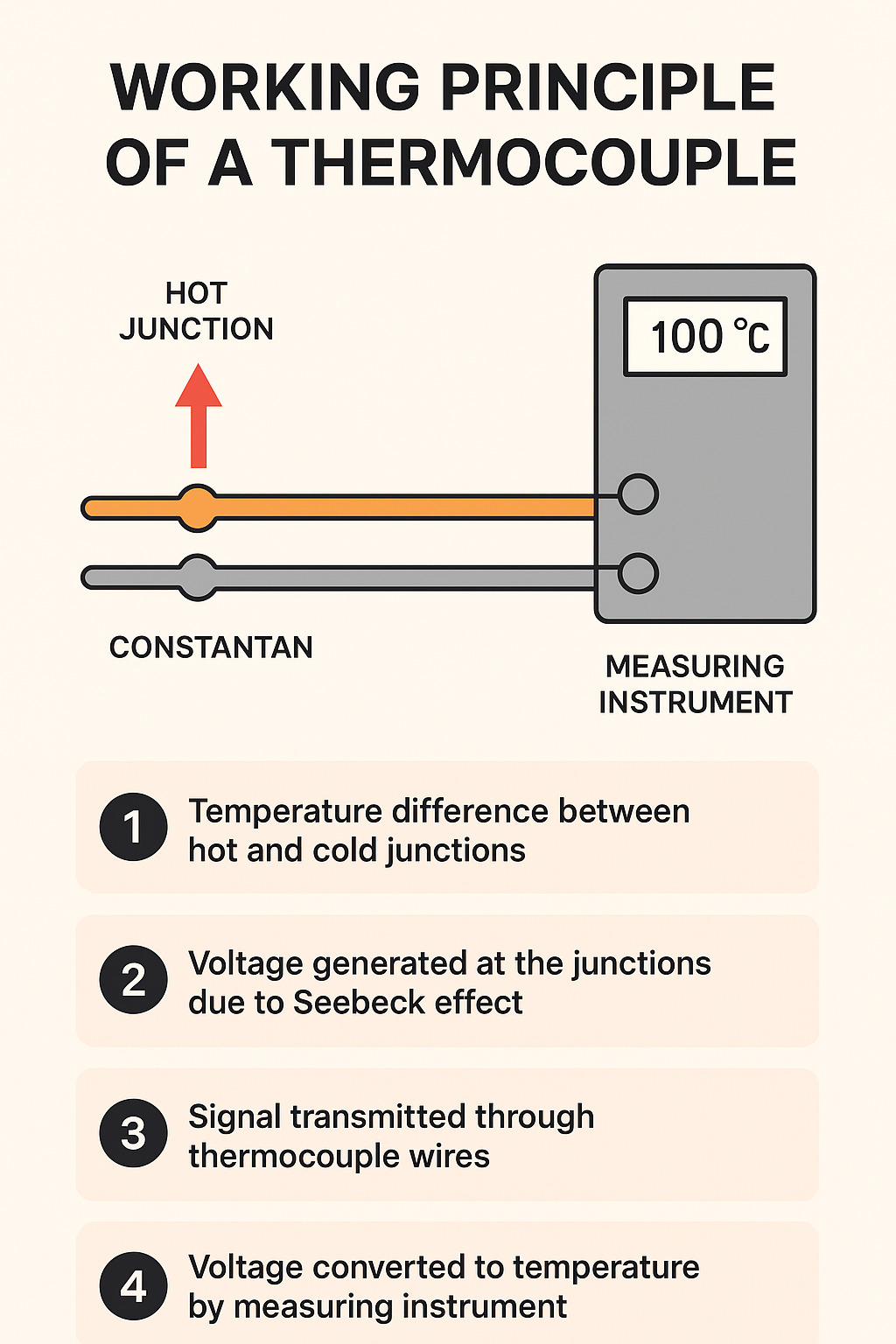
- Two dissimilar metals (e.g., copper and constantan) are joined at one end (hot junction).
- The other ends (cold junction) are connected to a measuring device.
- When the hot junction experiences a different temperature than the cold junction, a voltage is generated.
- This voltage is measured and converted into temperature using reference tables or built-in microcontrollers.
3. Main Components of a Thermocouple
A typical thermocouple consists of:
- Hot Junction – The point where the two dissimilar metals are joined and exposed to the measurement temperature.
- Cold Junction (Reference Junction) – The opposite end, usually maintained at a known reference temperature.
- Thermocouple Wires – Made of specific alloys depending on thermocouple type.
- Protective Sheath – A cover to protect the sensor from corrosion, abrasion, or high pressure.
- Measuring Instrument – Converts the thermoelectric voltage into a temperature reading.
4. Step-by-Step Working Principle of Thermocouple
- Temperature Difference Creation
The hot junction is placed in the environment whose temperature you want to measure, while the cold junction remains at a reference temperature. - Voltage Generation (Seebeck Effect)
The temperature difference between the junctions generates a millivolt signal. - Signal Transmission
The thermocouple wires carry this voltage to the measuring instrument. - Voltage-to-Temperature Conversion
The instrument uses calibration data (specific to the thermocouple type) to convert voltage into temperature.
5. Common Types of Thermocouples
Different thermocouple types are available depending on the metals used:
- Type K (Chromel–Alumel) – Most common, wide temperature range (-200°C to +1260°C).
- Type J (Iron–Constantan) – Suitable for lower temperature ranges (-40°C to +750°C).
- Type T (Copper–Constantan) – Excellent for low temperatures (-200°C to +350°C).
- Type E (Chromel–Constantan) – High sensitivity for cryogenic use.
- Type N (Nicrosil–Nisil) – Resistant to oxidation at high temperatures.
- Types B, R, S (Platinum–Rhodium Alloys) – Used for extremely high temperatures (up to +1700°C).
6. Advantages of Thermocouples
- Wide temperature range (from cryogenic levels to 1700°C)
- Fast response time
- Durability and ruggedness
- Simple construction
- Low cost compared to other sensors
- Self-powered (no external power supply needed)
7. Limitations of Thermocouples
- Lower accuracy compared to RTDs for certain ranges
- Susceptible to electrical noise
- Requires cold-junction compensation for accurate readings
- Output voltage is small and needs amplification
8. Applications of Thermocouples
Thermocouples are used in:
- Industrial Furnaces – Monitoring high-temperature processes
- Power Plants – Boiler and turbine temperature measurements
- Aerospace – Jet engine exhaust temperature monitoring
- Automotive Industry – Exhaust gas temperature sensors
- Food Processing – Oven and storage temperature checks
- Laboratories – Scientific experiments requiring precise temperature monitoring
9. Cold-Junction Compensation (CJC)
Since thermocouples measure temperature difference, not absolute temperature, the cold junction must be at a known temperature. Modern measuring devices include cold-junction compensation circuits that automatically correct for variations in ambient temperature.
10. Maintenance and Calibration
Thermocouples require regular calibration to maintain accuracy. Over time, metal degradation or contamination can affect voltage output. Regular checks and protective sheathing can extend the sensor’s life.
Conclusion of Working Principle of Thermocouple
The working principle of a thermocouple revolves around the Seebeck effect, where a temperature difference between two dissimilar metals generates a measurable voltage. Its simplicity, durability, and wide temperature range make it a reliable choice for industries worldwide.
Understanding how thermocouples work allows engineers, technicians, and researchers to make better decisions in selecting, installing, and maintaining these essential temperature sensors.