
Introduction of What is Ferrite Bead?
What is Ferrite Bead? ~ In modern electronic devices, maintaining clean and stable signals is critical. As circuits become more complex and operate at higher frequencies, they become increasingly vulnerable to electromagnetic interference (EMI) and radio frequency interference (RFI). These unwanted signals can degrade performance, cause malfunctions, and even damage sensitive components.
One of the most effective and widely used components for suppressing high-frequency noise is the ferrite bead. Compact, inexpensive, and easy to integrate, ferrite beads play a vital role in ensuring signal integrity and electromagnetic compatibility (EMC) in a wide range of applications.
This article explores what a ferrite bead is, how it works, its types, advantages, limitations, and applications in modern electronics.
What is Ferrite Bead?
A ferrite bead (sometimes called a ferrite choke) is a passive electronic component made of ferrite material—a ceramic compound consisting of iron oxide mixed with other metals such as manganese, nickel, or zinc. Its primary purpose is to suppress unwanted high-frequency noise in electronic circuits by providing frequency-dependent impedance.
Unlike resistors, capacitors, or inductors, ferrite beads specifically target high-frequency electromagnetic noise while allowing desired low-frequency signals or DC current to pass with minimal interference.
In simple terms:
- DC and low-frequency signals → pass through almost unaffected.
- High-frequency noise → absorbed and dissipated as heat.
This makes ferrite beads especially valuable in circuits prone to noise from switching power supplies, digital clocks, and RF transmissions.
How Does a Ferrite Bead Work?
The working principle of a ferrite bead is based on the magnetic and resistive properties of ferrite material.
When current passes through a ferrite bead:
- At low frequencies, the bead behaves almost like a wire, with negligible resistance.
- At higher frequencies, the bead exhibits inductive reactance and significant resistive impedance, effectively attenuating the noise.
This impedance is a combination of:
- Inductive reactance (jωL) → resists changes in current.
- Resistive losses (R) → convert noise energy into heat.
Thus, ferrite beads act as low-pass filters, blocking high-frequency interference while allowing useful signals to flow.
Construction of Ferrite Beads
Ferrite beads are typically constructed as:
- Surface Mount Devices (SMD) – small, chip-like components mounted directly onto PCB traces.
- Through-Hole Beads – cylindrical beads where wires or leads pass through a ferrite core.
- Cable Ferrites (Clamp-on or Slip-on) – larger beads designed to suppress noise on cables and power cords.
The choice depends on the application, frequency range, and required noise suppression.
Types of Ferrite Beads
Ferrite beads can be classified based on their application, material composition, and construction.
1. Based on Application
- Signal Line Ferrite Beads
- Designed to suppress high-frequency noise in data lines, clock signals, or communication interfaces.
- Common in USB, HDMI, and audio circuits.
- Power Line Ferrite Beads
- Used in power supply circuits to filter noise from switching regulators.
- Prevents unwanted noise from entering or leaving the power source.
2. Based on Construction
- Chip Ferrite Beads (SMD)
- Compact, cost-effective, and widely used in consumer electronics.
- Axial Ferrite Beads
- Similar to resistors in shape, suitable for through-hole PCB assembly.
- Clamp-On Ferrite Cores
- Attached externally on cables to suppress EMI without redesigning the circuit.
3. Based on Material
- MnZn Ferrites (Manganese-Zinc)
- Effective at lower frequencies (up to a few MHz).
- Suitable for power applications.
- NiZn Ferrites (Nickel-Zinc)
- Effective at higher frequencies (tens to hundreds of MHz).
- Commonly used for signal integrity in high-speed circuits.
Characteristics of Ferrite Beads
When selecting a ferrite bead, engineers consider the following parameters:
- Impedance (Ω) – Indicates how much noise the bead can suppress at a given frequency. Higher impedance means stronger suppression.
- Current Rating (A) – Maximum current the bead can handle without saturation or overheating.
- DC Resistance (DCR) – Resistance to DC current; ideally very low to minimize power loss.
- Frequency Range – The effective range over which the bead attenuates noise.
- Package Type – Determines compatibility with surface-mount or through-hole assembly.
Advantages of Using Ferrite Beads
- Effective Noise Suppression – Attenuates EMI/RFI at targeted frequency ranges.
- Compact and Low-Cost – Small footprint and affordable compared to other filtering solutions.
- Energy Dissipation – Converts high-frequency noise into heat, preventing it from spreading.
- Simplicity – Easy to implement without complex circuit redesign.
- Versatility – Applicable in both signal and power lines.
Limitations of Ferrite Beads
- Limited Frequency Range – Each bead is effective only within a specific frequency spectrum.
- Heat Dissipation – Excessive noise absorption can lead to overheating.
- Not a Complete Filter – Works best when combined with capacitors and inductors for EMI suppression.
- Current Limitations – Exceeding rated current can reduce effectiveness or damage the bead.
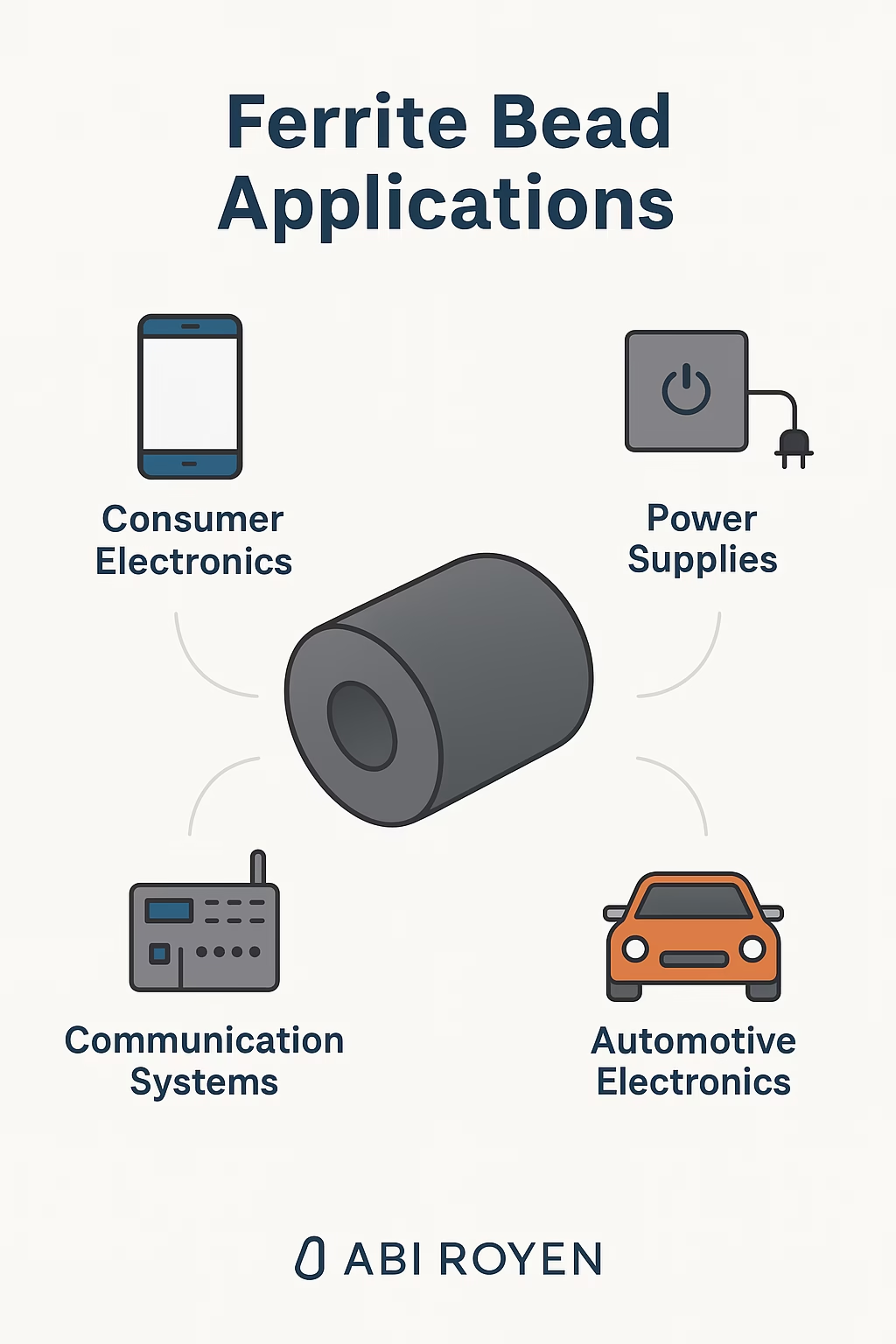
Applications of Ferrite Beads
Ferrite beads are found in almost every modern electronic system.
1. Consumer Electronics
- Smartphones, tablets, and laptops use ferrite beads to reduce EMI from processors and switching power supplies.
- Audio devices employ ferrites to minimize humming and distortion.
2. Power Supplies
- Suppress switching noise in DC-DC converters, AC adapters, and chargers.
- Improve efficiency and compliance with EMI regulations.
3. Communication Systems
- Used in USB, HDMI, Ethernet, and RF circuits to maintain signal integrity.
- Protects sensitive receivers from external interference.
4. Automotive Electronics
- Critical in electronic control units (ECUs), infotainment systems, and sensors.
- Helps vehicles meet strict automotive EMI/EMC standards.
5. Industrial Equipment
- Reduces interference in PLCs, motor controllers, and medical devices.
- Ensures stable operation in harsh environments.
6. Cable and Connector Noise Suppression
- Clamp-on ferrite beads are commonly attached to power cords, HDMI cables, and monitor cables to reduce EMI leakage.
Ferrite Bead vs. Inductor – What’s the Difference?
While both ferrite beads and inductors suppress noise, they function differently:
| Feature | Ferrite Bead | Inductor |
|---|---|---|
| Purpose | Suppress high-frequency EMI | Store energy in magnetic field |
| Frequency Response | Resistive at high frequency | Inductive at all frequencies |
| Dissipation | Converts noise into heat | Stores energy and releases later |
| Application | Noise filtering | Energy storage, filtering, and resonance |
How to Select the Right Ferrite Bead
Choosing the correct ferrite bead depends on several factors:
- Identify Noise Frequency – Determine the range of unwanted signals to be suppressed.
- Check Impedance Curve – Ensure the bead provides high impedance at the target frequency.
- Consider Current Requirements – Select beads that can handle the expected load current.
- Low DCR – Prevents unnecessary power loss in DC circuits.
- Package Size – Ensure compatibility with PCB design or cable diameter.
Best Practices for Using Ferrite Beads
- Place ferrite beads as close as possible to the noise source (e.g., power pin of IC).
- Use multiple beads in series for higher attenuation.
- Combine with capacitors to create more effective EMI filters.
- Always check manufacturer’s impedance-frequency curve before selecting.
Future Trends of Ferrite Beads
As electronic systems continue to operate at higher speeds with tighter EMI requirements, ferrite bead technology is also evolving.
- High-frequency optimized beads for gigahertz-range applications.
- Miniaturized SMD ferrite beads for compact IoT devices.
- Automotive-grade ferrites designed to meet stringent standards.
Conclusion of What is Ferrite Bead?
Ferrite beads may be small and inexpensive, but they play a critical role in modern electronics. By suppressing unwanted high-frequency noise, they ensure signal integrity, compliance with EMI standards, and reliable device performance.
From smartphones and laptops to automotive systems and industrial controllers, ferrite beads are everywhere. Understanding their function, types, and proper selection enables engineers to design cleaner, more stable, and interference-free circuits.