What is a Transistor? ~ In the world of electronics, few inventions have been as transformative as the transistor. Whether in smartphones, computers, audio systems, or satellites, transistors form the backbone of modern electronic devices. They are the fundamental building blocks that enable digital technology to function as we know it today.
This article will dive deep into what a transistor is, how it works, its history, types, and why it remains one of the most important components in electronics.
1. Definition: What is a Transistor?
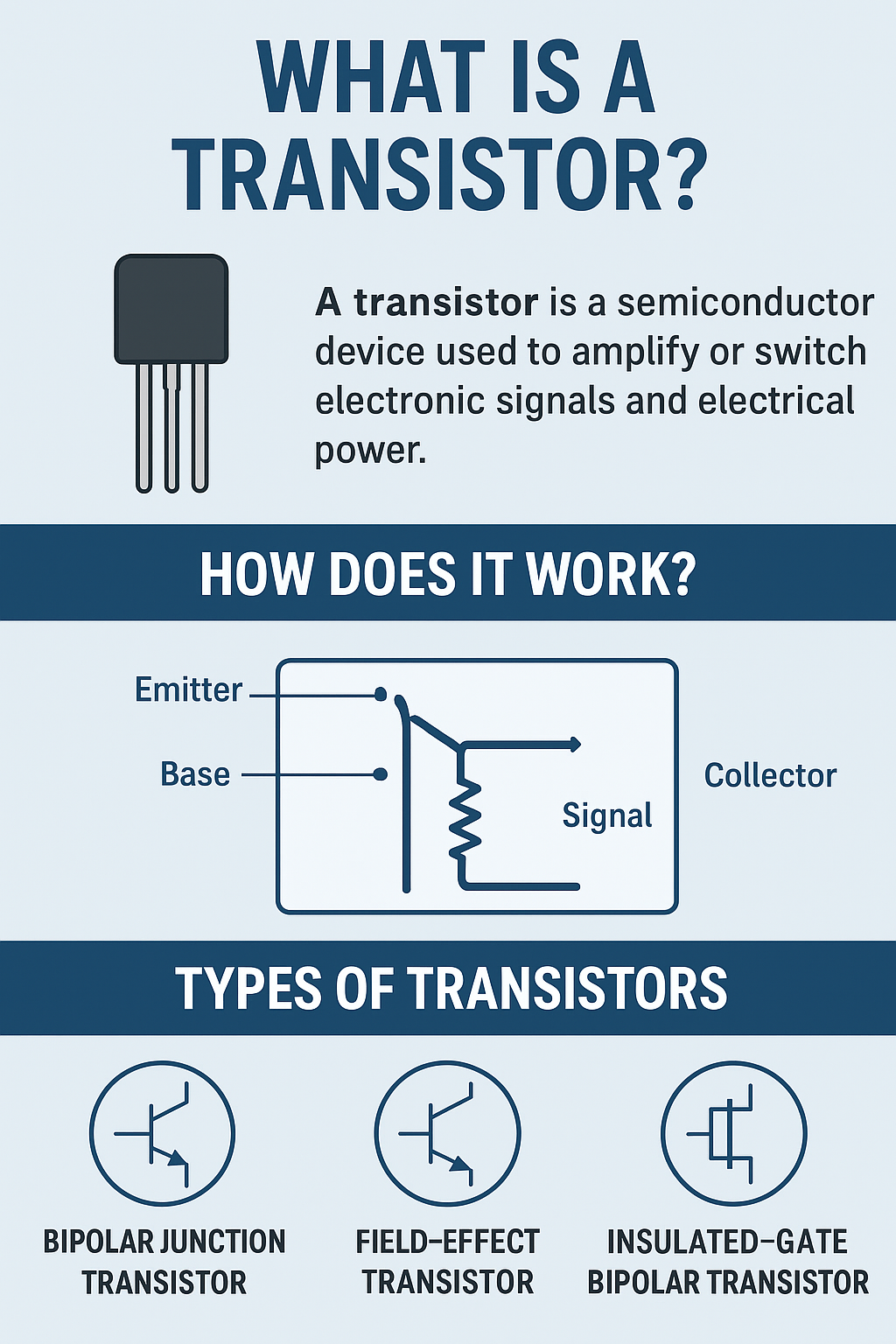
A transistor is a semiconductor device used to amplify or switch electronic signals and electrical power. It is typically made from silicon or germanium and has at least three terminals for connection to an electronic circuit.
In simple terms:
- A transistor can control the flow of current in a circuit.
- It acts like an electronic switch or gate for signals.
- It can also amplify signals, making weak electrical signals stronger.
2. A Brief History of the Transistor
The first transistor was invented in 1947 at Bell Laboratories by John Bardeen, Walter Brattain, and William Shockley. This invention replaced bulky and fragile vacuum tubes, revolutionizing the electronics industry.
- 1947: First point-contact transistor invented.
- 1950s: Junction transistors developed for mass production.
- 1960s onwards: Transistors integrated into microchips, enabling the growth of computers and digital systems.
- Today: Billions of transistors can be found in a single microprocessor.
3. Structure of a Transistor
Most transistors are built using semiconductors, which have electrical conductivity between conductors (like copper) and insulators (like rubber).
A typical transistor has three regions:
- Emitter (E): Emits charge carriers (electrons or holes).
- Base (B): A thin region that controls the flow of carriers.
- Collector (C): Collects the carriers, allowing current flow through the circuit.
For field-effect transistors (FETs), the three terminals are named:
- Source (S)
- Gate (G)
- Drain (D)
4. How Does a Transistor Work?
At its core, a transistor works by controlling the flow of current.
- As a Switch:
- When a small voltage is applied to the base (or gate), the transistor allows a larger current to flow between collector and emitter (or source and drain).
- Without base input, the transistor blocks the current.
- As an Amplifier:
- A small input current or voltage applied at the base/gate results in a much larger current at the collector/drain.
- This makes transistors ideal for amplifying signals in audio systems and radios.
5. Types of Transistors
There are two main categories of transistors:
a. Bipolar Junction Transistor (BJT)
- Uses both electrons and holes as charge carriers.
- Two main types: NPN and PNP.
- Commonly used for amplifiers.
b. Field-Effect Transistor (FET)
- Uses only one type of charge carrier.
- Controlled by voltage applied to the gate.
- Types include MOSFET (Metal-Oxide-Semiconductor FET) and JFET (Junction FET).
- Widely used in digital circuits and integrated chips.
6. Applications of Transistors
Transistors are found in almost every modern electronic device. Their applications include:
- Computers and Microprocessors: Billions of MOSFETs are used to build CPUs and memory chips.
- Switching Circuits: Used in power supplies, logic gates, and digital electronics.
- Amplifiers: Essential in radios, televisions, and audio equipment.
- Communication Systems: Used in transmitters and receivers for signals.
- Power Regulation: Helps in controlling current flow in power supplies and converters.
7. Advantages of Transistors over Vacuum Tubes
Before transistors, vacuum tubes were used in electronics. However, transistors offer several advantages:
- Smaller size → Enables compact electronic devices.
- Lower power consumption → Essential for portable devices.
- Longer lifespan → More reliable and durable.
- Less heat generation → Efficient for integrated circuits.
- Mass production → Enables cost-effective electronics.
8. The Role of Transistors in Modern Technology
Without transistors, modern digital life would not be possible. From smartphones to spacecraft, transistors are everywhere.
- Smartphones: Each chip contains billions of transistors.
- Artificial Intelligence (AI): Neural network processors rely on high-density transistor chips.
- Medical Equipment: Devices like pacemakers and MRI machines use transistors.
- Automotive Systems: Used in electric vehicles, sensors, and engine control units.
9. Future of Transistors
As technology advances, transistors continue to shrink while becoming more powerful.
- Nanotechnology: Researchers are developing transistors at the scale of nanometers.
- Quantum Transistors: Aimed at building future quantum computers.
- Carbon Nanotubes & Graphene: Promising materials for faster and more efficient transistors.
The trend known as Moore’s Law, which predicted transistor density doubling every two years, is slowing. However, innovation ensures that transistors will remain central to future electronics.
10. Conclusion of What is a Transistor?
So, what is a transistor? It is the tiny yet mighty component that makes modern electronics possible. Acting as both a switch and an amplifier, the transistor revolutionized technology and continues to power innovations in computing, communication, healthcare, and beyond.
From its invention in 1947 to its role in AI processors today, the transistor is truly the heart of modern electronics.