Introduction of What Are Electronic Components?
What Are Electronic Components? ~ Electronics has become the backbone of modern technology, powering everything from smartphones and computers to industrial machines and medical equipment. At the heart of all these devices are electronic components—the fundamental building blocks that control, process, and regulate electrical signals.
But what exactly are electronic components? How do they function, and why are they so essential in modern devices? This article will provide a comprehensive overview of electronic components, including their definition, types, roles in circuits, and applications in real-world technology.
What Are Electronic Components?
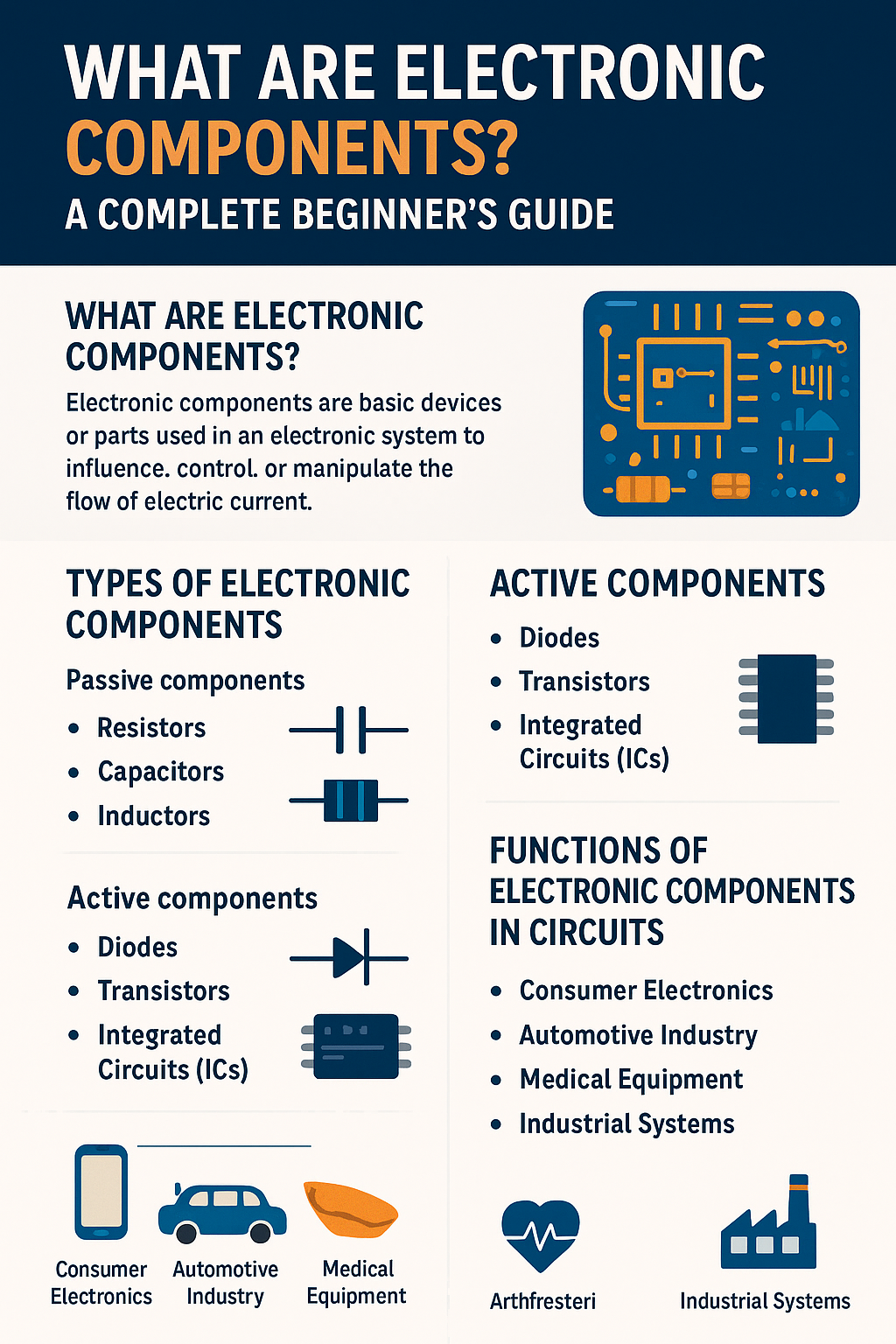
Electronic components are basic devices or parts used in an electronic system to influence, control, or manipulate the flow of electric current. They are usually made from materials such as metals, semiconductors, or conductive polymers, and they are assembled on circuit boards to create functional electronic devices.
In simple terms, electronic components are like the “ingredients” of an electronic recipe. Each has a specific role—resistors limit current, capacitors store energy, diodes allow current in one direction, and transistors act as switches or amplifiers.
Types of Electronic Components
Electronic components can be broadly categorized into two groups: active components and passive components.
1. Passive Components
Passive components do not generate energy; instead, they control or regulate the electrical current in a circuit.
- Resistors – Limit or control the flow of current. Measured in ohms (Ω).
- Capacitors – Store and release electrical energy. Used for filtering, timing, and energy storage.
- Inductors – Store energy in a magnetic field. Common in power supplies and radio frequency circuits.
2. Active Components
Active components require an external power source to operate and can amplify signals or control the flow of current.
- Diodes – Allow current to flow in one direction only. Used in rectifiers and signal protection.
- Transistors – Act as electronic switches or amplifiers. They are the foundation of modern digital circuits.
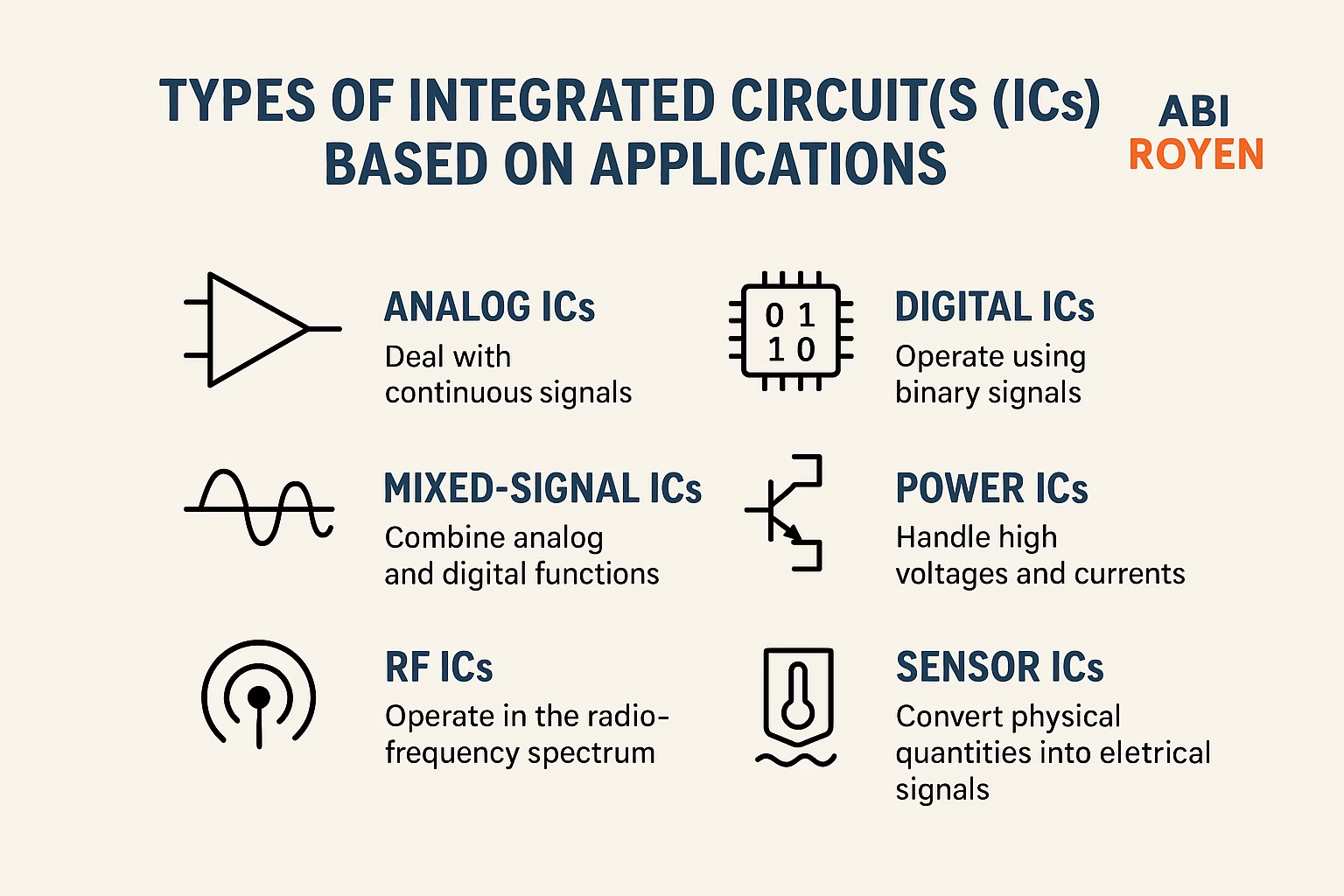
- Integrated Circuits (ICs) – Contain multiple components like transistors, diodes, and resistors on a single chip. Essential for microprocessors and memory devices.
Functions of Electronic Components in Circuits
Each electronic component has a specific function that contributes to the overall operation of a device.
- Resistors: Reduce voltage, limit current, and divide power.
- Capacitors: Store energy, smooth voltage fluctuations, and filter signals.
- Diodes: Prevent reverse current, protect circuits, and convert AC to DC.
- Transistors: Enable logic operations, amplification, and switching.
- ICs: Combine multiple functions into compact, powerful chips.
Without these components, it would be impossible to design circuits for even the simplest devices like flashlights, calculators, or digital watches.
Applications of Electronic Components
Electronic components are present in almost every aspect of modern life. Here are some key applications:
- Consumer Electronics – Smartphones, televisions, radios, laptops, and gaming consoles all rely on a combination of resistors, capacitors, and ICs.
- Automotive Industry – Cars use sensors, microcontrollers, and transistors for safety systems, navigation, and entertainment.
- Medical Equipment – Devices like ECG machines, MRI scanners, and pacemakers depend on reliable electronic components.
- Industrial Systems – Automation, robotics, and power control systems all use electronic building blocks for efficiency and precision.
- Communication Technology – Mobile networks, Wi-Fi routers, and satellites depend on electronic circuits to transmit and receive signals.
The Importance of Electronic Components in Modern Technology
Electronic components are critical enablers of innovation. Without them, modern computing, renewable energy systems, telecommunications, and healthcare technologies would not exist.
Some reasons why electronic components are important include:
- Miniaturization: Modern components allow powerful devices to be compact and portable.
- Efficiency: Components like transistors make energy-efficient systems possible.
- Reliability: High-quality components ensure the durability and safety of devices.
- Scalability: From small gadgets to large industrial machines, electronic components can be adapted for any application.
How Electronic Components Are Manufactured
The manufacturing of electronic components involves advanced processes in semiconductor fabrication, metal processing, and precision assembly.
- Resistors and capacitors are often made from ceramic, carbon, or metal films.
- Semiconductors like diodes and transistors are created from silicon wafers.
- Integrated Circuits are manufactured using photolithography to embed millions of transistors into a single chip.
These processes require high precision, as even microscopic defects can affect performance.
Future Trends in Electronic Components
With the rise of new technologies, electronic components continue to evolve:
- Miniaturization & Nanotechnology: Smaller, more efficient components are enabling wearable devices and advanced medical implants.
- Flexible Electronics: Components printed on flexible materials will lead to bendable phones and smart clothing.
- Energy-Efficient Components: Demand for eco-friendly devices is driving innovations in low-power semiconductors.
- Artificial Intelligence Integration: Advanced ICs designed specifically for AI processing are becoming more common.
Conclusion of What Are Electronic Components?
Electronic components are the foundation of modern technology. From resistors and capacitors to transistors and integrated circuits, each component plays a crucial role in making electronic devices functional, efficient, and reliable.
As technology continues to advance, the importance of electronic components will only grow, shaping the future of communication, medicine, industry, and everyday life.
If you are new to electronics, learning about these components is the first step to understanding how technology works. Whether you are a student, hobbyist, or professional, mastering the basics of electronic components opens the door to innovation and endless possibilities.