Electrical and electronic circuits rely heavily on resistors to control current and voltage. Among different resistor types, the variable resistor stands out due to its ability to adjust resistance values according to circuit requirements. Understanding variable resistor working is essential for students, engineers, and hobbyists who want to master circuit design and troubleshooting. This article explores the principle, construction, working, types, and applications of variable resistors in detail.
What is a Variable Resistor?
A variable resistor is an electrical component that allows resistance to be adjusted manually. Unlike fixed resistors, which have a constant resistance value, variable resistors can provide a wide range of resistance. This makes them useful in applications where flexibility and control are needed, such as tuning circuits, adjusting signal levels, or controlling the brightness of lights.
Variable resistors are commonly known in two main forms:
- Potentiometer – works as a voltage divider.
- Rheostat – used for current control.
Both types operate on the same principle but are applied differently based on circuit needs.
Read more at: What Is a Variable Resistor? A Complete Guide to Its Types, Functions, and Applications
Construction of a Variable Resistor
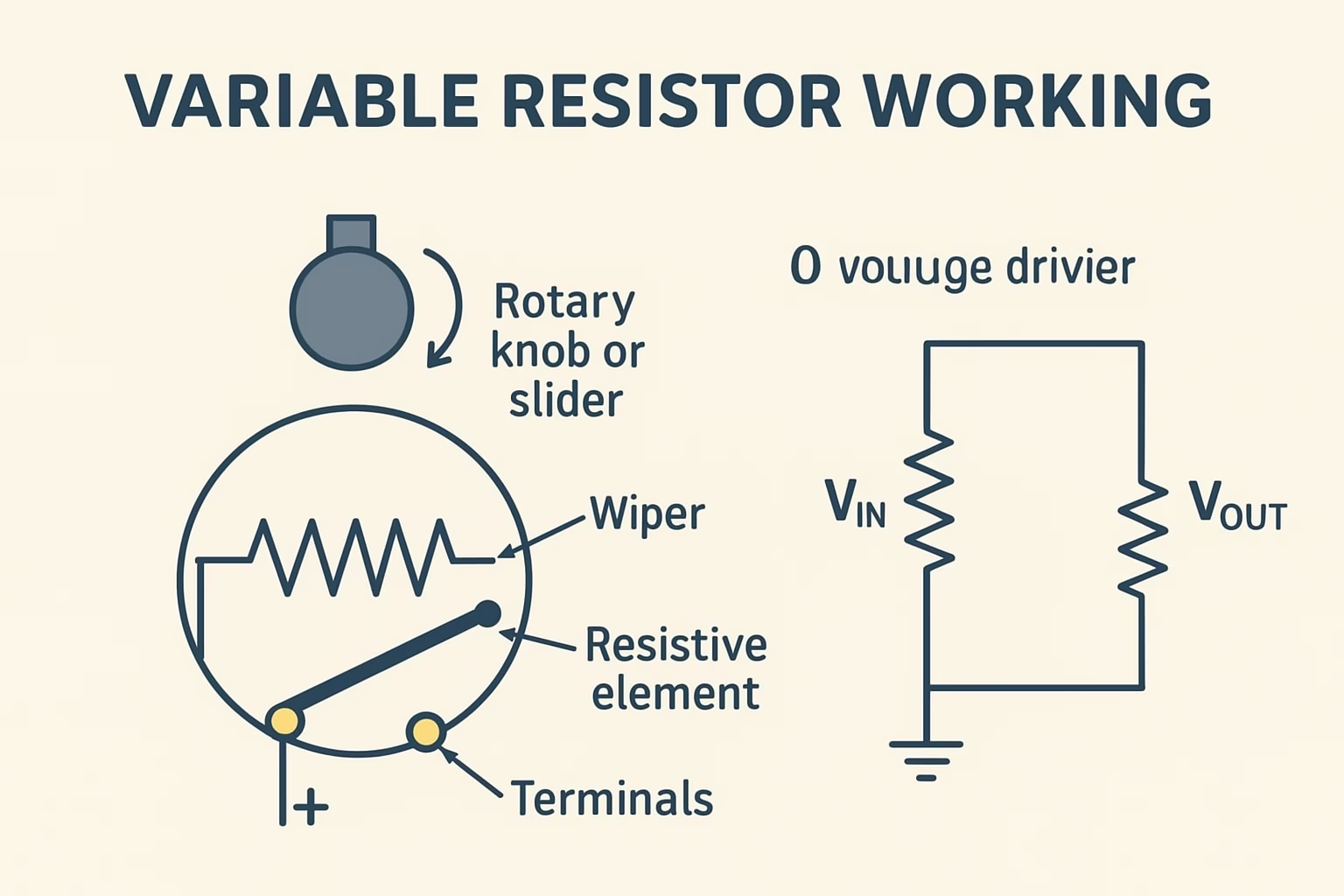
A typical variable resistor consists of the following parts:
- Resistive Element – usually made of carbon composition, cermet, or wire-wound material.
- Wiper (Sliding Contact) – moves along the resistive path to vary resistance.
- Terminals – provide electrical connections; usually three for potentiometers and two for rheostats.
- Housing/Body – protects the resistive track and provides mechanical support.
- Rotary Knob or Slider – allows manual adjustment of resistance.
The resistive element can be linear (straight path) or rotary (circular track), depending on the design.
Variable Resistor Working Principle
The working of a variable resistor is based on Ohm’s Law: V=I×RV = I \times RV=I×R
By adjusting the position of the wiper, the effective resistance between terminals changes. This influences the current flow and voltage distribution in the circuit.
- In a Potentiometer:
The wiper moves across the resistive track, dividing the input voltage into smaller output voltages. This makes it suitable for use as a voltage divider. - In a Rheostat:
The wiper changes the resistance directly in series with the load, thereby controlling current flow. This makes it ideal for adjusting lamp brightness or motor speed.
Types of Variable Resistors
There are different types of variable resistors, each serving specific purposes:
- Potentiometer – Three-terminal device used for voltage control. Commonly found in audio systems (volume control).
- Rheostat – Two-terminal device used for current control. Used in motor speed regulation and dimmer switches.
- Trimmer (Preset Resistor) – Small adjustable resistor used for fine-tuning in PCB circuits.
- Digital Potentiometer – Electronically controlled resistor used in modern applications where automation is required.
Read more at: Types of Variable Resistors: A Complete Guide to Their Classifications and Applications
Characteristics of Variable Resistors
Some important features include:
- Resistance Range: Can vary from a few ohms to several megaohms.
- Power Rating: Determines how much power the resistor can safely dissipate.
- Tolerance: Indicates accuracy of resistance value.
- Mechanical Life: Number of adjustment cycles before wear.
- Temperature Coefficient: Resistance stability under varying temperatures.
Applications of Variable Resistors
Variable resistors are versatile components widely used in both electrical and electronic applications. Some common uses include:
- Volume and Tone Control – In radios, speakers, and audio systems.
- Light Dimmers – Adjusting brightness of lamps and LEDs.
- Fan Speed Regulation – Controlling electric fan and motor speeds.
- Voltage Adjustment – Used in power supplies and tuning circuits.
- Sensor Calibration – Trimmers are used for adjusting circuit sensitivity.
- Measuring Instruments – Potentiometers are used for voltage measurement in laboratories.
- Feedback Circuits – Controlling gain in amplifiers.
Read more at: Understanding the Applications of Variable Resistors in Modern Electronics
Advantages of Variable Resistors
- Provides flexibility in circuit design.
- Allows real-time adjustment of current and voltage.
- Useful in both testing and permanent applications.
- Available in compact and cost-effective forms.
Limitations of Variable Resistors
- Mechanical wear reduces lifespan.
- Limited power-handling capacity compared to fixed resistors.
- Less precise compared to digital alternatives.
- Sensitive to dust and temperature variations.
Modern Developments: Digital Variable Resistors
With the advancement of electronics, digital potentiometers (digipots) have replaced mechanical versions in many applications. These resistors can be adjusted electronically via microcontrollers, offering higher accuracy, no mechanical wear, and remote control capability.
Applications of digital variable resistors include:
- Audio equalizers
- Automated calibration systems
- Industrial controllers
- Consumer electronics
Conclusion of Variable Resistor Working
Understanding variable resistor working is fundamental in electrical and electronic engineering. From simple volume knobs to advanced digital controllers, variable resistors play a crucial role in controlling current and voltage. Their flexibility, ease of use, and wide applications make them indispensable components in modern technology.
As the demand for precision and automation grows, the transition from mechanical to digital variable resistors highlights the ongoing evolution of electronic components. For students, engineers, and hobbyists, mastering the principles of variable resistors opens the door to better circuit design and innovation.