Introduction of Types Power Electronics Devices
Types Power Electronics Devices ~ Power electronics is one of the most critical areas in modern electrical and electronic engineering. It focuses on the study and application of devices that control and convert electrical power efficiently. From consumer electronics to renewable energy systems and industrial automation, power electronic devices are the backbone of energy conversion.
The demand for efficient, compact, and reliable power systems continues to grow, making it essential to understand the various types of power electronics devices. Each device has its unique features, advantages, and limitations, which determine where it can be applied.
In this comprehensive guide, we will explore the different types of power electronics devices, their working principles, and real-world applications.
What Are Power Electronics Devices?
Power electronics devices are semiconductor components designed to control, regulate, and convert electrical energy from one form to another. Unlike traditional electronic components that deal with small signals, power devices handle high voltages, currents, and power levels.
These devices play a crucial role in:
- Energy conversion (AC to DC, DC to AC, AC to AC, or DC to DC).
- Motor control in industries and electric vehicles.
- Power supply regulation in computers, telecommunication, and automation.
- Integration with renewable energy sources like solar and wind.
Major Types Power Electronics Devices
Let’s dive into the most important categories of power electronic devices.
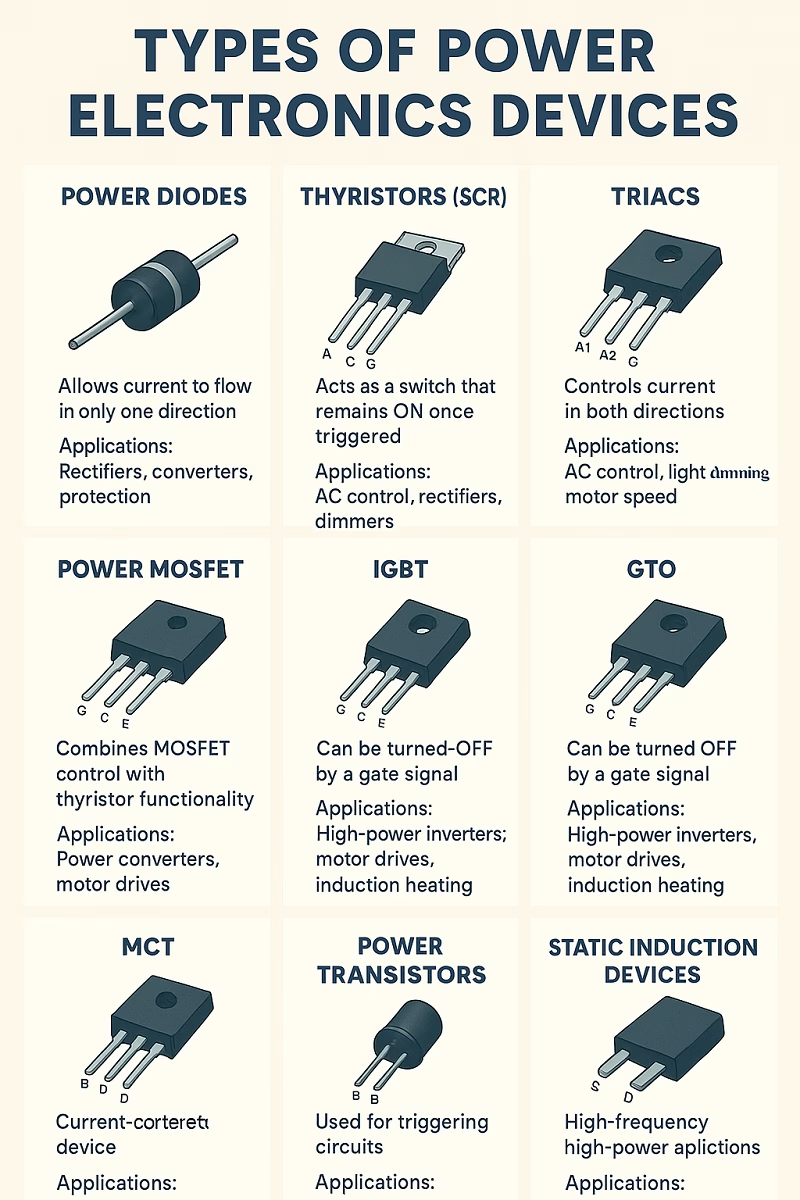
1. Power Diodes
Overview
A power diode is the simplest and most widely used device in power electronics. It allows current to flow in only one direction, making it suitable for rectification and protection.
Key Characteristics
- High current carrying capacity.
- Low forward voltage drop.
- Unidirectional operation.
Applications
- Rectifiers in power supplies.
- Freewheeling diodes in converters.
- Overvoltage protection in circuits.
2. Thyristors (SCR – Silicon Controlled Rectifier)
Overview
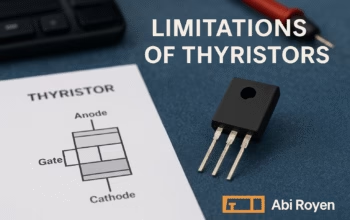
Thyristors are four-layer semiconductor devices that can handle high voltages and currents. They act as switches that remain ON once triggered until the current goes to zero.
Key Characteristics
- High power handling capacity.
- Controlled switching using a gate signal.
- Suitable for AC power control.
Applications
- AC motor drives.
- Controlled rectifiers.
- Light dimmers and power regulators.
3. TRIAC (Triode for Alternating Current)
Overview
TRIACs are similar to thyristors but can conduct current in both directions. This makes them particularly useful in AC applications where bidirectional control is required.
Key Characteristics
- Bidirectional conduction.
- Triggered by gate pulse.
- Compact and cost-effective.
Applications
- Domestic fan speed control.
- AC light dimmers.
- Industrial heater control.
4. Power MOSFET (Metal Oxide Semiconductor Field Effect Transistor)
Overview
MOSFETs are widely used in power electronics because of their fast switching speeds and efficiency. They are voltage-controlled devices ideal for low- to medium-power applications.
Key Characteristics
- High switching speed.
- Low conduction losses.
- Easy gate control.
Applications
- Switch-mode power supplies (SMPS).
- Electric vehicle controllers.
- DC-DC converters.
5. IGBT (Insulated Gate Bipolar Transistor)
Overview
IGBTs combine the advantages of MOSFETs and BJTs, offering both fast switching and high current handling. They are commonly used in high-power applications.
Key Characteristics
- High efficiency.
- High voltage capacity.
- Simple gate drive.
Applications
- Variable Frequency Drives (VFD).
- Renewable energy inverters.
- Electric traction systems.
6. GTO (Gate Turn-Off Thyristor)
Overview
A GTO is an advanced thyristor that can be turned ON and OFF by gate signals. Unlike SCRs, it doesn’t rely on current zero-crossing to turn OFF.
Key Characteristics
- High current capability.
- Fully controllable switching.
- Suitable for medium-frequency operations.
Applications
- Traction drives.
- High-power inverters.
- Induction heating systems.
7. MCT (MOS Controlled Thyristor)
Overview
An MCT integrates MOSFET control with thyristor functionality, offering enhanced efficiency and controllability.
Key Characteristics
- Low conduction losses.
- High-speed switching.
- Gate-controlled operation.
Applications
- Power converters.
- AC and DC motor drives.
- High-frequency inverters.
8. Power Transistors (BJT – Bipolar Junction Transistor)
Overview
Before the widespread use of MOSFETs and IGBTs, BJTs were common in power electronics. Although less popular today, they are still relevant in some applications.
Key Characteristics
- Current-controlled device.
- Moderate switching speed.
- Good current amplification.
Applications
- Amplification in power systems.
- Low- to medium-power converters.
- Audio systems and RF transmitters.
9. UJT (Unijunction Transistor)
Overview
The UJT is not a power switch but is used extensively in triggering circuits of thyristors and TRIACs.
Key Characteristics
- Low cost and simple design.
- Used mainly as a trigger device.
Applications
- Oscillators.
- Pulse generation.
- Thyristor firing circuits.
10. Static Induction Devices (SITh and SIT)
Overview
These are high-power semiconductor devices designed for extremely high-frequency and high-power applications.
Key Characteristics
- Very high current density.
- High-frequency operation.
- Fast response time.
Applications
- RF amplifiers.
- High-power switching.
- Space and defense electronics.
Comparison of Key Types Power Electronics Devices
| Device | Control Type | Switching Speed | Voltage Capacity | Main Applications |
|---|---|---|---|---|
| Power Diode | None | Fast | High | Rectifiers, protection |
| SCR (Thyristor) | Gate ON only | Medium | Very High | AC control, drives |
| TRIAC | Gate ON both ways | Medium | Medium | AC loads, dimmers |
| MOSFET | Voltage | Very High | Medium | SMPS, converters |
| IGBT | Voltage | High | High | Inverters, VFD, EV |
| GTO | Voltage (ON/OFF) | Medium | Very High | Traction, heating |
| MCT | Voltage | High | High | Drives, converters |
| BJT | Current | Medium | Medium | Amplification, RF |
| UJT | Trigger | Low | Low | Oscillators, firing |
Applications of Power Electronics Devices
Power electronic devices have transformed nearly every industry:
- Renewable Energy Systems – Solar inverters, wind turbine controllers.
- Electric Vehicles – Motor controllers, battery chargers, regenerative braking.
- Industrial Automation – Variable frequency drives, robotic control.
- Consumer Electronics – Laptop chargers, LED lighting, UPS systems.
- Aerospace and Defense – High-frequency radar, power management.
Future Trends in Power Electronics Devices
The future of power electronics is focused on higher efficiency, compact size, and sustainability. Some upcoming trends include:
- Wide Bandgap Devices (SiC and GaN): Offering faster switching and higher efficiency.
- Integration with AI: Smarter control for predictive maintenance.
- Eco-Friendly Designs: Reducing energy losses to support green technologies.
Conclusion of Types Power Electronics Devices
Understanding the different types of power electronics devices is essential for engineers, students, and industries aiming to harness electrical energy efficiently. From basic power diodes to advanced IGBTs and wide-bandgap semiconductors, these devices power our world in countless ways.
As technology advances, newer devices like SiC MOSFETs and GaN HEMTs will redefine the future of power electronics, making energy systems smarter, faster, and more sustainable.