
Transistors are fundamental building blocks of modern electronics. From small signal amplification in audio devices to high-power switching in industrial equipment, transistors are everywhere. Understanding the different types of transistors is essential for engineers, hobbyists, and students who want to design and troubleshoot electronic circuits effectively.
In this article, we’ll explore the main types of transistors, how they work, their advantages, disadvantages, and common applications.
1. Introduction to Transistors
A transistor is a semiconductor device used to amplify or switch electronic signals and electrical power. It typically consists of semiconductor material with at least three terminals for connection to an external circuit.
Transistors are vital because they can control large electrical currents with a small input signal, making them perfect for signal processing, voltage regulation, and power management.
2. Main Types of Transistors
Broadly, transistors can be divided into two main categories based on their working principle:
- Bipolar Junction Transistors (BJT) – current-controlled devices.
- Field-Effect Transistors (FET) – voltage-controlled devices.
We’ll dive deeper into these categories and their subtypes.
3. Types of Transistors: Bipolar Junction Transistor (BJT)
A BJT is a transistor that uses both electrons and holes as charge carriers. It has three terminals:
- Emitter (E)
- Base (B)
- Collector (C)
3.1 Types of BJT
There are two configurations:
- NPN Transistor – The most common type; current flows from collector to emitter when a positive voltage is applied to the base.
- PNP Transistor – Works opposite to NPN; current flows when the base is negative relative to the emitter.
3.2 Advantages of BJT
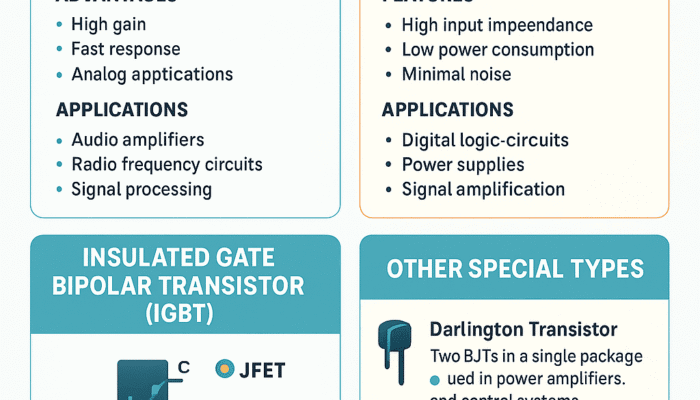
- High gain
- Fast response for switching
- Good for analog applications
3.3 Applications
- Audio amplifiers
- Radio frequency circuits
- Signal processing
For a detailed explanation, please read the following article: Bipolar Junction Transistors (BJT): Structure, Operation, and Applications
4. Types of Transistors: Field-Effect Transistor (FET)
A FET controls the flow of current using an electric field. It is a voltage-controlled device with high input impedance, making it ideal for many sensitive circuits.
4.1 Main Types of FET
- JFET (Junction Field-Effect Transistor)
- Simple design, low noise
- Used in amplifiers and buffer circuits
- MOSFET (Metal-Oxide-Semiconductor Field-Effect Transistor)
- Most widely used transistor in modern electronics
- Comes in Enhancement Mode and Depletion Mode versions
- Used in switching regulators, CPU design, and digital circuits
4.2 Advantages of FET
- High input impedance
- Low power consumption
- Minimal noise
4.3 Applications
- Digital logic circuits
- Power supplies
- Signal amplification
For a detailed explanation, please read the following article: Understanding Field-Effect Transistors (FET): Types, Working Principle, and Applications
5. Types of Transistors: Insulated Gate Bipolar Transistor (IGBT)
The IGBT combines the high input impedance of a MOSFET with the high-current capability of a BJT.
5.1 Key Features
- High efficiency
- Handles high voltage and current
- Controlled by voltage like MOSFETs
5.2 Applications
- Motor drives
- Electric vehicle controllers
- Renewable energy inverters
For a detailed explanation, please read the following article: Understanding IGBT (Insulated Gate Bipolar Transistor): Working Principle, Applications, and Advantages
6. Other Special Types of Transistors
Apart from the main categories, there are specialized transistors designed for specific purposes:
6.1 Types of Transistors: Darlington Transistor
- Consists of two BJTs connected to provide very high current gain.
- Used in power amplifiers and control systems.
For a detailed explanation, please read the following article: Darlington Transistor: Structure, Working Principle, Applications, and Advantages
6.2 Types of Transistors: Phototransistor
- Activated by light instead of electrical signals.
- Used in optical sensors and automatic lighting.
6.3 Types of Transistors: Unijunction Transistor (UJT)
- Mainly used in triggering circuits and oscillators.
6.4 Types of Transistors: Heterojunction Bipolar Transistor (HBT)
- Uses different semiconductor materials for improved speed.
- Common in high-frequency communications.
7. How to Choose the Right Types of Transistors
When selecting a transistor for your application, consider:
- Voltage Rating – The maximum voltage the transistor can handle.
- Current Rating – Maximum current capacity.
- Gain (hFE) – Amplification factor.
- Switching Speed – Important for high-frequency applications.
- Package Type – TO-92, TO-220, SMD, etc.
- Power Dissipation – How much heat the transistor can safely handle.
8. Practical Applications of Transistors
- Switching Circuits – Turning devices on/off electronically.
- Amplifiers – Increasing the strength of weak signals.
- Oscillators – Generating waveforms for radios and clocks.
- Regulators – Maintaining constant voltage levels.
- Signal Modulation – Used in communication systems.
9. Future Trends in Transistor Technology
As electronics continue to evolve, transistors are getting smaller, faster, and more efficient. Innovations such as FinFET and carbon nanotube transistors promise even greater performance for next-generation electronics, from AI processors to quantum computing.
10. Conclusion Types of Transistors
Transistors are at the heart of every modern electronic device. Whether you’re building a simple amplifier or designing a high-power industrial controller, understanding the types of transistors and their characteristics will help you make better design decisions.
From BJTs to FETs, MOSFETs, IGBTs, and specialized versions like phototransistors, each type has its strengths and applications. By choosing the right transistor, you can ensure optimal performance, efficiency, and reliability in your projects.