Types of thyristors ~ Thyristors are a key category of solid-state semiconductor devices widely used in power control, switching applications, and industrial electronics. Known for their ability to handle high voltages and currents, thyristors serve as efficient switches in AC and DC systems, making them essential in everything from light dimmers to motor drives and HVDC transmission systems.
In this article, we’ll explore the main types of thyristors, their working principles, characteristics, and where each type is typically used. This knowledge is crucial for engineers, technicians, and electronics hobbyists working in power electronics and control systems.
What is a Thyristor?
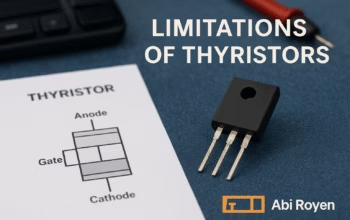
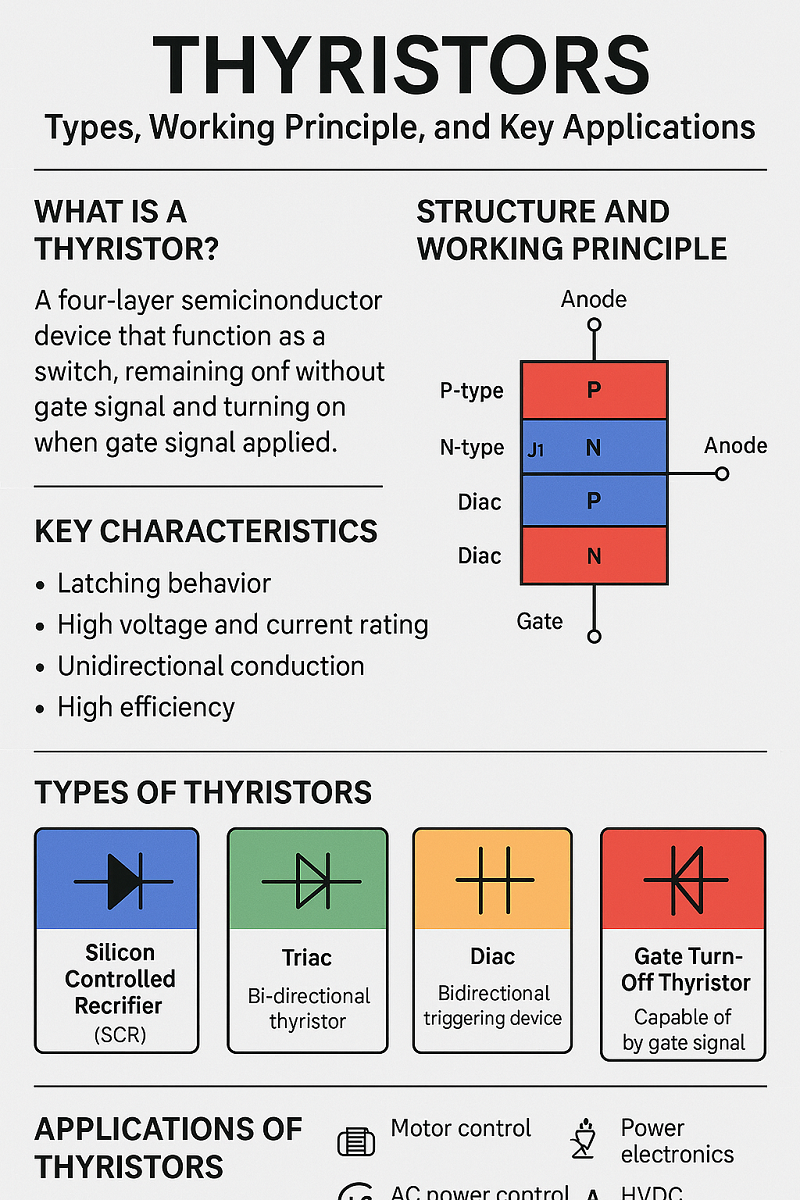
A thyristor is a four-layer (PNPN) semiconductor device with three terminals: anode, cathode, and gate. When a triggering signal is applied to the gate, the thyristor switches from its non-conductive (off) state to a conductive (on) state, allowing current to flow from anode to cathode. Once turned on, the thyristor remains conducting even after the gate signal is removed, as long as there is sufficient current.
1. Types of Thyristors: Silicon Controlled Rectifier (SCR)
SCR is the most common and fundamental type of thyristor.
Structure & Working:
- It has three terminals: anode, cathode, and gate.
- Triggered by a small gate pulse.
- Once turned on, it remains on until the current falls below a holding threshold.
Key Characteristics:
- Unidirectional conduction (only conducts in one direction).
- Excellent for DC applications or rectified AC.
Applications:
- Controlled rectifiers
- Overvoltage protection
- DC motor drives
- Battery chargers
2. Types of Thyristors: TRIAC (Triode for Alternating Current)
TRIAC is a bidirectional thyristor that conducts current in both directions, making it suitable for AC applications.
Structure & Working:
- Similar to two SCRs connected in inverse parallel.
- Controlled with a gate signal in either direction.
Key Characteristics:
- Can switch AC signals.
- Simplifies circuit design by eliminating the need for two SCRs.
Applications:
- Light dimmers
- Fan speed controllers
- Domestic appliance control
- Heater regulation
Read more: Understanding TRIAC (Triode for Alternating Current): Structure, Working Principle, and Applications
3. Types of Thyristors: DIAC (Diode for Alternating Current)
DIAC is a bidirectional trigger device often used to initiate TRIACs.
Structure & Working:
- Symmetrical PNPN structure without a gate terminal.
- Conducts when the applied voltage exceeds the breakover voltage.
Key Characteristics:
- Used for precise triggering.
- Cannot control conduction manually.
Applications:
- Starter circuits for TRIACs
- Phase control applications
- Timers and oscillators
Read more: DIAC (Diode for Alternating Current): Working Principle, Characteristics, and Applications
4. Types of Thyristors: Gate Turn-Off Thyristor (GTO)
GTO can be turned on and off by gate signals, unlike SCRs which require current interruption to turn off.
Structure & Working:
- Similar to SCR, but with the ability to turn off via a negative gate current.
Key Characteristics:
- Requires complex gate drive circuits.
- Faster turn-off than SCR.
Applications:
- Electric traction
- High-power inverters
- Induction heating
Read more: Gate Turn-Off Thyristor (GTO): Working Principle, Applications, and Advantages
5. Types of Thyristors: Reverse Conducting Thyristor (RCT)
RCT integrates a diode in reverse parallel with an SCR within a single package.
Structure & Working:
- Allows reverse current flow like a freewheeling diode.
Key Characteristics:
- Reduces need for external snubber circuits.
- Ideal for inductive loads.
Applications:
- Induction motor drives
- Inverters
- Welding machines
Read more: Understanding Reverse Conducting Thyristor (RCT): Structure, Working, and Applications
6. Types of Thyristors: Light Activated Silicon Controlled Rectifier (LASCR)
LASCR is a special type of SCR that is triggered by light instead of an electrical gate pulse.
Structure & Working:
- Uses a photodiode or phototransistor for triggering.
Key Characteristics:
- Offers electrical isolation between control and load.
- Useful in high-voltage environments.
Applications:
- Optical isolators
- High-voltage DC transmission
- Light-triggered switching systems
7. Types of Thyristors: Programmable Unijunction Transistor (PUT)
PUT is a thyristor-like device used in triggering applications and timers.
Structure & Working:
- Has three terminals: anode, cathode, and gate.
- Used in timing circuits where programmable breakover voltage is needed.
Key Characteristics:
- Less common than other types.
- Mainly used in specific triggering or oscillator circuits.
Applications:
- Sawtooth waveform generation
- Phase-control circuits
- Oscillator circuits
Read more: Programmable Unijunction Transistors (PUT): Structure, Operation, and Applications
Comparison Table: Types of Thyristors
| Type | Conduction Direction | Gate Trigger | Turn-Off Control | Applications |
|---|---|---|---|---|
| SCR | Unidirectional | Yes | Needs current drop | Rectifiers, motor drives |
| TRIAC | Bidirectional | Yes | Current zero crossing | Light dimmers, AC control |
| DIAC | Bidirectional | No | Voltage controlled | TRIAC triggering |
| GTO | Unidirectional | Yes (on/off) | Gate signal | Inverters, traction control |
| RCT | Unidirectional + diode | Yes | Current drop | Inductive loads |
| LASCR | Unidirectional | Light | Needs current drop | Optical switching, HVDC systems |
| PUT | Unidirectional | Yes | Voltage breakover | Oscillators, timers |
Why Types of Thyristors Matters
Choosing the right type of thyristor ensures optimal performance, protection, and efficiency in electronic and power circuits. The selection depends on:
- Direction of current flow (unidirectional vs bidirectional)
- Control method (gate vs light)
- Turn-off requirements
- Application voltage and current ratings
Conclusion of Types of Thyristors
Thyristors play a fundamental role in controlling power in electronic systems, and their versatility is enhanced by the wide range of types available. From the basic SCR to the sophisticated GTO and LASCR, each type of thyristor has unique characteristics suited for specific tasks.
Understanding their differences is essential for engineers designing circuits that demand reliability, precision, and efficiency in power management.
Whether you’re building a simple dimmer circuit or designing complex industrial controllers, this knowledge will help you choose and use the right type of thyristor.
📌 Explore More at Abi Royen
For more in-depth guides on power semiconductors, control systems, and electronics, visit our Power Electronics section and subscribe to stay updated!