
Types of Inductors ~ Inductors are vital passive components in electronic circuits, used for their ability to store energy in a magnetic field when electrical current flows through them. They play critical roles in filters, power supplies, RF circuits, and signal processing systems. However, not all inductors are the same—various types exist, each optimized for specific applications and operating conditions.
In this article, we will explore the different types of inductors, how they are classified, and where they are typically used in modern electronics.
What Is an Inductor?
An inductor is a passive two-terminal electronic component that resists changes in current. It typically consists of a coil of wire wound around a core material. When current flows through the coil, it generates a magnetic field, and any change in the current induces a voltage (electromotive force or EMF) that opposes the change, according to Lenz’s Law and Faraday’s Law of Induction.
Key parameters that define an inductor include:
- Inductance (measured in Henrys)
- Core type and material
- DC resistance (DCR)
- Current rating
- Saturation current
- Q factor (quality factor)
Classification of Inductors
Inductors can be classified in several ways:
- Based on Core Material
- Based on Shape and Construction
- Based on Application
Let’s dive into each of these categories.
1. Types of Inductors Based on Core Material
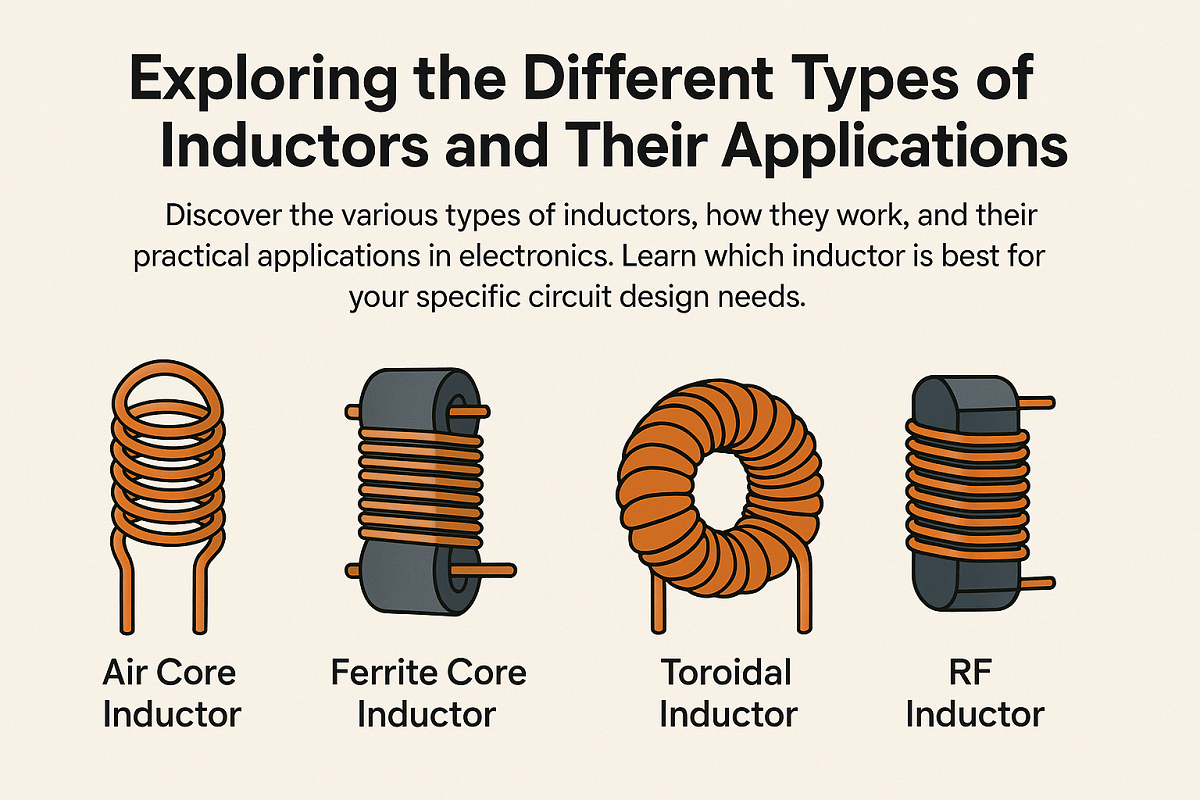
a. Air Core Inductors
These inductors have no core material; the coil is wound on a non-magnetic material (like plastic or ceramic). Since there is no magnetic core, air core inductors do not suffer from core saturation and exhibit high linearity.
- Advantages: No core loss, high frequency response
- Disadvantages: Larger size, lower inductance
- Applications: RF circuits, high-frequency filters
b. Iron Core Inductors
These use iron or laminated iron sheets as the core, increasing inductance and magnetic permeability.
- Advantages: High inductance, compact design
- Disadvantages: Higher core losses at high frequencies
- Applications: Audio equipment, power supplies
c. Types of Inductors Ferrite Core Inductors
Ferrite cores are made of ceramic compounds with magnetic properties. They provide a balance between performance and cost and are widely used in electronics.
- Advantages: Low eddy current losses, high-frequency efficiency
- Disadvantages: Brittle and temperature-sensitive
- Applications: Switch-mode power supplies (SMPS), EMI suppression
d. Powdered Iron Core Inductors
Powdered iron cores are composed of iron particles mixed with a binder. They are used when a controlled level of permeability is needed.
- Advantages: Low cost, stable performance
- Disadvantages: Lower saturation point compared to ferrite
- Applications: DC-DC converters, filtering applications
2. Types of Inductors Based on Shape and Construction
a. Toroidal Inductors
These are wound on a donut-shaped (toroidal) core. Their geometry helps in confining the magnetic field, reducing EMI.
- Advantages: High efficiency, compact size, low electromagnetic interference
- Disadvantages: More difficult to wind manually
- Applications: Power transformers, audio amplifiers
b. Multilayer Inductors
Constructed by stacking multiple layers of windings and insulation, typically used in surface-mount technologies.
- Advantages: Small footprint, suitable for compact circuits
- Disadvantages: Lower current handling
- Applications: Mobile phones, wireless modules
c. Wire-Wound Inductors
Made by winding insulated wire around a core. These are the most common type and are available in both through-hole and SMD versions.
- Advantages: Versatile, high current rating
- Disadvantages: Larger compared to multilayer types
- Applications: Power regulators, audio crossover networks
d. SMD Inductors
Surface-mount device (SMD) inductors are designed for automated PCB assembly.
- Advantages: Compact, compatible with modern electronics
- Disadvantages: Limited power rating
- Applications: Smartphones, laptops, embedded systems
3. Types of Inductors Based on Applications
a. RF Inductors
These are specifically designed for high-frequency radio frequency circuits. They are optimized for low resistance and high Q factor.
- Applications: Oscillators, antennas, RF amplifiers
b. Power Inductors
Power inductors are used in circuits where high current flows. They manage power delivery and filter high currents.
- Applications: Power supplies, converters, inverters
c. Choke Coils
Chokes are inductors designed to block AC while allowing DC to pass. They suppress high-frequency noise.
- Applications: EMI/RFI suppression, power line filtering
d. Differential Mode Inductors
Used to filter differential noise between two conductors, often seen in communication systems.
- Applications: USB filters, network cables, signal conditioning
e. Common Mode Chokes
Designed to filter common-mode noise in both lines of a pair simultaneously.
- Applications: Power adapters, HDMI, Ethernet
Choosing the Right Types of Inductors
When selecting an inductor for your application, consider the following factors:
- Operating frequency
- Required inductance
- Current rating
- DC resistance
- Size and mounting type (SMD or through-hole)
- Thermal stability
- Cost and availability
Each application demands a specific type of inductor, and choosing the wrong type can degrade performance or lead to failure.
Conclusion of Types of Inductors
Inductors come in many types, each tailored to specific functions within an electronic circuit. Whether you are designing a power supply, a radio transmitter, or a filtering system, understanding the different types of inductors and their characteristics is crucial to choosing the right component.
As technology continues to advance, so does the demand for more efficient and compact inductors. Keeping up with inductor technology will help engineers build better, more reliable, and higher-performing systems.
For more guides and tutorials on electronic components, visit Abi Royen – Electronics Engineering & Solutions.